
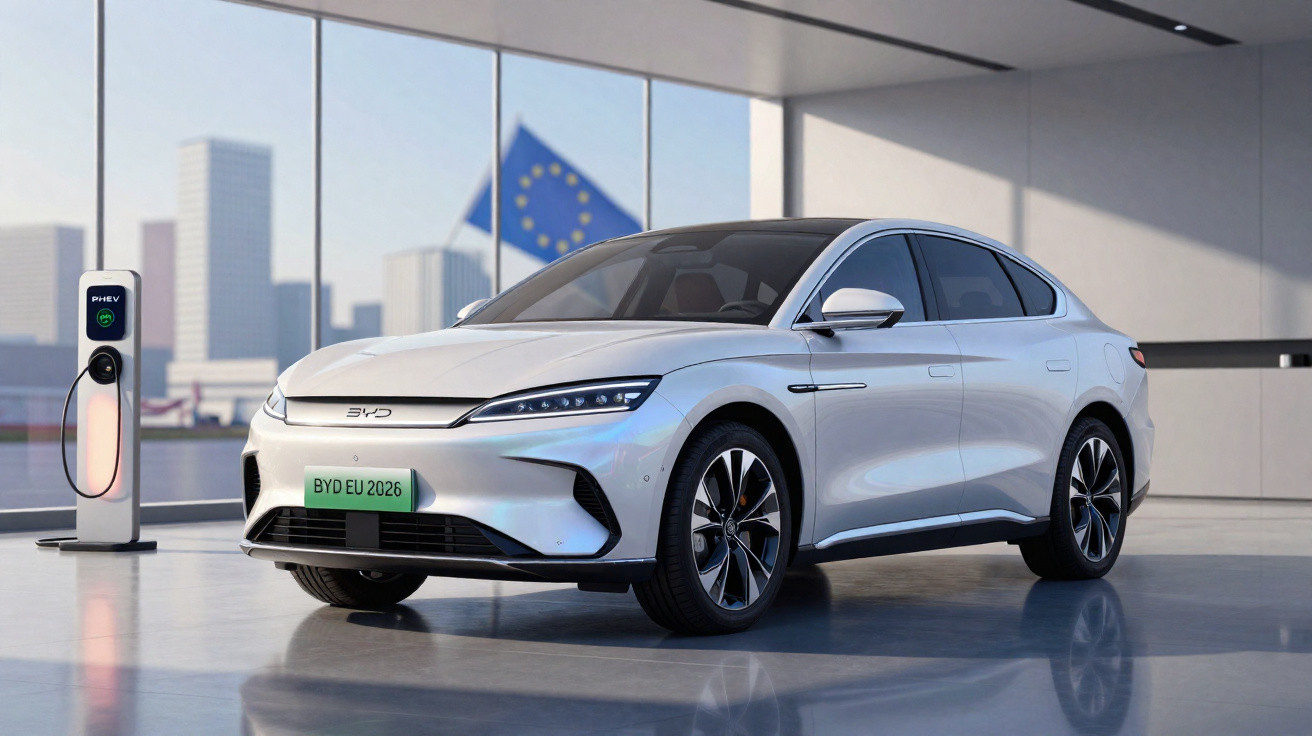
Chinese brands’ advance in Europe is no longer being driven only by battery-electric cars, as regulators and manufacturers once feared. Plug-in hybrids are taking an increasingly large share of that growth, and the figures for the first half of 2026 make that clear.
Chinese plug-in hybrids take the top three in Europe
In the first six months of the year, the three best-selling plug-in hybrids in Europe all came from Chinese manufacturers, with BYD clearly in control by placing two models at the top of the rankings.
BYD Seal U, BYD Atto 2 and Jaecoo 7: H1 2026 sales
From January to June, the BYD Seal U was Europe’s best-selling plug-in hybrid, reaching 44 616 registrations and posting growth of 53,8% versus the same period in 2025.
The BYD Atto 2 sits in a notable second place. Initially launched only as an electric model, it gained a plug-in hybrid version late last year and has already totalled 31 547 units. With no 2025 equivalent because it was not yet on sale, the Atto 2 led June sales by a wide margin and is now the biggest threat to the Seal U’s lead.
Rounding out the podium is the Jaecoo 7, with 31 075 units sold and the strongest increase in the Top 3: +212,8% year on year.
Response to tariffs
Plug-in hybrids now account for 31% of total sales by Chinese brands in Europe, closing in on electric cars, which represent 35%. Last year, these two technologies stood at 22% and 38% respectively, underlining the growing importance of plug-in hybrids to Chinese brands’ commercial performance.
Against that backdrop, the European Union (EU) is already considering introducing additional tariffs for plug-in hybrids produced in China as well, according to Handelsblatt. So far, however, the European Commission has not officially confirmed the move.
It is worth recalling that in 2024 the European Union imposed extra duties of up to 35,3% on 100% electric cars made in China, on top of the existing 10%. The measure covers all electric vehicles manufactured there, regardless of the brand’s origin, and is intended to counter the competitive advantage created by state support granted to Chinese carmakers.
Following the introduction of those tariffs, several Chinese manufacturers increased their focus on other powertrains-most notably plug-in hybrids, a segment that had previously been dominated by European brands.
The rest of the Top 10
Even with Chinese models locking out the top three, some European plug-in hybrids also stood out in a positive way. The Mercedes-Benz GLC recorded sales growth of 37,1%, while the Skoda Kodiaq rose by 12,6%.
Among the other five models in the Top 10, every one of them declined. The sharpest fall was for the Toyota C-HR, down 24,4%, followed by the Ford Kuga, which dropped 13,9%.
Overall, Europe’s plug-in hybrid market grew by 25,5% in the first half, reaching 736 013 units.

Comments
No comments yet. Be the first to comment!
Leave a Comment