
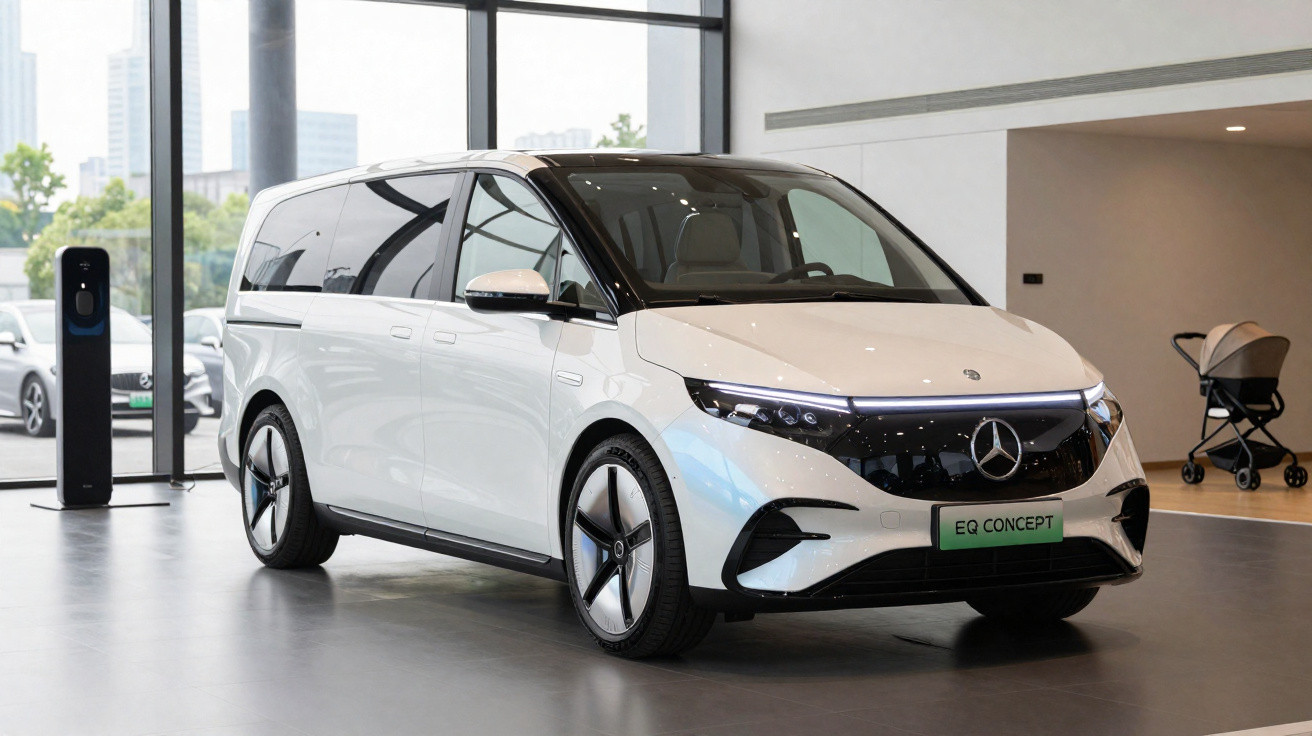
The Mercedes-Benz EQT Concept arrives as something of a counter-move at a time when, over the past decade, MPVs have all but vanished from the market (Mercedes itself retired models such as the R-Class MPV).
In their place came the SUV wave, as families realised they did not need an MPV to do the school run or for an annual holiday (particularly as European demographic trends clearly show the number of children per household has been falling rapidly).
SUVs typically deliver a more rounded on-road feel and a more desirable image, while also offering cabins with seating systems that are usually less complex - and less expensive - which suits both manufacturers and buyers.
Even so, there remains a market for MPVs, whether for larger families, passenger-transport businesses, or parcel and goods delivery. In the latter cases, demand is often met by commercial derivatives of these body styles - something Mercedes-Benz already covers across the Citan, Sprinter and V-Class ranges.
In the case of the new T-Class (which will be offered with internal-combustion engines as well as this EQT), the target audience clearly overlaps. After all, the most compact V-Class (4.895 m) is actually shorter than the T (4.945 m), which Mercedes describes as a compact van - although at almost 5.0 m long, 1.86 m wide and 1.83 m tall, it is not exactly small.
Florian Wiedersich, EQT product marketing lead, underlines that “the idea is to win over a type of customer for whom price is a very important factor and who understands that premium SUVs are too expensive, but who wants a functional, spacious transport solution for a potentially large group of users”.
Up to seven occupants and up to five babies
The Mercedes-Benz EQT Concept uses sliding doors on both sides, creating a wide opening that makes it easier to reach the individual seats in the third row (which, like the three seats in the second row, can take child seats).
Helping access further, the backrests of the fixed second-row seats fold and drop in a single motion - a quick, straightforward action that also produces a flat load floor. The two third-row seats can slide forwards and backwards by a few centimetres to balance rear passenger space with luggage volume, and they can also be removed entirely to increase carrying capacity even more.
A shorter body style will also be available, with only two rows of seats (for the Citan, the T-Class and the EQT), with an overall length of around 4.5 m.
The airy cabin - already suggested by the squared-off body and tall roof, which features a translucent central section - is defined by a black-and-white theme. This includes white leather upholstery (partly recycled) on the seats and a dashboard whose upper section incorporates a practical semi-enclosed storage tray (above the instruments, handy for small items or documents you want within easy reach).
Gloss-black circular air vents, galvanised trim details and a multifunction steering wheel with Touch Control buttons create an immediate visual link to Mercedes passenger cars.
The same applies to the MBUX infotainment system, which can be operated via the 7” central touchscreen, the steering-wheel buttons or, optionally, the “Hey Mercedes” voice assistant with artificial intelligence (which learns the driver’s habits over time and can even suggest routine actions, such as calling a family member on Friday when that is a common habit).
Modern genes from the EQ family
Although it is not yet showing its final series-production form - due to reach the market in the second half of next year, a few months after the petrol/Diesel-engined T-Class - this concept car is clearly identifiable as part of the EQ family thanks to the black front panel between the LED headlamps, finished in a glossy surface with a background pattern of stars.
Those stars (drawn from the Mercedes emblem), in different sizes with a 3D effect, are repeated across the vehicle: in the 21″ alloy wheels (production versions will be smaller, likely 18” and 19”), in the panoramic roof, and even on the electric skateboard displayed with the concept to connect it with leisure activities (alongside a helmet and relevant kit, mounted behind the two seats in the third row).
Also characteristic of EQ models is a full-width LED light strip across the front, creating a striking contrast and a distinctive night-time signature.
A closely guarded secret
Very little is known - and in some areas, nothing at all - about the Mercedes-Benz EQT Concept’s electric drivetrain. The rolling platform will be shared with the new-generation Citan (in two versions, Panel Van and Tourer), which is still scheduled to be launched in 2021, and the lithium-ion battery pack is expected to sit in the floor between the two axles.
It will be smaller than the EQV’s 100 kWh battery (the electric version is more than five metres long and is the heavier vehicle), which delivers a 355 km range and supports 11 kW AC charging and up to 110 kW DC charging.
It would not be unreasonable to point towards a battery capacity between 60 kW and 75 kW and a range in the region of 400 km - but these are estimates.
At this stage, with the Mercedes-Benz EQT existing only as a concept and still a little over a year away from its market launch, Mercedes’ decision-makers are not prepared to share more specific technical details, not least to avoid handing too many advantages to rivals…

Comments
No comments yet. Be the first to comment!
Leave a Comment