
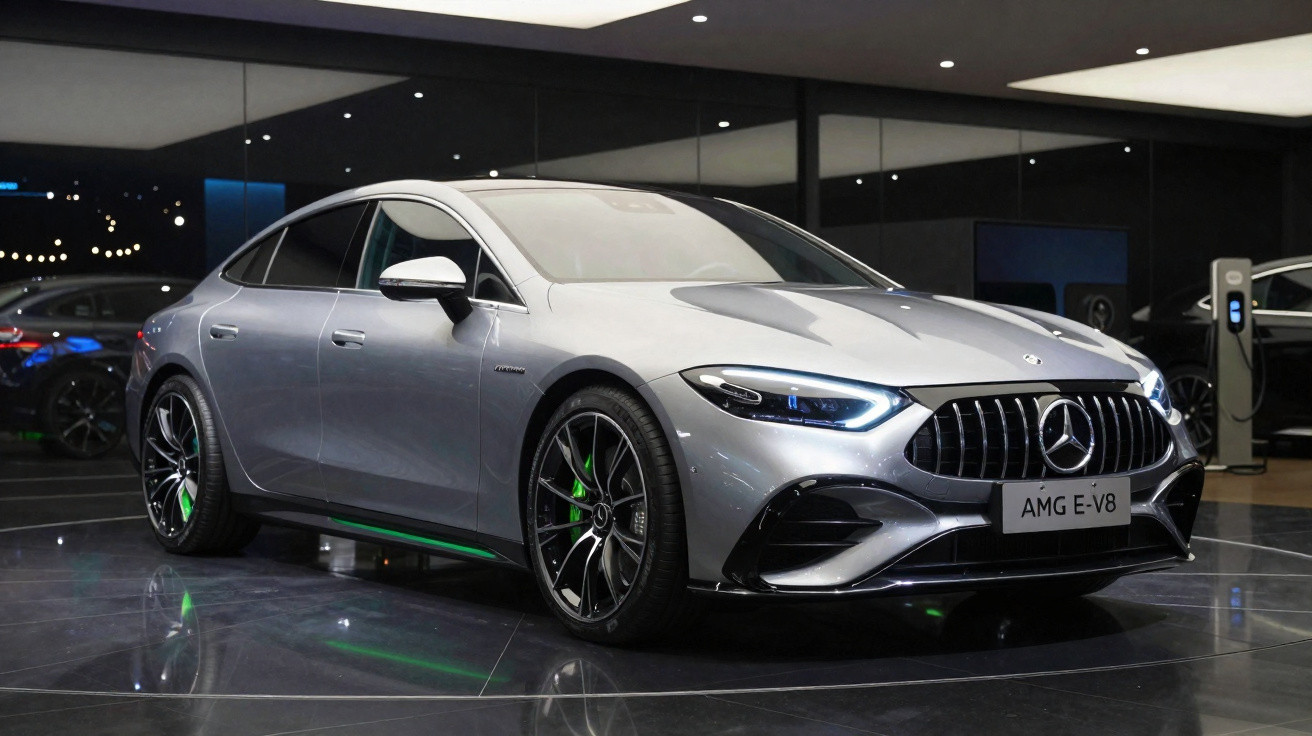
Large-displacement engines with plenty of cylinders have always been central to Mercedes-AMG’s story. However, ever-tighter emissions rules have forced the Affalterbach division into a painful identity rethink.
V8s have increasingly been replaced by intricate plug-in hybrid systems and turbocharged six- and four-cylinder engines. That shift takes on a new scale with the latest Mercedes-AMG GT 4-door. Beyond the badge, it inherits little to nothing from the car it replaces.
Mercedes-AMG GT 4-door: from V8 to three electric motors
The grand tourer recipe and muscular proportions have been dropped in favour of a more extreme silhouette, while the iconic V8 has been swapped out for a powertrain built around three electric motors. The change has been controversial, particularly because of the styling and the move to electrification. Reports now suggest that, inside the company, the programme never truly achieved consensus.
A €1 billion mistake?
According to the German outlet Manager Magazin, a Mercedes-Benz executive allegedly said this model “shouldn’t even exist”, adding that it only went ahead because “it was already too late to cancel it”. In total, around €1 billion is said to have been spent developing the model.
Even so, that figure is still far below the €5 billion reportedly required to develop the Mercedes-Benz EQE and EQS, as part of a strategy driven by Ola Källenius, the brand’s chief executive, to accelerate the electric transition.
Manager Magazin also claims the same manager described the EQ range strategy as “the biggest failure in the company’s history”, arguing that management reached that view after a 90% drop in sales of those models in 2024.
European pressure
Ultimately, much of this comes down to the European Union (EU) continuing to tighten the screws on car makers. Emissions requirements are becoming increasingly restrictive, pushing brands to lean heavily into electrification and to find ways of persuading consumers to embrace electric vehicles.
Ultra-fast-charging-capable architectures, larger-capacity batteries to extend range, and more competitive pricing all form part of that approach. In the sports car segment, we even see models adopting dedicated software that mimics gearboxes and internal combustion engine sounds to make EVs feel more engaging.
Making an electric Mercedes-AMG feel like a V8
The new Mercedes-AMG GT 4-door goes further still: as well as simulated sounds and a virtual gearbox, it adds a vibration unit beneath the driver’s seat. The aim is not only to hear an artificial V8 through the speakers. It is to feel it.
Comments
No comments yet. Be the first to comment!
Leave a Comment