
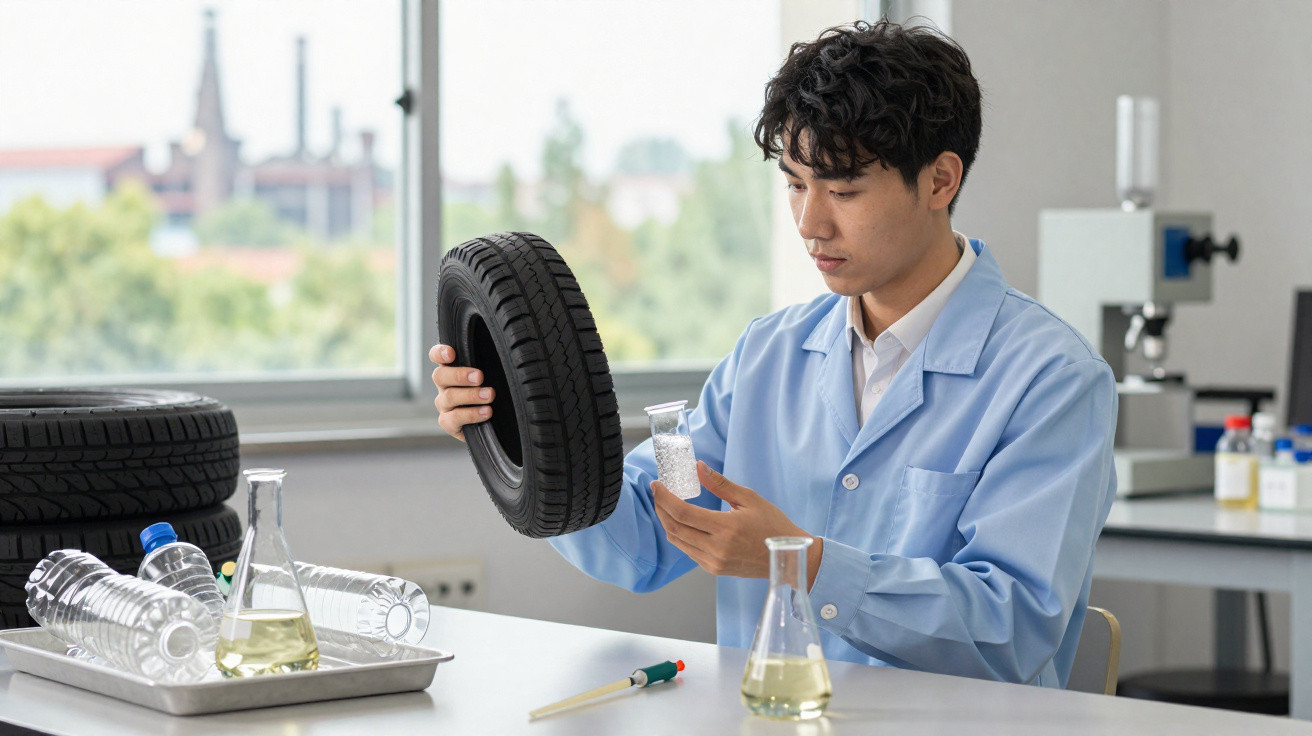
Michelin is not aiming to manufacture tyres made solely from recycled plastic. Plastic - and, in this specific case, PET (polyethylene terephthalate), a thermoplastic polymer that is now widespread (from clothing to bottles for water and fizzy drinks) - is simply one of many components in a tyre. Michelin says there are more than 200.
More than rubber: what a tyre is made of
It is common to say a tyre is “made of rubber”, but that description is incomplete. In practice, a tyre blends natural rubber with synthetic rubber, steel, textile materials (synthetic), various polymers, carbon, additives, and other constituents.
Because this is a complex mix - and because not every element is easy to recycle or reuse - tyres carry a significant environmental footprint, including during their time on the road.
Michelin’s sustainability roadmap (2030 and 2050)
For that reason, Michelin is pursuing the target of producing tyres that are 100% sustainable by 2050, within a circular-economy model. In other words, the ambition is to manufacture tyres using only renewable and recycled materials.
As a nearer-term milestone, Michelin has set the goal that 40% of the materials in its tyres will be sustainable as early as 2030.
Recycled PET
PET is already used by Michelin and other manufacturers as fibre in tyre production. Across the industry, this takes place at a rate of 800 thousand tonnes per year, which corresponds to 1.6 billion tyres produced.
However, while PET can be recycled via thermomechanical routes, the resulting recycled material historically did not consistently match the properties of virgin PET. As a result, it did not re-enter the tyre manufacturing chain. This is where a key step towards a sustainable tyre has been made - and where Carbios comes in.
Carbios’ enzymatic recycling validated by Michelin
Carbios is a pioneer in bio-industrial solutions and aims to reshape the life cycle of plastic and textile polymers. Its approach relies on enzymatic recycling of PET plastic waste. Michelin’s tests validated Carbios’ recycled PET, enabling its use in tyre production.
Carbios’ process uses an enzyme capable of depolymerising PET (found in bottles, trays and polyester clothing), breaking it down into its monomers (the repeating building blocks within the polymer). After the monomers go through polymerisation again, the outcome is PET plastic products that are 100% recycled and 100% recyclable, with quality equivalent to PET made from virgin feedstock. According to Carbios, its processes allow infinite recycling.
In other words, the Carbios recycled PET tested by Michelin met the same toughness requirements needed for Michelin’s tyre manufacturing.
This progress not only helps Michelin reach its sustainable-tyre objective more quickly, but also supports a reduction in virgin PET production, which is petroleum-derived (like all plastics). Based on Michelin’s calculations, recycling nearly three billion PET bottles would provide all the fibres it requires.




Comments
No comments yet. Be the first to comment!
Leave a Comment