
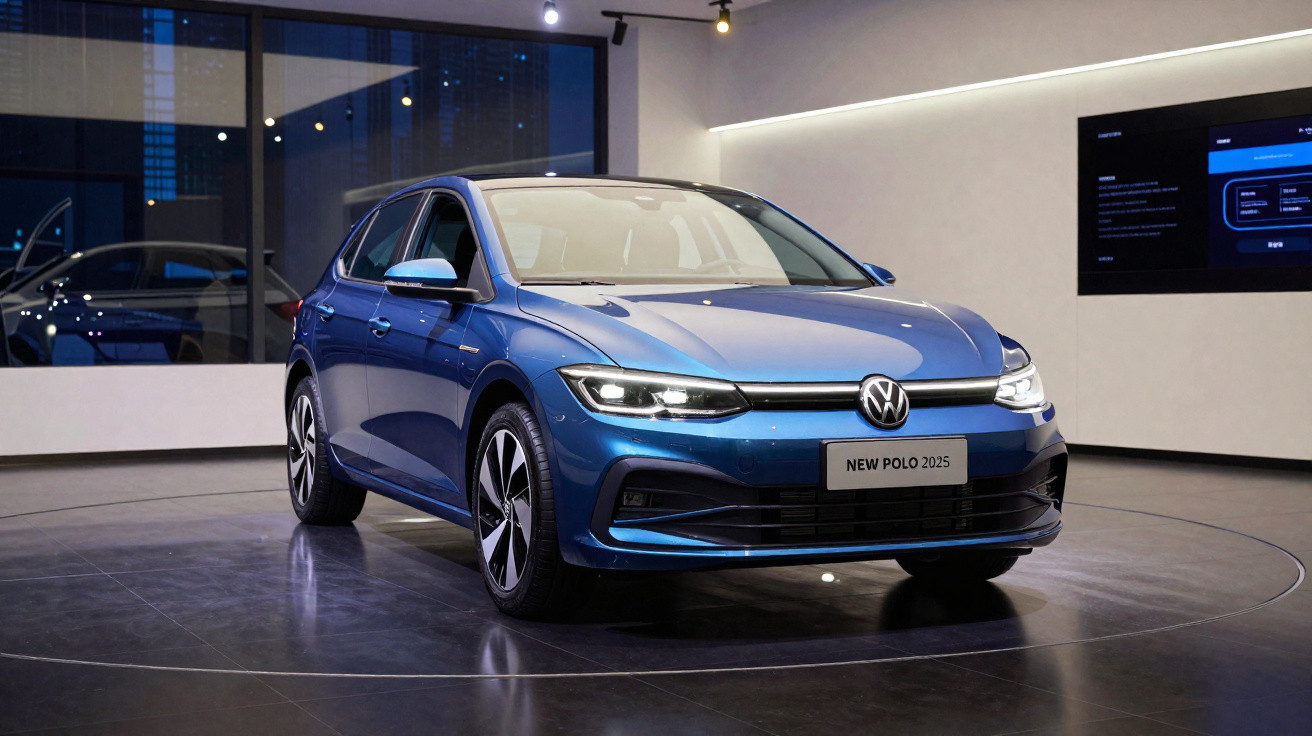
Around five months ago, the Volkswagen Polo received an update that brings technology rarely seen in this class and a look that now sits much closer to the Golf - while still promising the familiar capability it has always been known for.
First launched in 1975 and with more than 18 million units sold, the Polo remains one of the segment’s most important players. Now in its sixth generation, it has been refreshed to answer rivals that received their updates before the German model.
I have already had the chance to drive it for a short stint on Portuguese roads and experience the changes first-hand. Interestingly, this initial encounter came not long after I tested the new Skoda Fabia - a model that shares the same platform (and more…) with the Polo - so you can expect a few comparisons between the two.
To avoid “missing the train”, the Polo has undergone a thorough facelift that makes it look very similar to its bigger “brother”, the Golf. The revisions to the bumpers and light clusters are substantial enough to make you believe you are looking at an entirely new model.
Standard LED technology stands out front and rear, highlighted by a full-width horizontal strip across the nose that gives this Polo a stronger road presence.
For those who want to go “further”, there are optional intelligent LED Matrix headlights - a feature that is still highly unusual in this segment.
Adding to that are Volkswagen’s new badge at the front and rear, plus the model’s new written name, positioned just beneath the brand emblem on the tailgate.
Inside, the Polo has also taken a meaningful step forward, particularly in terms of technology. An 8-inch digital cockpit is standard across the range, although a 10.25-inch digital instrument cluster is available as an option. The multifunction steering wheel is also completely new.
In the centre sits an infotainment display offered in four different versions: 6.5-inch (Composition Media), 8-inch (Ready2Discover or Discover Media), or 9.2-inch (Discover Pro).
The larger systems use the modular MIB3 electrical platform, which provides improved connectivity, online services and Cloud integration, while also enabling wireless smartphone pairing via Android Auto and Apple CarPlay.
Chassis has not been changed
Turning to the chassis, there is nothing new to report, as the updated Polo continues to use the MQB A0 platform, with independent MacPherson suspension at the front and a torsion-beam rear axle.
That continuity helps it remain one of the roomiest cars in its class. And on the subject of space, the boot offers a luggage capacity of 351 litres.
This is where a comparison with its Czech “cousin”, the Skoda Fabia, is inevitable: as well as offering a larger boot - 380 litres - it also feels slightly more generous in the rear seats. But don’t misunderstand me: the Polo is still among the most spacious models in the segment.
What about the engines?
The engine line-up is also unchanged, except for the Diesel options, which have been removed from the menu. At launch, the Polo is offered only with 1.0-litre three-cylinder petrol versions:
- MPI, naturally aspirated and 80 cv, with a five-speed manual gearbox;
- TSI, turbocharged and 95 cv, with a five-speed manual gearbox or, optionally, a seven-speed DSG automatic (dual-clutch);
- TSI with 110 cv and 200 Nm, available only with DSG;
- TGI, natural-gas with 90 cv (six-speed manual gearbox).
By the end of the year, the Polo GTI arrives, powered by a 2.0-litre four-cylinder petrol unit producing 207 cv.
And what is it like to drive?
During this first drive - in the 1.0 TSI with 95 cv and a five-speed manual gearbox - the overall impression was a positive one.
The Polo feels more grown-up than ever, consistently polished and, above all, very comfortable. In my view, the label “Mr Competence” suits it perfectly.
Visually, it is nowhere near as eye-catching as the Peugeot 208, the Renault Clio or even the new Skoda Fabia, yet it continues to appeal with a more classic stance (despite the updates and the digitalisation it has undergone) and with the manners of a genuine long-distance cruiser.
Even so, despite doing most things well, it still does not deliver much in the way of fun. Here, cars such as the Ford Fiesta or the SEAT Ibiza retain a clear advantage. On top of that, I occasionally noticed a lack of “firepower” from this engine, especially at lower revs, where you end up leaning heavily on the gearbox.
In this respect, the Skoda Fabia fitted with the same 1.0 TSI but with 110 cv and a six-speed manual gearbox feels more responsive.
And the fuel consumption?
If I sometimes wished for a bit more punch from this unit, I cannot fault its fuel use: at normal speeds, without making any special effort to save fuel, I finished this short test with an average of 6.2 l/100 km. With a little patience, it is fairly easy to get into the 5 l/100 km range.
And the prices?
The updated Volkswagen Polo is already on sale in the Portuguese market, and deliveries to the first customers have already begun.
The range starts at 18 640 euros for the version with the 1.0 MPI engine producing 80 cv and rises to 34 264 euros for the Polo GTI, featuring a 2.0 TSI with 207 cv, which arrives closer to the end of the year.
As for the variant we drove on this first outing - the 1.0 TSI 95 cv - it starts at 19 385 euros.
Comments
No comments yet. Be the first to comment!
Leave a Comment