
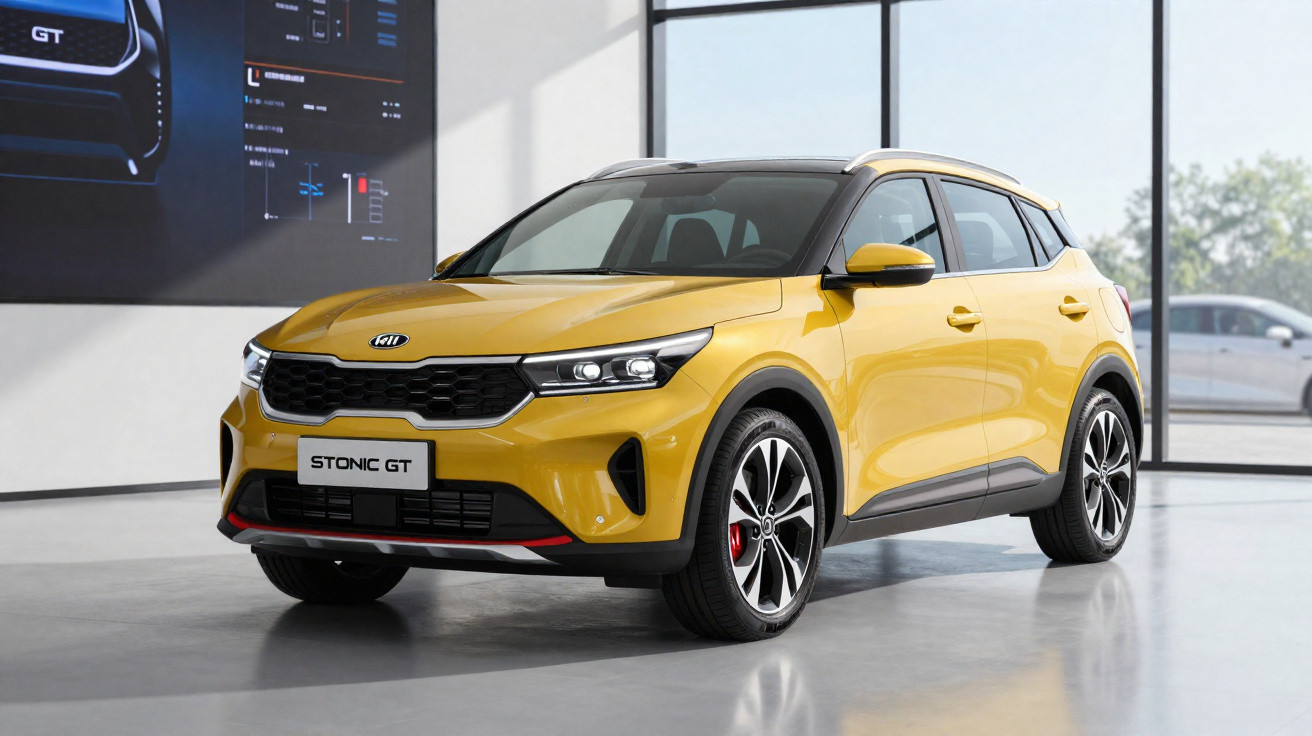
Introduced to the world four years ago, the Kia Stonic has recently been refreshed and arrives on the Portuguese market packed with updates and talking points that should help it “make a splash” again in the B-SUV class.
When the “topic” is small SUVs with strong character and lots of technology, the list of contenders keeps growing. This category has been drawing more and more attention from buyers and, as a result, from manufacturers too. And right now, being merely “ok” is no longer enough to stand out.
We drove the updated Stonic in the new GT Line trim and with the brand-new mild-hybrid engine under the bonnet. So, did it win us over? That’s exactly what I’ll answer in the lines below - and with these changes, I’m confident the Stonic is in its best shape yet.
It still has style
With the latest update, the South Korean brand has given the Stonic the GT Line signature, bringing a sportier look. That’s “down to” the model-specific bumpers, which incorporate three new air inlets directly beneath the front grille, the LED lighting (headlamps, rear lights and fog lamps), and the chrome-look protective detailing.
Adding to the effect, the 17” wheels on this car feature a GT Line-exclusive design, and the door-mirror caps are now finished in black and can be matched to the roof colour.
And speaking of the roof, it can be specified in a contrasting colour to the body (black or red) as a 600 euros option. Standard metallic paint in a single colour costs 400 euros.
More technology, more safety
Inside, the key changes include a carbon-fibre-effect trim panel across the dashboard; seats combining black cloth with synthetic leather; a new height- and reach-adjustable “D”-shaped steering wheel in perforated leather with the GT Line logo; and, naturally, a broader tech upgrade.
These touches - together with the chrome pedal covers, a detail unique to the GT Line version - give this Kia Stonic a more sporting and more eye-catching cabin ambience.
The driving position is immediately convincing and noticeably sportier (in other words: lower) than in some rivals. The steering wheel feels great in the hands, and the seats provide excellent lateral support while still striking a sensible balance between holding you in place and keeping you comfortable.
From an ergonomics and packaging standpoint, the Stonic’s interior works well - and the physical climate-control buttons deserve genuine praise. Build quality is at a good level, although most of the materials are quite hard to the touch, even across the upper sections.
The 4.2” display in the instrument panel now has higher resolution, which makes the information far easier to read. In the centre, there’s a new 8” touchscreen running a new infotainment system with smartphone integration via Android Auto and Apple CarPlay.
On the subject of smartphones - and because it never hurts to ask - a wireless charging pad in the centre console would be very welcome.
And what about space?
The Kia Stonic’s boot is rated at 332 litres, which is far from a class-leading figure. Even so, the cabin offers plenty of storage areas (in the doors, on the centre console ahead of the gear selector, and in the armrest).
As for rear-seat space, it’s perfectly acceptable, with enough room to carry two adults in reasonable comfort. The centre seat is a difficult place for anyone to sit, but that’s an “issue” shared by most models in this segment. Fitting one - or two! - child seats in the back also won’t be a problem.
In equipment terms, this small SUV comes well specified and includes, among other features, automatic switching between dipped and main beam, a reversing camera, automatic air conditioning, an auto-dimming interior rear-view mirror, and keyless entry and start.
Also standard on this version are safety systems such as lane-keeping assist, autonomous emergency braking that can also detect pedestrians and cyclists, driver attention warning, and hill-start assist.
MHEV technology is a clear step forward
The Kia Stonic GT Line is only available with the new 1.0 turbo T-GDi 120 cv engine - different from the 2018 1.0 T-GDi - paired with a 48 V mild-hybrid (MHEV) system. It can be ordered with a six-speed manual gearbox or a seven-speed dual-clutch automatic.
The car we tested had the seven-speed DCT, which proved to be a strong performer: it makes city traffic easy to deal with and remains consistently smooth and comfortable.
A lot of that comes down to the 1.0 T-GDi MHEV powertrain itself, delivering 120 cv and 200 Nm of maximum torque (with the manual gearbox, that figure drops to 172 Nm).
Together, the engine and gearbox feel lively and let you make the most of the 120 cv on offer, especially at higher revs where the little unit is genuinely surprising. That’s particularly good news for overtakes and in-gear acceleration.
And fuel consumption?
Kia quotes an average consumption figure of 5,7 l/100 km, which is very close to the almost 6 l/100 km shown by the trip computer at the end of our four-day test with the Stonic.
The Eco driving mode plays a big part in achieving this: using the coasting function, it can decouple the transmission from the engine and shut the three-cylinder unit off completely at speeds up to 125 km/h - and a press of either pedal is enough to “wake it up” again.
Also key to these figures is the notably strong regenerative effect, with a pronounced engine-braking sensation that’s very noticeable - sometimes too much so - which slightly detracts from overall smoothness.
The system’s operation, with its lithium-ion polymer battery mounted beneath the boot floor, can be monitored via a graphic display in the onboard computer.
Does the handling convince?
The Kia Stonic is one of the most fun-looking cars in the segment, but does it deliver behind the wheel? Don’t expect this small South Korean SUV to be the most engaging drive in its class - that title still belongs to the Ford Puma.
Instead, the Stonic GT Line stands out for how easy it is to live with, how “quick” it feels around town, and for relatively restrained fuel use. One thing is clear, though: on the road it feels more eager than the raw figures suggest - 0 to 100 km/h takes 10,4s and top speed is 185 km/h.
Is it the right car for you?
When it first arrived, the Stonic stood out for its originality and for offering a different take on the SUV idea. But in a segment that moves quickly, these recent updates were overdue - and they’re crucial to keep this small South Korean SUV “in the game”.
With stronger technology and safety provision, the Stonic now has more going for it than ever, but the biggest difference comes from the new 1.0 T-GDi paired with the 7DCT gearbox and supported by a 48 V mild-hybrid system.
Not only does the Kia Stonic benefit from this light electrification, it also gains a lot from the automatic gearbox, which transforms day-to-day ease of use in heavy city traffic.
The Kia Stonic GT Line tested here is, by some distance, the most expensive Stonic in the line-up, with prices starting at 27 150 euros (and you still need to add the cost of paint). It can be bought for a lower amount by taking advantage of the finance campaign running at the time this article was published.
The 7DCT gearbox adds 1500 euros compared with the manual, but given the practical value it brings, it’s almost a must-have option in my view.

Comments
No comments yet. Be the first to comment!
Leave a Comment