
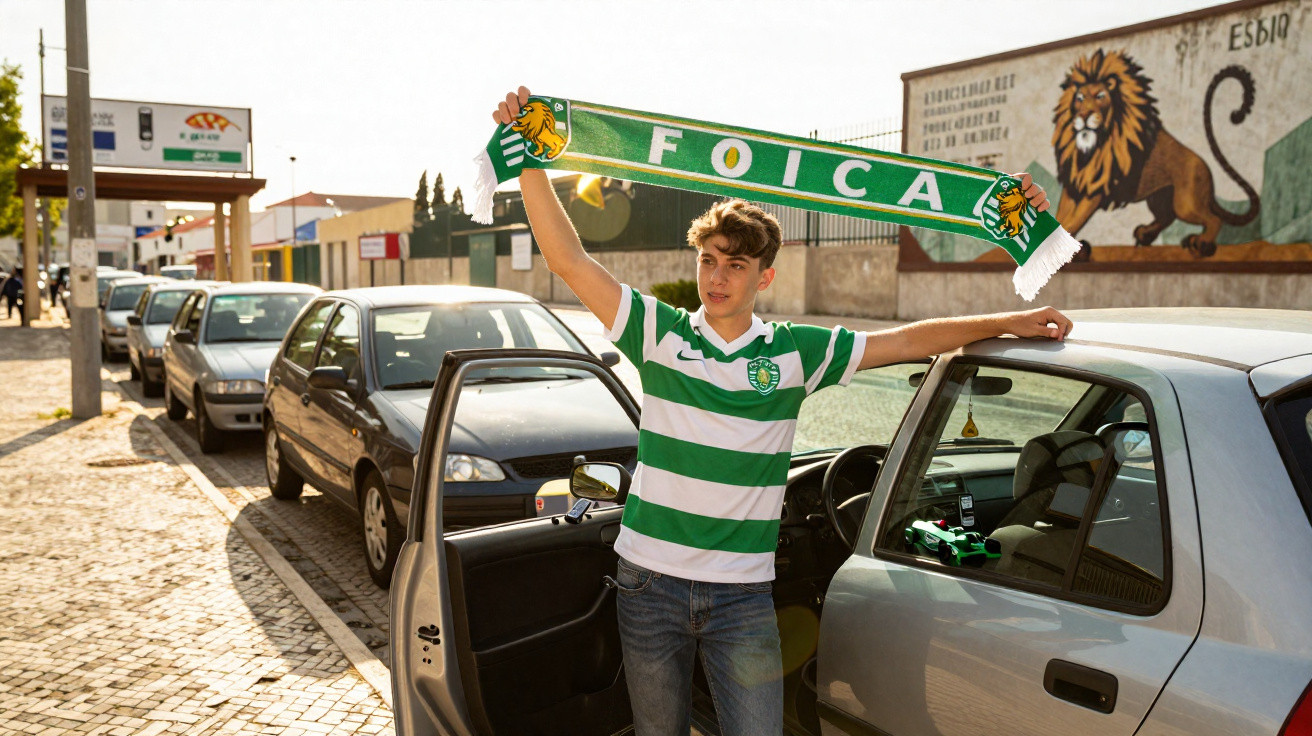
This article is a column. On our team there are people who couldn’t care less about football, others who support Porto, Sporting, Benfica, and so on. Read it in that spirit, with no ill intent. Above all, enjoy it!
Sporting Clube de Portugal and a long-awaited title
Nearly two decades on, Sporting Clube de Portugal are on the verge of being crowned Portuguese football champions again. The last time was in 2002. Back then, João Pinto and Mário Jardel were leading figures for the Lions, while Rúben Amorim - today’s Sporting manager - was just 17 and playing for Benfica’s youth team.
Leaving the tactical chat aside, it wasn’t only football that went through a major upheaval. So, with Sporting in tow, let’s climb into the time machine and revisit the car market in 2002. Does any of this ring a bell?
Once upon a time, a long time ago…
So much time has passed, and the car market has shifted so dramatically, that 2002 now feels like a different universe. In those days, Diesel cars were the market’s “kings and masters”, nobody was seriously imagining electric cars, and hybrids were only just finding their feet.
Lane-keeping assistance? Nowhere to be seen. A central multimedia screen in the dashboard that mirrors everything on our smartphones belonged to James Bond films - 007, the world’s most famous secret agent - rather than everyday motoring.
The car industry in 2002: brands, safety and the rise of SUVs
In 2002, Tesla still didn’t exist, Jaguar Land Rover still didn’t exist (Jaguar and Land Rover were part of Ford), and the Opel Corsa - still under General Motors - had just become Portugal’s best-selling car, with 17 811 units sold.
The second-generation Renault Laguna had just made history as the first car to achieve five stars in EuroNCAP tests, and the Nissan Qashqai - one of the models most responsible for the SUV boom - was only just entering development.
Motorsport in 2002: champions of the era
In motorsport, Michael Schumacher was at the peak of his powers and, in 2002, secured his fifth (of seven) Formula 1 world titles with Scuderia Ferrari. In the World Rally Championship, it was Marcus Grönholm - in a Peugeot 206 - doing the celebrating.
Back on the showroom floor, you could find models as different as the Volvo XC90, the Swedish brand’s first SUV - a body style it would later lean on almost entirely -, the Peugeot 406, the “eternal” Volkswagen Golf (in its fourth generation) - now “haunted” by the ID.3 -, the Ford Fiesta, which had just received a new generation, and the Mazda MX-5, which at that time was still in its second generation, known as the NB.
Time, of course, moved on: the Peugeot 406 is no more - the 508 has followed in its footsteps -, the Mazda MX-5 has “aged” by two generations (now the ND), the Ford Fiesta has reached its seventh generation, the Volkswagen Golf remains Europe’s best-selling model, and the Volvo XC90 is now only offered in electrified versions (plug-in and mild-hybrid).
"This trip to the past would not be complete without mentioning fuel prices in 2002. On average, Diesel cost €0.67 per litre and 98 RON unleaded petrol cost €0.97."
If you’ve “stuck with it” this far, you’ll have realised that 19 years really is a long time - and that an awful lot has changed. But the love of football is still the same - with more VAR or less VAR - just as the passion for cars has survived almost everything.
As for me, I hope you enjoyed this detour back to 2002. To finish, as a supporter of another club, I’m writing - in full fair play - a sentence I never thought I’d type while working at Razão Automóvel, and which seems the most likely: congratulations Sporting Clube de Portugal, Portuguese football champions 2021.
Comments
No comments yet. Be the first to comment!
Leave a Comment