
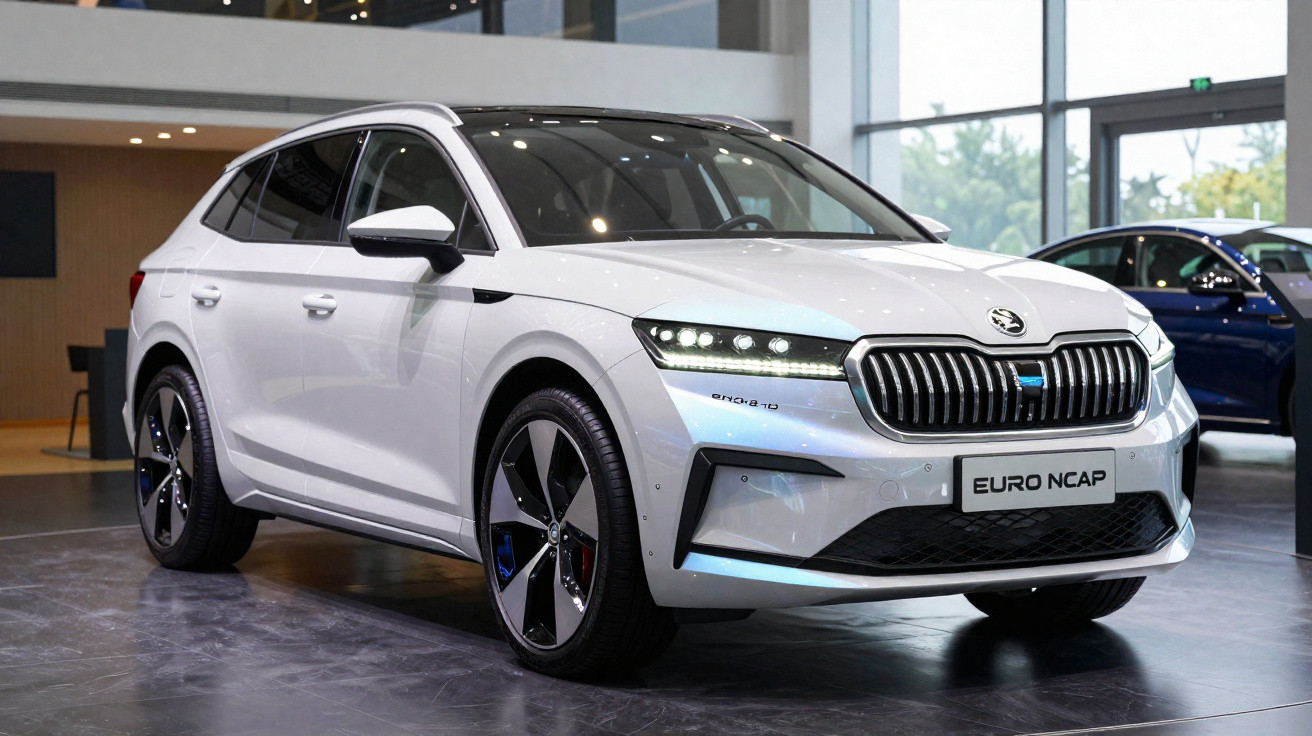
A further round of Euro NCAP testing has now published the safety performance of three more models: the electric “siblings” Skoda Enyaq iV and Volkswagen ID.4, plus the Dacia Sandero, one of the most affordable cars on the market.
Euro NCAP results for Skoda Enyaq iV and Volkswagen ID.4
Starting with the two EVs, and as we also saw with the ID.3 (which uses the same MEB platform as the Enyaq iV and ID.4), the demanding Euro NCAP programme was passed with relative ease-both in crash testing and in the effectiveness of their driver-assistance systems.
Both electric crossovers achieved five stars, with results that were extremely close to one another-unsurprising given their shared underpinnings and safety equipment-while strong scores were recorded across every assessment area.
Dacia Sandero: is “low cost” reflected in safety?
The outcome for the Dacia Sandero (which also applies to the Logan) tells a different story. The Romanian model managed only two stars, a disappointing result.
That said, a closer look at the data shows its crash-test performance is perfectly respectable. If Euro NCAP assessed only the car’s passive safety (crash tests), the Sandero would have received a four-star rating.
The issue is that, today, Euro NCAP places substantial weight on active safety: the systems intended to prevent crashes, such as autonomous emergency braking, as well as driver aids like a lane-departure warning.
With the Sandero’s low asking price, these features are either available only as options or not offered at all. Euro NCAP typically tests cars with safety equipment that is standard across all versions, although it can also run parallel tests on the same vehicle when an optional safety pack is offered.
For example, the Dacia Sandero does not have a front-facing camera-only a radar-based autonomous braking system that can detect other vehicles, but not pedestrians and/or cyclists, as Michiel van Ratingen, Euro NCAP’s Secretary General, points out.
EU rules from July 2022 and what they mean for Dacia
As van Ratingen notes, shortly, from July 2022, all models-including all Dacias-will have to comply with new safety regulations imposed by the European Union.
In this new General Safety Regulation, a great deal of attention is being paid to crash prevention. It will require all new vehicles sold within the European Union to be fitted with additional advanced driver-assistance systems for functions such as advanced autonomous emergency braking, lane-departure warning and driver fatigue warning.
These systems will also become part of the Dacia Sandero’s offering. The two-star result achieved now should improve when the car is retested with this equipment.
Comments
No comments yet. Be the first to comment!
Leave a Comment