
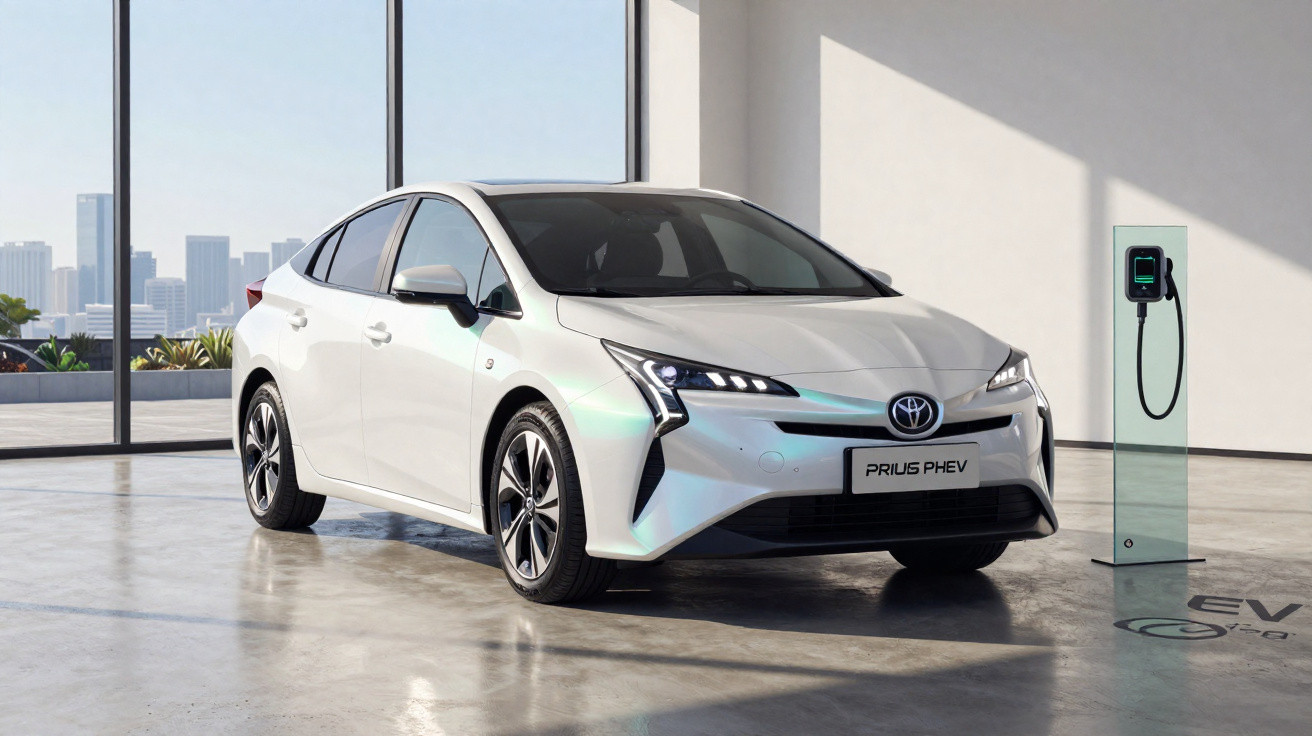
Talking about hybrid cars without mentioning Toyota is virtually impossible. The Japanese brand’s involvement with more environmentally friendly powertrains began exactly 20 years ago with the first-generation Prius. And, like any long-running relationship, it has had its highs and lows.
Two decades and 10 million vehicles later, that relationship looks stronger than ever - in the shape of the Toyota Prius Plug-in. Since its launch in 2012, this Japanese model has moved in step with the industry’s progress and the global rise in hybrid sales, especially in Portugal. For this second generation, Toyota said it would redefine plug-in technology within its hybrid model. A promise is a promise…
More engaging handling and effective response
Let’s start with one of the headline points of this new Toyota Prius Plug-in generation: range. At the core of the car is Toyota’s latest PHV technology. The lithium-ion battery, positioned beneath the boot, has doubled from 4.4 to 8.8 kWh, and pure-electric range has increased by the same margin: from 25 km to 50 km. It’s a meaningful jump that (for the first time in the Prius Plug-in) allows the combustion engine to take a back seat - it’s now possible to do everyday journeys entirely in electric mode.
If there were any doubt, the Toyota Prius Plug-in really is built for the urban jungle. It encourages smooth, progressive and quiet driving, with no tailpipe emissions and no fuel consumption - in 100% electric mode, of course. The driving position is good, although the armrest on the centre console sits too high - not a major issue, especially if your hands are where they should be: on the steering wheel.
For anyone who isn’t an habituée of hybrids or EVs, the lack of an instrument cluster directly in front of you can feel a little odd at first, but you quickly adapt to the display positioned in the middle of the dashboard.
While the Prius Plug-in is an excellent companion in town, switching off ECO mode and upping the pace shows the Japanese model can meet the minimum expected. The changeover from the electric unit to the 1.8-litre petrol engine is handled a little more discreetly (in other words, more quietly) than, for example, in the C-HR (Hybrid), which also uses a CVT gearbox.
In this respect, it’s worth highlighting the 83% increase in electric power (now 68 kW), enabled by the development of a powertrain using a dual electric motor system - the new one-way clutch inside the transaxle makes it possible to use the hybrid system generator as a second electric motor. The upshot is a 135 km/h top speed in “zero-emissions” mode, compared with the previous 85 km/h.
The Prius Plug-in delivers a driving experience that, while not exactly “electrifying”, still feels involving - even at higher speeds. With support from the combustion engine, it can accelerate from 0–100 km/h in 11.1 seconds and reaches a top speed of 162 km/h.
Dynamically, it’s a Toyota Prius… And what does that mean? It isn’t a car designed to be driven with “a knife between your teeth”, nor to be pinned through corner after corner (as if you’d expect that…), but the chassis, suspension, brakes and steering do the job.
And no, we haven’t forgotten consumption. Toyota quotes a combined average of 1.0 l/100 km (NEDC cycle), a utopian figure for anyone travelling well beyond the 50 km electric range, but not far from realistic for those doing shorter routes and choosing to charge the battery daily. Speaking of charging, the Prius Plug-in also moves forward compared with its predecessor. Maximum charging power rises from 2 to 3.3 kW, and Toyota promises times up to 65% quicker - that is, 3 hours and 10 minutes from a standard household socket.
A… unique design
With the driving impressions covered, we turn to one of the most subjective - and least agreed-upon - aspects of the Prius, and by extension the Prius Plug-in: the design.
In this second generation, the Prius Plug-in not only adopts a new look, it also became the second model to use the new TNGA platform - Toyota New Global Architecture. Measuring 4,645 mm long, 1,760 mm wide and 1,470 mm tall, the new Prius Plug-in is 165 mm longer, 15 mm wider and 20 mm lower than the previous model, and it weighs 1,625 kg.
From a styling standpoint, Toyota’s design team had a tough brief: take a look that never really convinced and make it more striking, more appealing and more aerodynamic. The result is a model with longer body overhangs, a completely revised lighting signature (using LED lights), and a front end featuring a three-dimensional acrylic treatment. Is it more distinctive and attractive? We think so - but the rear is too… different. As for aerodynamics, the Cd remains at 0.25.
Inside
Inside, the Prius Plug-in keeps its modern, bold approach. The 8-inch touchscreen (similar to the one in the C-HR) dominates the cabin and provides access to the usual navigation, entertainment and connectivity systems.
The graphics (a little dated and confusing) linked to Toyota’s PHV technology can be viewed on another dashboard display made up of two 4.2-inch TFT screens arranged horizontally. The Prius Plug-in also includes a wireless charging pad for smartphones.
Further back, the two rear passenger seats are separated by a tunnel. The boot, meanwhile, has been affected by the larger battery. By increasing its volume by 66%, the battery forced the boot floor up by 160 mm, and capacity dropped from 443 litres to 360 litres - the same as the Auris, a model that is 210 mm shorter. On the plus side, the carbon-fibre boot lid - a first for mass-production vehicles - helped offset the weight increase at the rear.
All of that said, the new Toyota Prius Plug-in is another important step towards democratising (plug-in) hybrids. It’s a step that ends up shorter than you might expect once you consider the rather high price for a model whose benefits still remain tied to electric range - despite the significant improvements.
Comments
No comments yet. Be the first to comment!
Leave a Comment