
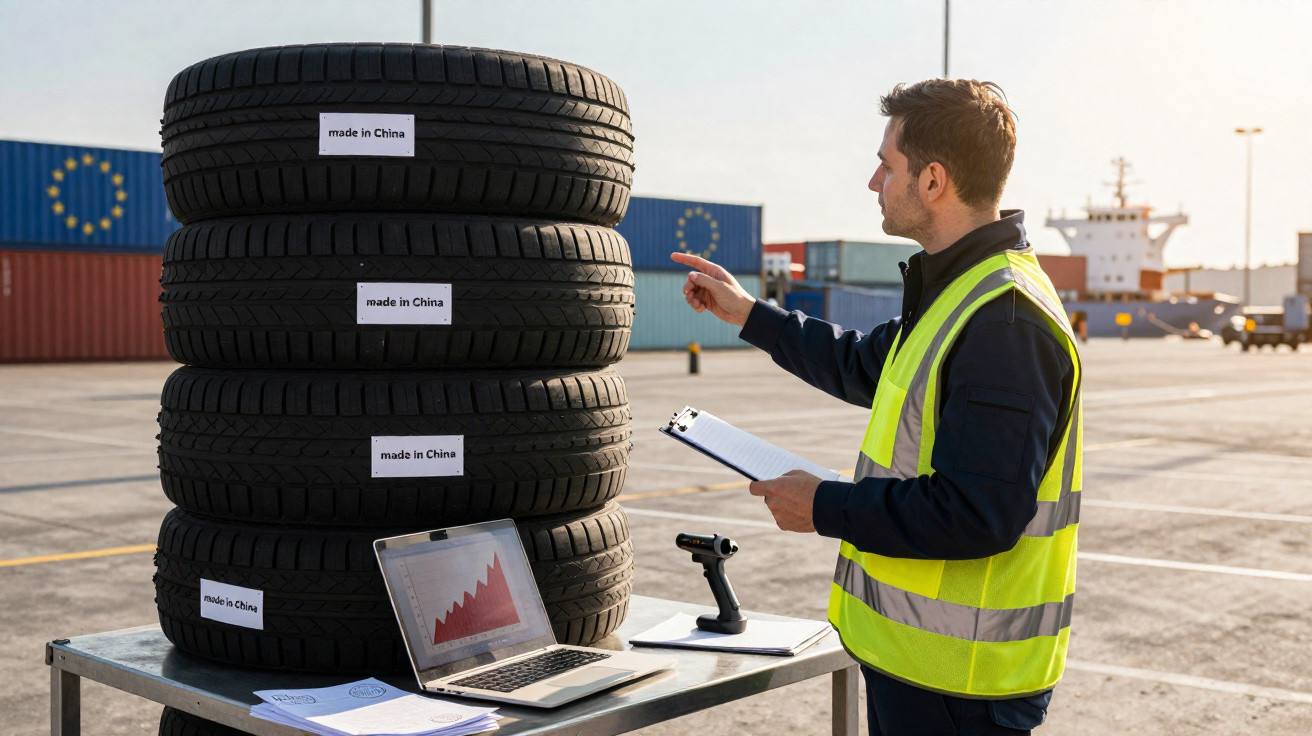
The European Union has once again tightened restrictions on Chinese imports. After electric cars, the focus has now shifted to tyres made in China, which will be subject to new tariffs designed to curb what Brussels views as unfair competition.
The move follows an investigation by the European Commission, launched in May 2025 after a complaint from the Coalition Against Unfair Tyre Imports, an association representing several European manufacturers.
Brussels found that a number of Chinese producers had been selling tyres in Europe below their market value - a practice known as dumping - to the detriment of the European industry. According to the European Commission, Chinese imports increased their market share at the expense of European manufacturers in a market worth more than €18 billion in 2024.
Tariffs up to 45.3%
The new measures cover passenger-car and light commercial vehicle tyres produced in China with a load index of 121 (maximum load per tyre: 1450 kg).
Depending on the manufacturer, the anti-dumping tariffs range from 24.4% to 45.3%, with the exception of South Korea’s Hankook. The tyre maker will face a duty of just 4.3% on the tyres it produces in China - the lowest rate assigned by the European Commission. Brussels argued that Hankook’s models sit in a higher-priced segment and have had a limited impact on European producers.
Most producers that co-operated with the investigation will be charged 24.4%, while other exporters could be subject to the maximum rate of 45.3%.
In 2024, the EU imported around 93 million tyres made in China, out of a total of 330 million, giving Chinese brands a 28% market share worth €2.5 billion. Three years earlier, that share stood at just 18%.
How the duty is applied at the EU border
According to Automobilwoche, the new tariffs will not be applied to the consumer selling price, but to the declared value when the goods enter the European Union. In 2024, each tyre imported from China entered the EU with an average declared value of €30.30.
In practical terms, this equates to an increase of about €13.70 per unit where the maximum 45.3% tariff applies, or roughly €7.40 when the rate is 24.4%.
Likely effect on retail pricing
After VAT is added - but before distributor and retailer margins - the expected impact on the final price is likely to be between €9 and €16 per tyre. The effect should be most noticeable in the entry-level segment, where an increase of this size represents a significant proportion of the overall price.
Brussels rejects criticism
In its complaint to the European Commission, the Coalition Against Unfair Tyre Imports claimed that several manufacturers were applying dumping margins of between 41% and 104%, selling tyres at prices 30% to 65% lower than those of European competitors.
Following the investigation, Brussels concluded that these practices contributed to losses in market share, sales and production volumes for the European industry, thereby justifying the introduction of anti-dumping tariffs.
China and several European importers have challenged the decision, warning it could lead to price rises and reduce the availability of budget tyres. The European Commission, however, maintains that the measures are necessary to restore fair competitive conditions.
Separate subsidies inquiry due in December
A parallel investigation is also under way into potential subsidies granted to Chinese producers, and it is expected to be completed in December.

Comments
No comments yet. Be the first to comment!
Leave a Comment