
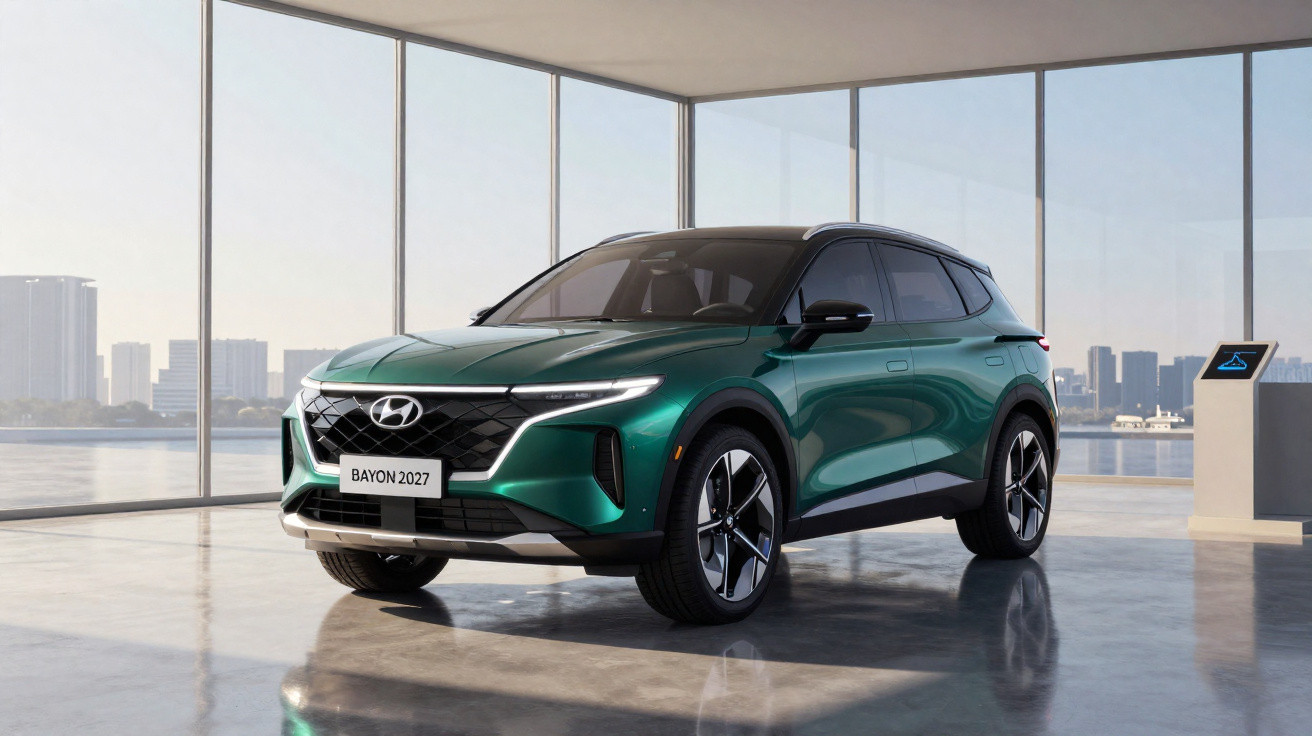
Just over a year after Hyundai refreshed the Bayon - its smallest SUV - the next generation has already been spotted out testing, both in South Korea and up at the Arctic Circle. It is due next year and is expected to be larger, with a noticeably different look from today’s model, alongside updates to its technology and mechanical line-up.
In the spy photographs accompanying this article, the development cars remain heavily camouflaged, but there is already enough to hint at several of the key changes coming to Hyundai’s new South Korean SUV.
Less crossover, more SUV
The second-generation Bayon looks set to move away from the current model’s crossover-style proportions and design cues, shifting closer to a more traditional SUV shape. The overall impression is tougher and more “square” than the Bayon on sale now, helped by a flatter roofline and a more upright stance. At both the front and rear, it is also possible to make out full-width light bars - a styling theme that has become increasingly common across the industry.
Final exterior measurements have not yet been confirmed, but everything points to the 2027 Bayon being larger than the current car, bringing it closer in size to the Kauai.
There is still no clear view of the cabin, although the layout is not expected to stray far from Hyundai’s most recent launches, typically featuring two side-by-side screens - one for the driver’s instruments and the other for infotainment. In terms of practicality, the increase in exterior dimensions should translate into more room for passengers and luggage.
A hybrid Hyundai Bayon on the way?
Significant changes are also anticipated under the bonnet. In Portugal, the Bayon is currently offered only with a 1.0 T-GDi three-cylinder petrol engine producing 100 hp, paired with a 48 V mild-hybrid system. With the second generation, that option is likely to be joined by another, more efficient alternative.
All signs suggest that the 2027 Bayon will gain a full hybrid powertrain for the first time (one that does not need plugging in), mirroring the approach taken by one of its strongest rivals, the Toyota Yaris Cross.
While there are no official details on the hybrid system yet, there is a strong chance it will be the same set-up used in the Kauai HEV. That combines a 1.6-litre petrol engine (102 hp) with an electric motor (32 kW or 44 hp), delivering a maximum combined output of 138 hp. In the Kauai, Hyundai quotes 4.6 l/100 km, but in the smaller, lighter Bayon that figure could be lower if it adopts the same powertrain.
Adding this new option to the Bayon would support Hyundai’s wider plan to expand its hybrid range across more models by 2030, while also strengthening the brand’s B-SUV offering in one of the market’s most hotly contested segments.
When will it arrive?
The new Hyundai Bayon is scheduled to launch in 2027, although rumours suggest it could be unveiled before the end of this year.
Comments
No comments yet. Be the first to comment!
Leave a Comment