
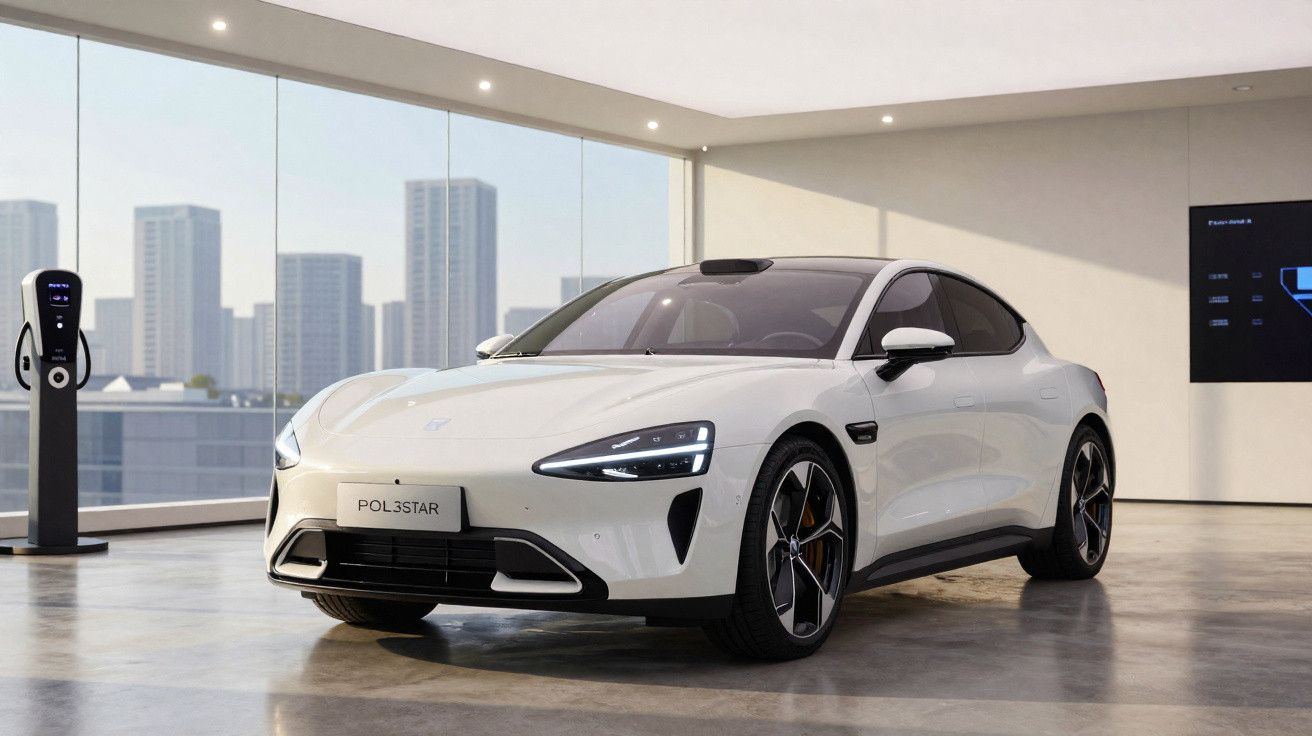
With the car industry growing cautious as demand for electric vehicles cools, Polestar appears unfazed - holding its line and refusing to stray from the direction it set out.
So much so that the brand has just unveiled the biggest product push in its still-young history: four new models over the next three years, all fully electric.
That is the recipe Polestar believes will keep it building its position among premium marques. Even if the early days were rocky, the “machine” is finally running smoothly. And ambition is not in short supply. The aim is to lift sales by double digits this year, following 2025, when it delivered its strongest year ever.
Against that backdrop, we spoke exclusively with Michael Lohscheller - the German executive who has led Polestar since 2024, after spells at Opel, Volkswagen, Mitsubishi and VinFast.
Having completed more than 120 marathons, Lohscheller has brought the energy, discipline and drive of endurance racing to the Swedish brand - which faces its own long-distance test.
The course is set
The hurdles are substantial, not least because the automotive sector is going through an especially unsettled period. Yet Polestar is clear about its destination - and, as the saying goes, that is already half the battle.
For the German chief, that certainty is Polestar’s biggest competitive edge, particularly at a time when many direct rivals have been revisiting their future plans, easing off all‑in electrification and doubling down again on internal combustion engines.
“ We have a clear objective. We know where we want to go. And that isn’t true for everyone,” he told us, picking up on our comparison between his marathon passion and the race Polestar is running: “We know where the start is and where the finish line is”.
“I hope we can all agree that we must eliminate emissions from the mobility and transport sector. But some of our competitors don’t agree with that. I don’t know what race they’re running, but it’s not ours,” he added.
An absolute “no” to hybrids
While some of Polestar’s competitors are stepping back from promises of full electrification to make room for new hybrid models, Michael Lohscheller draws a firm, non-negotiable red line:
“We are not going to build hybrids (…) you can quote me”.
“We know what we’re doing: we want to make only electric cars and we want to broaden our portfolio so more people can access our brand,” he reiterated, before directing criticism at the European Commission. The Commission recently relaxed emissions targets for 2035, opening the door to continued internal combustion engines - albeit under very specific conditions.
On that point, Polestar’s boss accepts the changes “are not significant”, but he stresses this has been discussed with policy-makers “for years and years and years” and that the car industry “invested billions of euros in electrification”: “now people want to discuss things again and that isn’t right”.
Europe at risk?
More than simply reacting to what amounts to rule changes mid‑game from the European Commission, Lohscheller was keen to underline that these political U‑turns and reversals in Europe “do not help the industry”.
We need to compete with global companies that offer zero‑emissions mobility. I believe Europe would do better to compete than to try to protect everyone.
“Tariffs and protectionism will never be a good path for Europe. We want to compete, we want to bring innovative ideas to consumers and we want to honour the agreements that were made over many years,” he insisted.
Backing the customers
Although he acknowledges Europe’s stop‑start progress towards full electrification “is not good”, Michael Lohscheller points out that every car sold is a vote of confidence in the Swedish brand’s strategy:
“ We are staying fully electric because our customers are voting for us. Politicians can do a lot, but it’s customers who vote for us. They vote for Polestar,” he told us, while also recognising how important the expansion of physical retail locations is to the brand’s growth.
It is worth recalling that, despite initially trying to establish itself with a purely digital go‑to‑market approach, Polestar has gradually shifted towards a hybrid model. Its network now exceeds 200 physical locations (almost always linked to existing Volvo sites), and the target is to grow beyond 350.
“It’s essential that our customers have a premium experience. And we believe the best way to deliver that is through dealers, with qualified salespeople who can explain the car and its technical differentiators, can do a test drive and present an offer,” he said.
The biggest product offensive ever
To underpin the ambition Polestar is projecting, the plan rests on what Lohscheller calls the largest product offensive in the brand’s history: four new models by 2028.
Sitting at the top of that pyramid is the Polestar 5, a four‑door GT due as soon as this summer, taking on the role of flagship for the Swedish manufacturer. It can be seen as a rival to the Porsche Taycan and can already be ordered in Portugal, with prices starting at 122 600 euros.
It is a technological showcase with a striking design, including versions producing a combined 650 kW (884 cv) and 1015 Nm, capable of sprinting from 0 to 100 km/h in 3,2s. But at a time when Polestar is still focused on boosting sales volumes (it recorded 60 119 vehicles sold in 2025), attention is also turning to the 7, set to become the new entry point to the Polestar line‑up.
Due to launch in 2028, this C‑segment SUV - comparable to a Volvo EX40 or BMW iX1 - has everything it needs to become the Swedish brand’s best‑seller. Not least because it is expected to be the most affordable model in the range, a title currently held by the Polestar 2, which will also receive a replacement in early 2027.
Meanwhile, the Polestar 4 - which unexpectedly established itself as Polestar’s best‑seller - will gain a second version, planned for the end of this year. It will be a kind of crossover blending “the genes of an estate car with the versatility of an SUV”.
The Apple logic
All told, Polestar’s range has never been broader and, by 2028, it will span five models (or six, if we count the two variants of the 4). And it will always follow the same naming convention: a new model, a new number.
To Lohscheller, the reasoning could not be simpler: “Every time we launch a new car, we assign a new number. That’s why the Polestar 7 received a new designation, since the Polestar 6 has already been unveiled and will arrive a little later,” he explained, reaching for a comparison that is as unexpected as it is hard to ignore: “Apple does the same thing”.
Comments
No comments yet. Be the first to comment!
Leave a Comment