
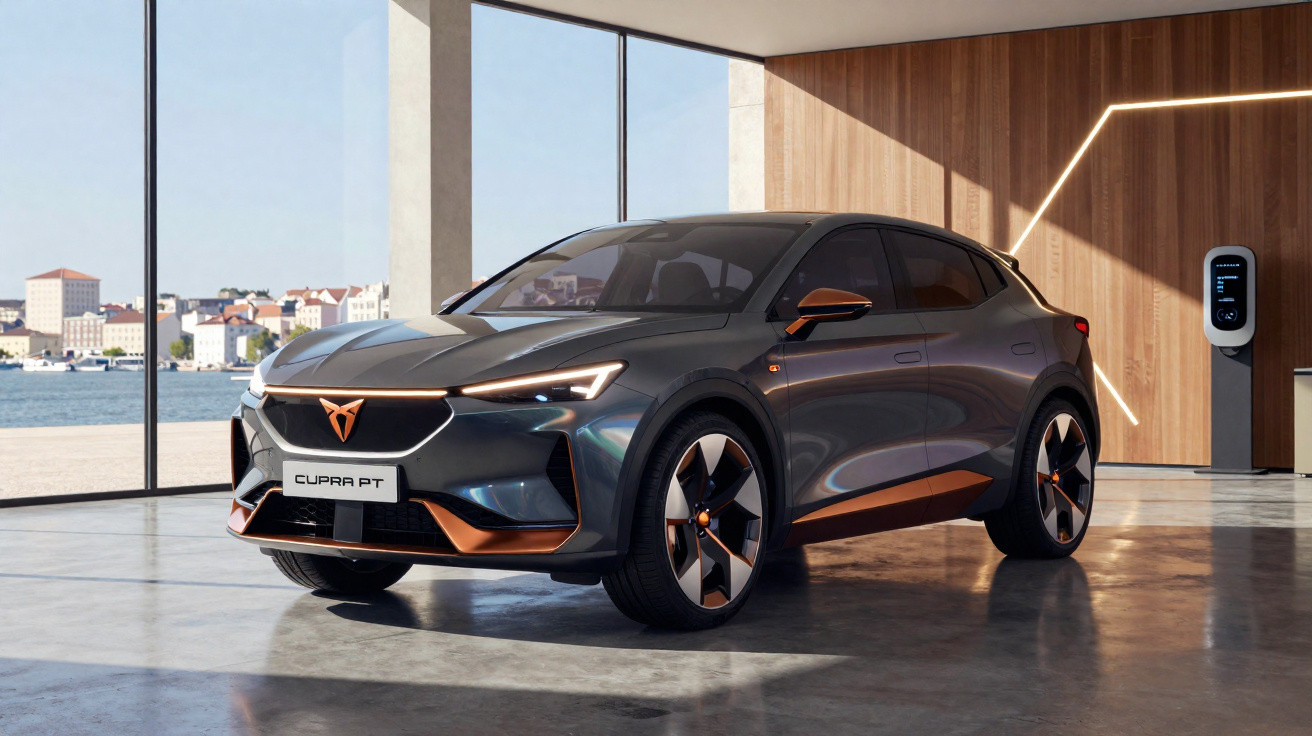
Since March, Pedro Fondevilla has been steering CUPRA’s operations in Portugal, and he is unequivocal: “the brand will continue to grow in Portugal”.
His confidence does not appear to be shaken by the headwinds facing the automotive industry.
“Only those who don’t know where they’re going fear the future,” he says, explaining that his main focus is expanding CUPRA in Portugal, with particular emphasis on bringing hybrid and electric models to market.
Where is CUPRA headed?
Despite having been present for only three years and operating in an unfavourable global environment-driven by the COVID-19 pandemic-CUPRA recorded 11% growth in 2020, which equated to a total of 27 400 vehicles sold.
Fondevilla attributes part of that performance “to the excellent reception of the CUPRA Formentor”. This model already represents 60% of CUPRA’s sales worldwide and more than 80% in Portugal. “It was the first model where we applied 100% of the brand’s DNA. It’s a model with its own personality, and that showed in demand.”
For him, that “own personality” is precisely one of CUPRA’s success factors: “We know our design may not appeal to everyone, but those who like it, really like it.” That is why the brand’s future lies in launching more models that are 100% CUPRA.
The CUPRA Born will be the Spanish brand’s first fully electric model. It is due to arrive in Portugal at the end of 2021, followed by another electric vehicle, the CUPRA Tavascan, in 2024.
The electrification challenge
Sales of electric and electrified models in Portugal rose by more than 50% in 2020. Even so, in Fondevilla’s view, the country’s electric-vehicle charging infrastructure “still isn’t keeping up with the needs and the willingness drivers have to make this transition. The charging network isn’t enough-there’s a long road ahead”.
When it comes to CUPRA, he argues that the hurdles are of a different kind: “regardless of the technology, CUPRA models have to be rewarding to drive.
CUPRA’s results show there are customers who don’t want ‘spaceships’. They want cars with sophisticated design that are enjoyable to drive,” he says, pointing to electrification as one of the brand’s key challenges.
On whether CUPRA will continue to offer internal-combustion engines in its line-up, Fondevilla neither confirms nor denies that this technology will remain part of the brand’s future, preferring to state that “at CUPRA we will always pay attention to what our customers need”. And as we know, there is still room at CUPRA for models such as the CUPRA Formentor VZ5:
Either way, Fondevilla believes that, in CUPRA’s future, driving pleasure will always sit at the very heart of the brand-an outlook shaped by more than 20 years of experience in the automotive sector.
Pedro Fondevilla’s career path
A graduate in Business Administration and Management from the University of Barcelona, with a postgraduate qualification in Marketing from ESADE Business School, Fondevilla began his professional career as a controller in France with the Renault Group, before returning to Spain with the same group.
In 2006, he joined Volkswagen Group España Distribución (then VAESA), holding various roles in the Commercial area before moving into Volkswagen’s Marketing Department-a position he held until 2018, when he joined SEAT S.A.
Comments
No comments yet. Be the first to comment!
Leave a Comment