
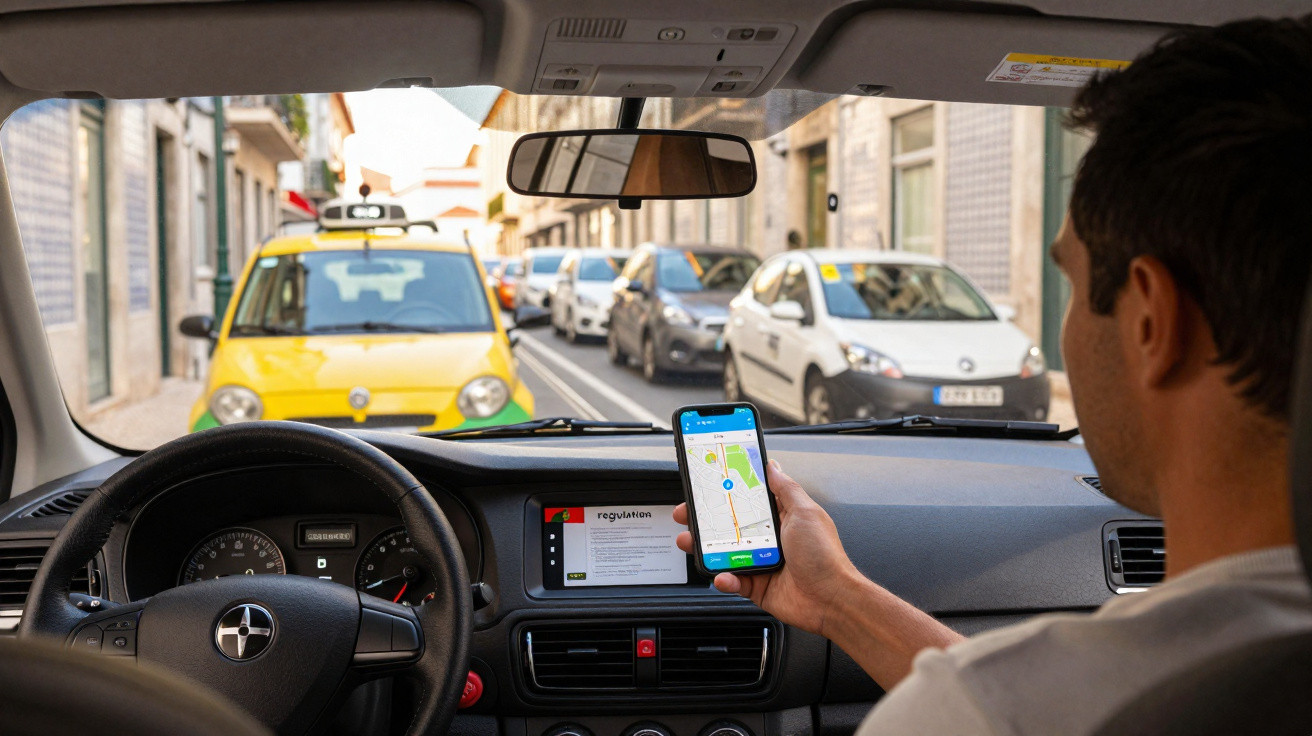
Portugal’s law governing TVDE activity is about to be overhauled. The Assembly of the Republic has approved a revision of the 2018 framework, aiming to align the sector with how the market has developed and to tackle several issues flagged since platforms such as Uber and Bolt began operating in Portugal.
Even so, the new rules are not yet in force: they still require the President of the Republic’s promulgation and subsequent publication in the Portuguese Official Gazette. That said, the revised regime introduces wide-ranging changes.
The package affects driver training and eligibility criteria, the rules applying to vehicles and to platforms, and in several respects brings the TVDE regime closer to the one that applies to taxis.
TVDE takes on a new meaning
One of the most symbolic amendments concerns what the acronym TVDE actually stands for. The acronym stays the same, but it changes from “Individual, Paid Passenger Transport in Unmarked Vehicles via an Electronic Platform” to “Paid Passenger Transport in Vehicles Made Available Electronically”.
According to the bill, referring to “unmarked” vehicles no longer reflects reality, because TVDE vehicles are now identified through mandatory stickers-and the new law strengthens that identification further.
The word “individual” is also removed, creating legal room for shared-ride services, where multiple passengers can split the same journey.
Taxis will be able to operate on platforms
Another major change is that taxis are brought into the digital-platform ecosystem. Until now, TVDE activity and taxi services have been regulated under separate regimes. Under the new law, taxis will be able to accept trips directly through electronic platforms such as Uber or Bolt, while keeping their own identity and their own licensing.
However, when a trip is booked through a TVDE platform, the vehicle, driver and operator become subject to the rules that govern TVDE activity. In practical terms, while providing a TVDE service the taxi driver will not be allowed to pick up passengers from the street, use taxi ranks, or rely on circulation, stopping or access rules reserved for taxis.
Drivers will have to speak Portuguese
Entry requirements for the profession are also tightened. Drivers will now have to demonstrate a functional command of the Portuguese language that is suitable for carrying out the role.
This skill will be incorporated into the initial training course, which will have a minimum duration of 50 hours, combining both theory and practice.
The training will end with a mandatory assessment made up of 30 questions. To pass, the trainee must answer correctly at least 27.
Vehicles will be allowed to be older
The maximum age of cars used for the activity is also changing. At present, TVDE vehicles cannot be more than seven years old, counted from the date of first registration. Under the new law, they may be up to 10 years old. For fully electric cars, the limit rises to 12 years.
However, the requirement to undergo an annual periodic roadworthiness inspection remains. The first inspection will still take place one year after the date of first registration.
Unlimited dynamic pricing
Another significant shift relates to fares. Currently, when demand increases, platforms may apply dynamic pricing, pushing the price up. But those increases are constrained by law and cannot exceed double the average price charged over the previous 72 hours.
Under the new law, that ceiling is removed. Platforms will be able to apply dynamic fares without a maximum cap defined in legislation.
Tighter enforcement
Vehicles will still be required to display an identifying sticker, but it will have to meet new security requirements.
The seal will be issued by IMT (the Institute for Mobility and Transport) and will become non-removable. It will include anti-fraud holographic elements and a digital identifier, via a QR code or another equivalent electronic-reading method. The aim is to make enforcement easier and to reduce the risk of counterfeits or the reuse of the same sticker across different cars.
IMT will take on a more central role in overseeing the sector. Beyond issuing the new stickers, the body will manage the national register for the activity, control driver training, and monitor compliance with the new rules, working alongside other enforcement authorities.
Emergency button and onboard cameras
Platforms will be required to provide an emergency mechanism that can be activated by either the driver or the passenger. This system should enable a dangerous situation to be reported quickly and allow relevant information to be passed to the authorities, such as the vehicle’s identification and its location.
The new law also allows in-vehicle video recording systems to be installed to strengthen the safety of occupants and drivers. Recording may capture images only-never audio-and it will depend on the occupants’ consent, while also being subject to data protection rules.
Advertising will be allowed
TVDE cars will also be permitted to display advertising both inside and outside the vehicle.
Until now, any advertising was banned. Under the revised framework, it will be allowed under the same terms that apply to vehicles used in taxi services.
When will the rules take effect?
Although the Assembly of the Republic has already approved the changes, they have not yet taken effect. The legislation must first be promulgated by the President of the Republic and published in the Portuguese Official Gazette.
Under the approved text, the new law will come into force on the first day of the month following its publication. Some measures may nonetheless depend on additional regulation before they can be fully applied.






Comments
No comments yet. Be the first to comment!
Leave a Comment