
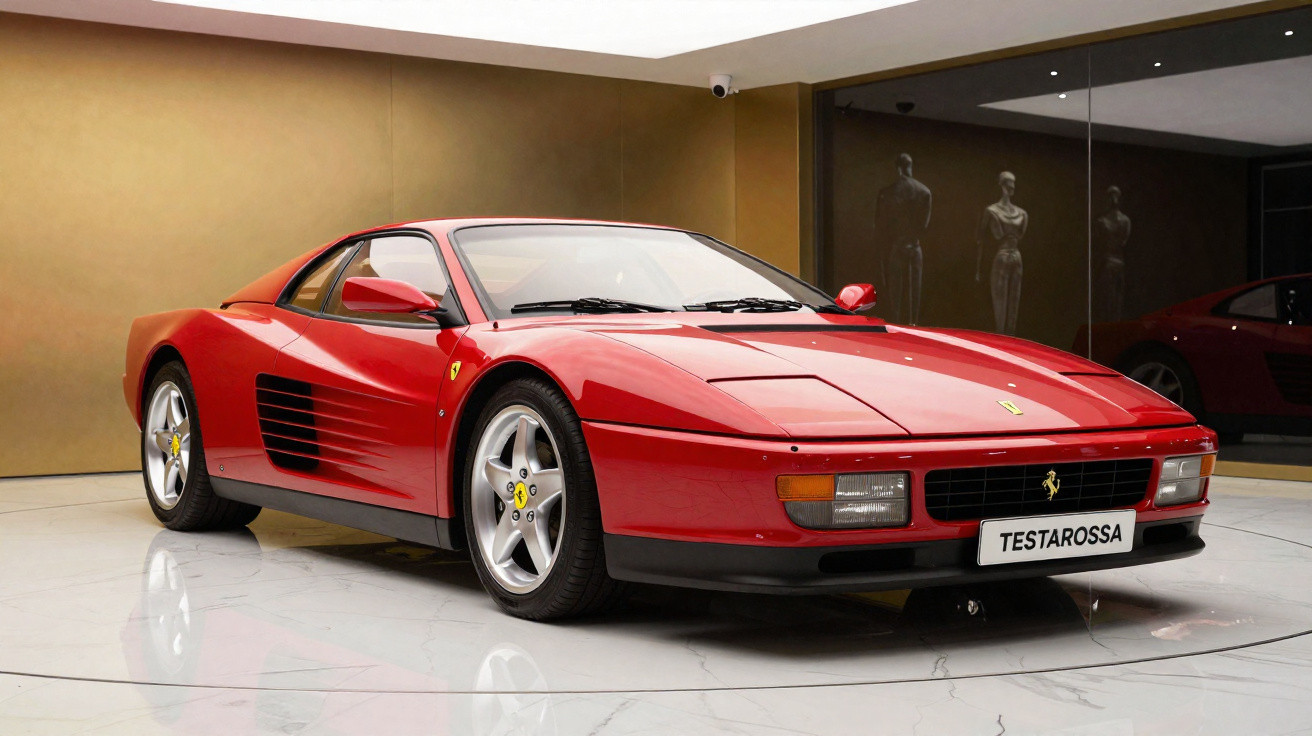
Ferrari has revived the Testarossa name for the successor to the SF90 Stradale, but-unlike the 1984 Testarossa-it does not use a V12. Instead, it features a twin-turbo V8 that forms part of a plug-in hybrid system.
And here’s the debate that has sparked so many comments and arguments: it is not really about the loss of cylinders or the electrification of the new Testarossa, but about the claim that the 1984 car had a V12 rather than a 12-cylinder boxer (or a flat-12). All right, I’ll admit the styling of the new 849 Testarossa has generated far more comments and discussion…
The argument over what the Testarossa’s 12-cylinder layout actually is predates the car itself-and it has regained momentum now that this legendary name has returned. That makes this a perfect moment to clear it up properly.
Ferrari Testarossa: flat-12 looks, 180° V12 reality
To be frank, at first glance the Ferrari Testarossa engine looks like a classic boxer: 12 horizontally opposed cylinders. Visually, it does not resemble a “V” at all. In terms of its shape, you can indeed call it a flat-12 (flat), but from an engineering standpoint it is not a true boxer-it is a 180° V12.
Proof that it is not a boxer comes from Mauro Forghieri, former technical director of Scuderia Ferrari (1962–1971 and 1973–1987):
“Don’t call it a Boxer. It is more accurate to call it a flat (flat) 12-cylinder. Or, if you prefer, a 12-cylinder with a 180° ‘V’.”
Mauro Forghieri, quoted in the book “Ferrari Engines” (2019), Francesco Reggiani and Keith Bluemel
The crankpin detail that separates boxer from V
So what sets this engine apart from a boxer like those found in the Porsche 911 or in Subaru models? It comes down to one crucial operational difference that places the Testarossa engine in the “V” camp rather than the boxer camp: the crankpins for the connecting rods-or, more precisely, whether opposing pistons share crankpins.
In a true boxer engine, each piston has its own dedicated crankpin. That means opposing pistons move in sync: they reach top dead centre and bottom dead centre at the same time. The result is perfect balance (and the potential to run a lighter crankshaft), along with a very distinctive sound-exactly the character people associate with those cars.
The 1984 Ferrari Testarossa engine works differently. Each pair of opposing pistons shares the same crankpin. What does that change? When one piston reaches top dead centre, the piston opposite it reaches bottom dead centre-almost like a tug-of-war between cylinders. That is the typical behaviour of a V engine, even though in this case the two cylinder banks sit at a 180° angle.
Despite this technical difference, Ferrari’s flat-12 shared with boxer engines the advantage of being mountable very low in the engine bay, helping to lower the centre of gravity. In the Testarossa, however, that benefit was not fully exploited, because the engine was positioned above the gearbox.
Ferrari doesn’t help
This uncertainty over what kind of 12-cylinder the Testarossa uses has lasted for decades, and it even predates the Testarossa itself-because the engine first appeared in the 1970s. One of the biggest reasons the confusion has persisted is Ferrari itself.
That is because the first road car to use this 180° V12 was the 365 GT4 BB, launched in 1973. At the time, “BB” was said to stand for… Berlinetta Boxer, referring to the body style and the engine. Today we know the letters BB actually had a different, less politically correct meaning, but this was the official explanation Ferrari chose-misleading as it may be.
After the 365 GT4 BB came the 512 BB/BBi-keeping the same “misdirection” in the name-and then, in 1984, the Testarossa arrived. It would later develop into the 512 TR and the F512 M, before production ended in 1996.
Ferrari’s flat-12 evolved with each model, too. It was first identified as the F102 in the 365 GT4 BB, and it was largely derived from the 60° V12-the famous Colombo. With the 512 BB it became the F110, and with the Testarossa it gained a multi-valve head and the designation F113. It began at 4.4 litres (F102) with 340 cv and finished at 4.9 litres (F110, F113) with 440 cv, remaining naturally aspirated throughout.

Comments
No comments yet. Be the first to comment!
Leave a Comment