
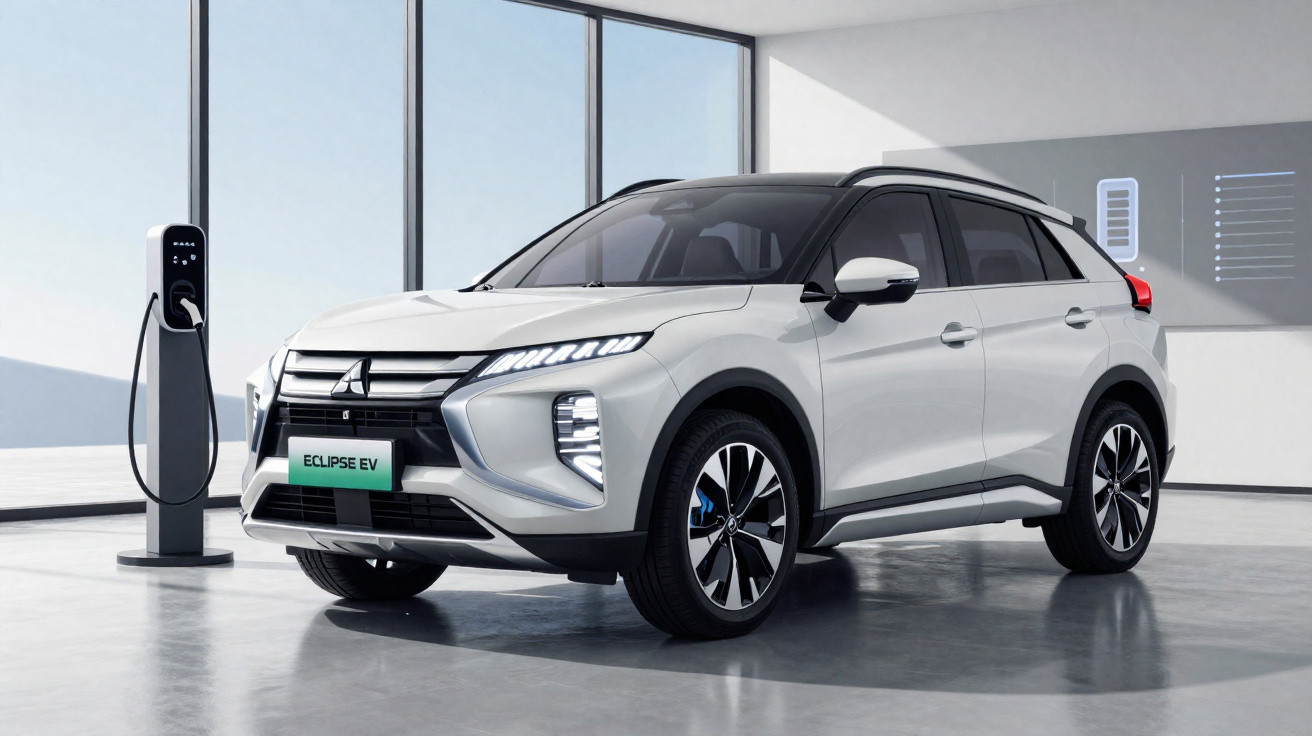
Mitsubishi has pulled the covers off the new Eclipse Cross, presented as the Japanese brand’s first truly 100% electric model. That distinction matters because the i-MiEV came much earlier, when today’s EV market was still in its infancy and, at the time, it carried a price tag of more than €40,000.
The new compact SUV is another product of the Renault–Nissan–Mitsubishi Alliance, and it makes no effort to hide its close family ties to its twin, the Renault Scenic E-Tech.
Battery, range and charging for the Mitsubishi Eclipse Cross
At launch, the Mitsubishi Eclipse Cross will be offered with an 87 kWh battery, which is claimed to deliver more than 600 km of maximum range (WLTP). A second option with a smaller-capacity battery is due to follow next year.
Whichever battery is chosen, DC rapid charging is available, with a maximum power of up to 150 kW.
Performance, regenerative braking and dimensions
The electric motor in this set-up produces a maximum of 160 kW (217 cv) and 300 Nm of torque. The official figures include 0–100 km/h in 8.4s and a top speed of 170 km/h. Regenerative braking can be adjusted across four levels.
In styling terms, the bodywork adopts the latest evolution of the Dynamic Shield front-end design, paired with the Wide Hexagon theme at the rear. Based on the CMF-EV platform, it measures 4.47 metres in length, 1.86 m in width and 1.57 m in height.
Interior technology and connectivity
Inside, Mitsubishi prioritised digital features and comfort during the Eclipse Cross’s development. As a result, a 12.3” central touchscreen takes pride of place on the centre console.
From this interface, drivers can access Google services, including maps, the virtual assistant and the Google Play app store. Smartphone integration is also covered via Apple CarPlay and Android Auto.
European production and an eight-year warranty
Production of the fully electric Mitsubishi Eclipse Cross will take place at the Douai plant in France, starting in the final quarter of this year. It will share the assembly line with other Renault–Nissan–Mitsubishi Alliance models and is expected to reach the market shortly afterwards, in 2026.
For Mitsubishi, this is positioned as a key model in its European electrification plan, joining the new Mitsubishi Outlander PHEV as well as the upcoming Grandis.
On the reliability front, the brand continues to offer extended cover. The motor and battery are backed for eight years or 160,000 kilometres, while corrosion protection runs for up to 12 years-an argument Mitsubishi believes could help the model stand out against its most direct rivals.
Comments
No comments yet. Be the first to comment!
Leave a Comment