
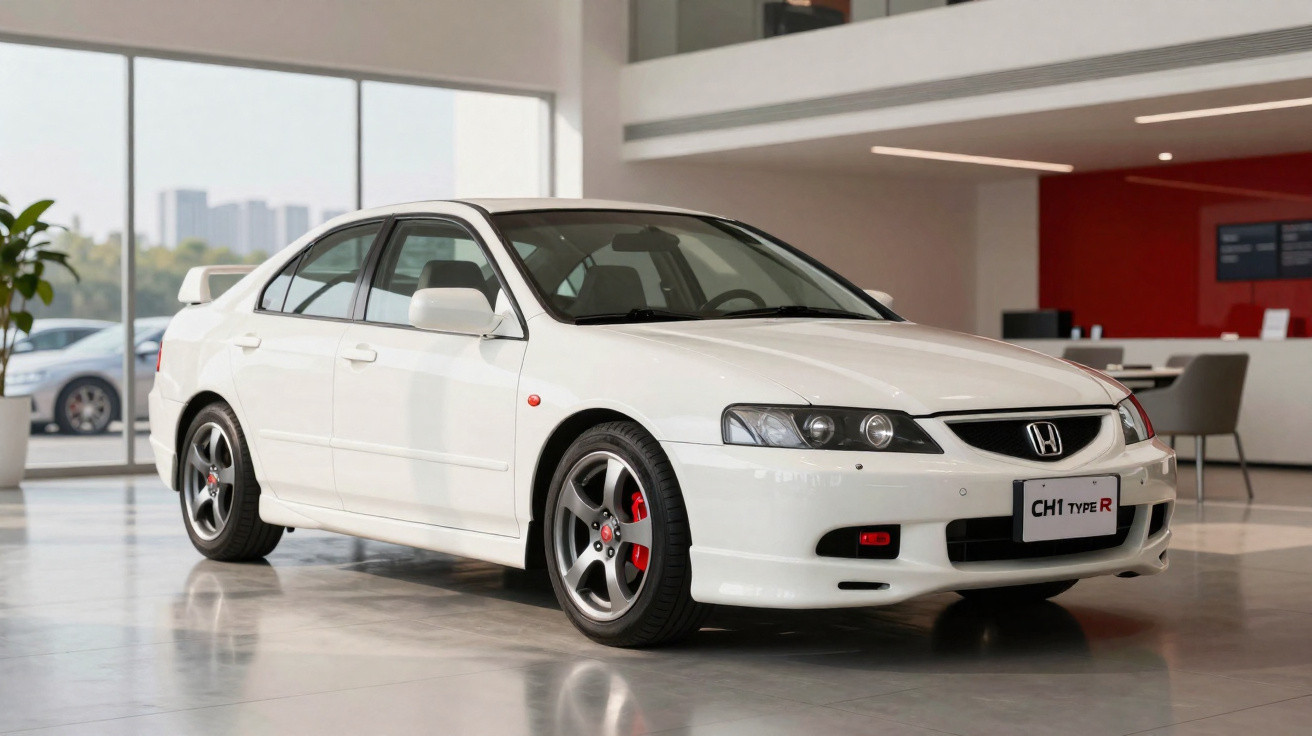
Back in 1998 - 20 years ago (Editor’s note: this piece was originally published in 2018) - the Honda Accord Type R (CH1) was unveiled. Yes, you read that correctly: an Accord Type R. It was a capable family car, yet it was never exactly celebrated for engaging handling, let alone for its “sportiness”.
So why would Honda decide that the Accord deserved the Type R treatment?
With the Type R badge gaining momentum - the NSX and Integra were giving the name serious profile - and with the Accord enjoying extra attention thanks to its (reasonably successful) appearances in the hugely popular touring car championships dominating European circuits at the time, the surprising thing would have been not to build a Honda Accord Type R.
A proper Type R
This was not a homologation special, but Honda’s engineers still approached it with meticulous care. The end result was so strong that the Honda Accord Type R not only ended up “wiping the floor” with its contemporaries in comparison tests - at a time when V6 engines were the default choice for the top versions in the D-segment - it was even pitched head-to-head with cars that had clear competition ambitions, such as the Subaru Impreza GT Turbo. This Accord was a true Type R.
That becomes obvious when you look at what was done to this Accord versus the rest of the range. Compared with the regular Accord 2.0, the Type R was 57 kg lighter - tipping the scales at just 1306 kg - thanks to the removal of some sound-deadening material. Even so, the rear bulkhead was reinforced, helping deliver a 40% increase in body rigidity.
Visually it leaned sportier through the addition of a body kit, but it was still a long way - a very long way - from the overt styling theatrics of today’s Civic Type R. It was a wolf in sheep’s clothing, only really giving away that it was a more special Accord when fitted with the optional (and functional) rear wing - an option chosen in most cases.
Ride height was lowered, the suspension was stiffened, the wheels grew to 17″, the brakes were upgraded, and a Torsen limited-slip differential was added. In dynamic terms the Accord was reinvented - communicative steering, a sharp chassis, and an involving driving experience - while still remembering its family brief by retaining strong comfort levels.
The engine, the star
As with any Type R, the headline act was the engine. Based on the same unit used in the Honda Prelude, it received a higher 11:1 compression ratio, new pistons, sequential fuel injection, a revised intake, and a freer-flowing exhaust system.
Despite the decidedly unglamorous H22A designation - specifically the H22A7 version for the European market - the naturally aspirated 2.2-litre inline four produced 212 cv at 7200 rpm and 222 Nm at 6700 rpm.
Power went through a five-speed manual gearbox with shorter ratios, though it was still criticised for being long - fourth gear stretched beyond 190 km/h. Even so, 100 km/h came up in 6,9s, but performance tailed off at higher speeds because the gearing left the engine outside the “right zone” - in other words, outside VTEC operation.
There was another Accord Type R
The Honda Accord Type R remains the most “adult” Type R of the lot, but that does not make it any less accomplished. Its design shows the same care and build quality you would expect from any other Type R.
Europe only ever received one Accord Type R, but Japan got another in the next generation, introduced in 2002. Called the Euro R, it swapped the 2.2 for an even more rev-happy 2.0 - the revered K20A - with 220 cv and a six-speed manual gearbox.
About “Glories of the Past”. This is Reason Automobile’s column dedicated to models and versions that stood out in one way or another. We like to revisit the machines that once made us dream. Join us on this journey back in time here at Reason Automobile.
Comments
No comments yet. Be the first to comment!
Leave a Comment