
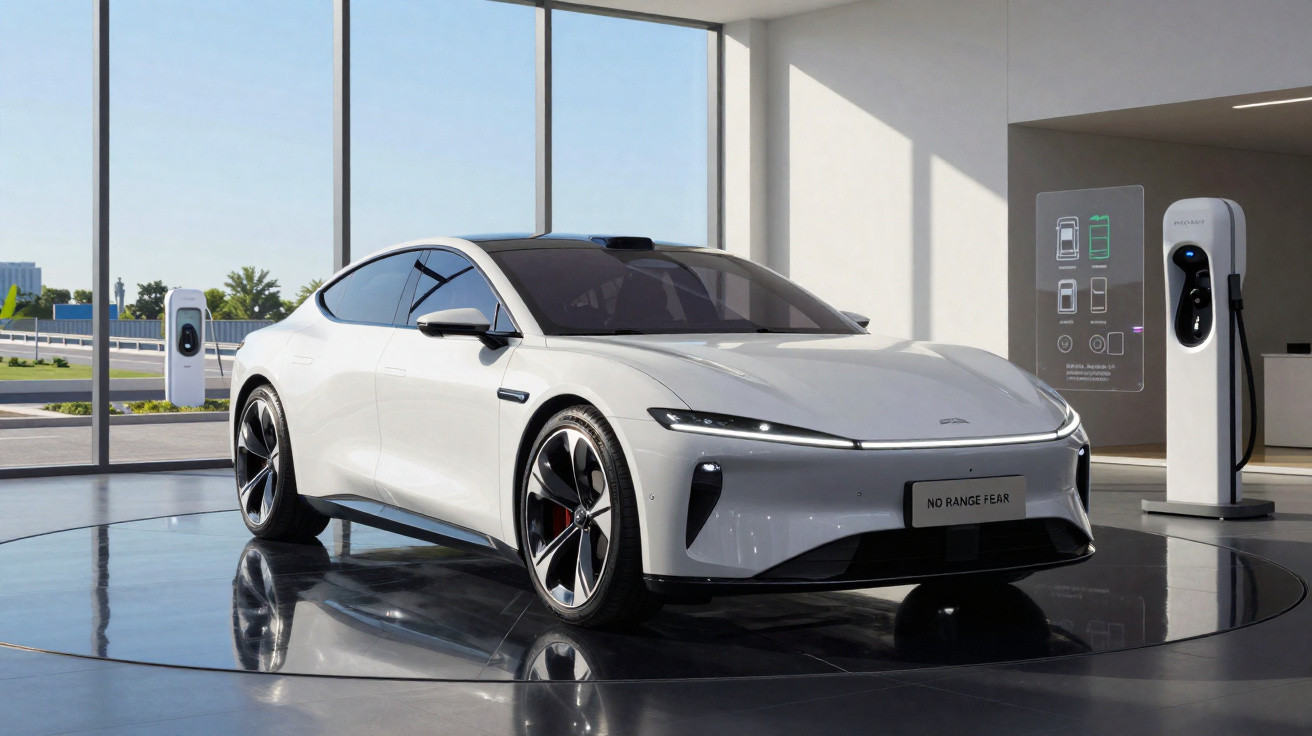
After ending incentives for buying electric cars in the USA at the end of last year, Donald Trump has once again made these vehicles a focus of his criticism, implying that electric-car drivers suffer from a kind of illness.
The remarks come just a few months after the US president removed federal incentives for purchasing electric vehicles, at a time when his energy policy continues to move further away from the approach taken by the previous administration.
Donald Trump’s Las Vegas rally comments on electric cars
At issue is what is commonly called range anxiety. In the US president’s telling, people who drive electric cars “have a disease”, referring to the constant worry about how much charge is left in the battery.
“Têm uma doença. Estão a conduzir um carro elétrico e apercebem-se que a bateria está a descer. Começam a pensar nisso quando ela ainda está a três quartos da capacidade. Estas pessoas são loucas”, he said during a rally in Las Vegas.
In the same speech, Donald Trump again defended his decision to abolish what he calls the “electric mandate”, arguing that Americans were being forced to buy electric vehicles “with no way to charge them”.
What Trump means by the “electric mandate”
Despite the phrase, there has never been any federal requirement in the USA to buy electric cars. The president uses the term to refer to the tax incentives and environmental policies of the previous administration designed to speed up the electrification of the car fleet.
“Eu acabei com o mandato elétrico. Eu não quero falar sobre isso porque Elon Musk não ficou propriamente feliz comigo, mas eu tive de o fazer.”
Donald Trump, President of the USA
What is range anxiety?
The concern highlighted by Donald Trump is known in the automotive industry as range anxiety. The expression describes a driver’s fear of running out of battery before reaching a charging point.
In the early years of electrification-when electric cars offered far less range than they do today and public charging networks were much smaller-this was one of the main barriers to adopting electric vehicles.
Over the last few years, however, the situation has shifted markedly. Many models now advertise ranges above 500 km on the WLTP cycle, and the rollout of rapid-charging networks has significantly reduced this concern in several markets.
In the European Union (EU), for instance, the public charging network is expanding faster than the electric-car fleet. By the end of 2025 there were 1.1 million public charging points across Europe, five times more than in 2020.
In the USA, though, the picture is somewhat different. Uneven access to charging infrastructure-especially outside major urban areas-means range remains one of the main worries for many prospective buyers.
USA behind Europe and China
While Europe and China continue to push electric vehicles, the USA is moving in the opposite direction. According to Donald Trump, only around 7% of cars sold in the USA are 100% electric. That is a markedly lower share than in Europe (22.2%) and China (33%).

Comments
No comments yet. Be the first to comment!
Leave a Comment