
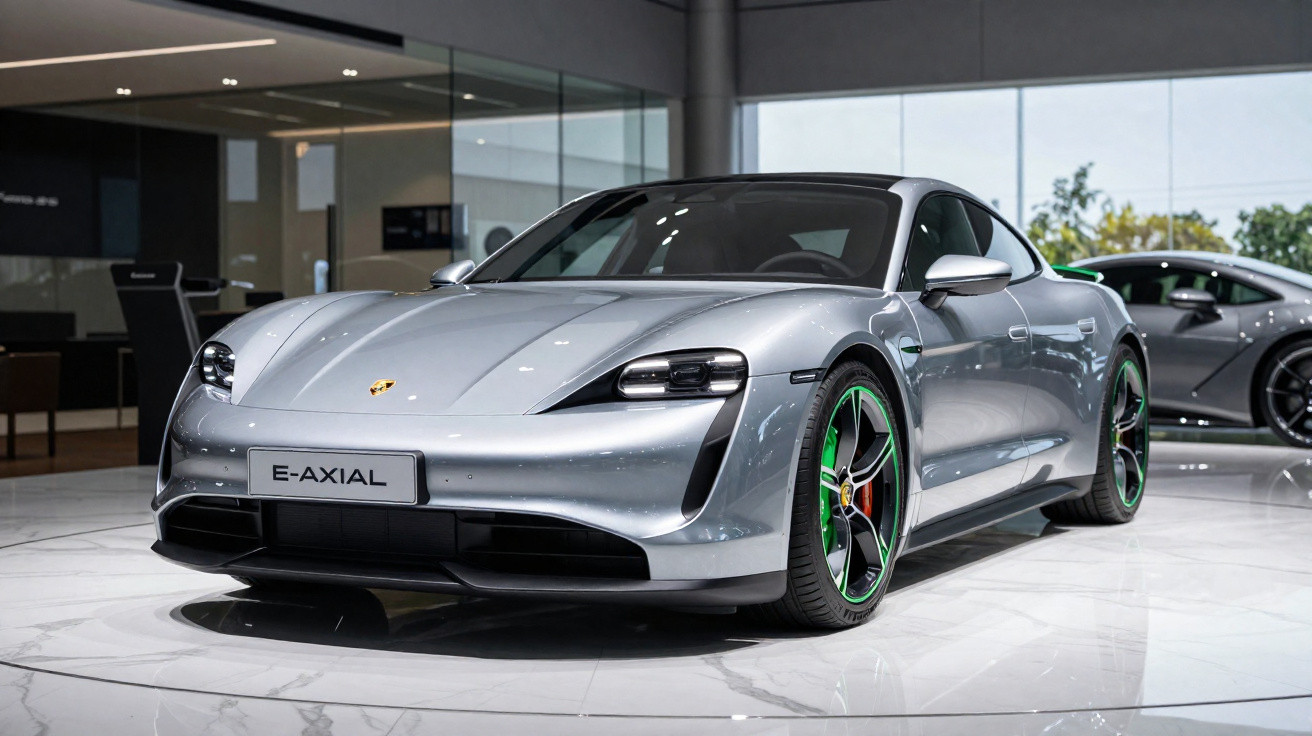
Ferrari and Lamborghini already use axial flux electric motors in their hybrids, and it looks as though Porsche has no intention of being left behind.
Axial flux electric motors explained
So what, exactly, are axial flux electric motors? Unlike conventional radial flux electric motors-where the magnetic field travels in a circular path-in an axial motor the flux runs parallel to the axis of rotation.
That layout enables a unit that is both smaller and lighter, while delivering more power and torque for each kilogram. To illustrate the potential, the latest prototype from YASA-a British company owned by Mercedes-Benz and specialised in this type of motor-delivers peak output of up to 750 kW (1020 hp), yet weighs just 12.7 kg and measures only 7.6 cm in thickness.
With that in mind, the Stuttgart brand appears keen to adopt the technology. Porsche has filed a patent with the World Intellectual Property Organization (WIPO) for a hybrid system that makes use of axial flux electric motors.
For use “in a sports car”
Although the patent allows for application in any passenger model, the illustrations and wording point to a more specific target: use “in a sports car”, with a mid-mounted or rear-mounted engine. Could this be a hint at the next generation of the 911?
The idea is straightforward. Rather than placing a radial flux electric motor inside the PDK gearbox-as is done on the new Porsche 911 GTS T-Hybrid and across the brand’s plug-in hybrids-an axial flux electric motor could sit between the engine and the transmission, thanks to its extremely slim design. It could even be positioned between the two sections of the dual-mass flywheel.
This approach has the advantage of being shorter than the current arrangement, but that is not the only upside. According to the patent, it also produces less heat, which would in turn improve cooling for the entire powertrain.
The patent points towards the use of an automatic gearbox, specifically Porsche’s familiar PDK (dual-clutch), with no mention of any potential manual transmission.
No need to plug it in
Porsche’s patent for this new hybrid set-up does not appear intended for plug-in hybrids, but rather for conventional hybrids (“full hybrids”) that do not require external charging. That is because the brand states that the transmission input shaft and the engine output would be coupled to the rotor of the axial flux electric motor-meaning they always rotate together.
What it could mean for Porsche performance models
Allowing for some speculation, an axial flux hybrid system like this seems particularly well suited to the company’s sports cars, such as the Porsche 911 or the successor to the 718, which will no longer be exclusively electric.
As with the current T-Hybrid system, the priority would likely be performance rather than pure efficiency. It is even possible to picture a scenario in which this technology gives the 911 GT3 and GT3 RS a meaningful increase in power without giving up the sought-after, near-mythical naturally aspirated six-cylinder boxer engines capable of reaching 9000 rpm.


Comments
No comments yet. Be the first to comment!
Leave a Comment