
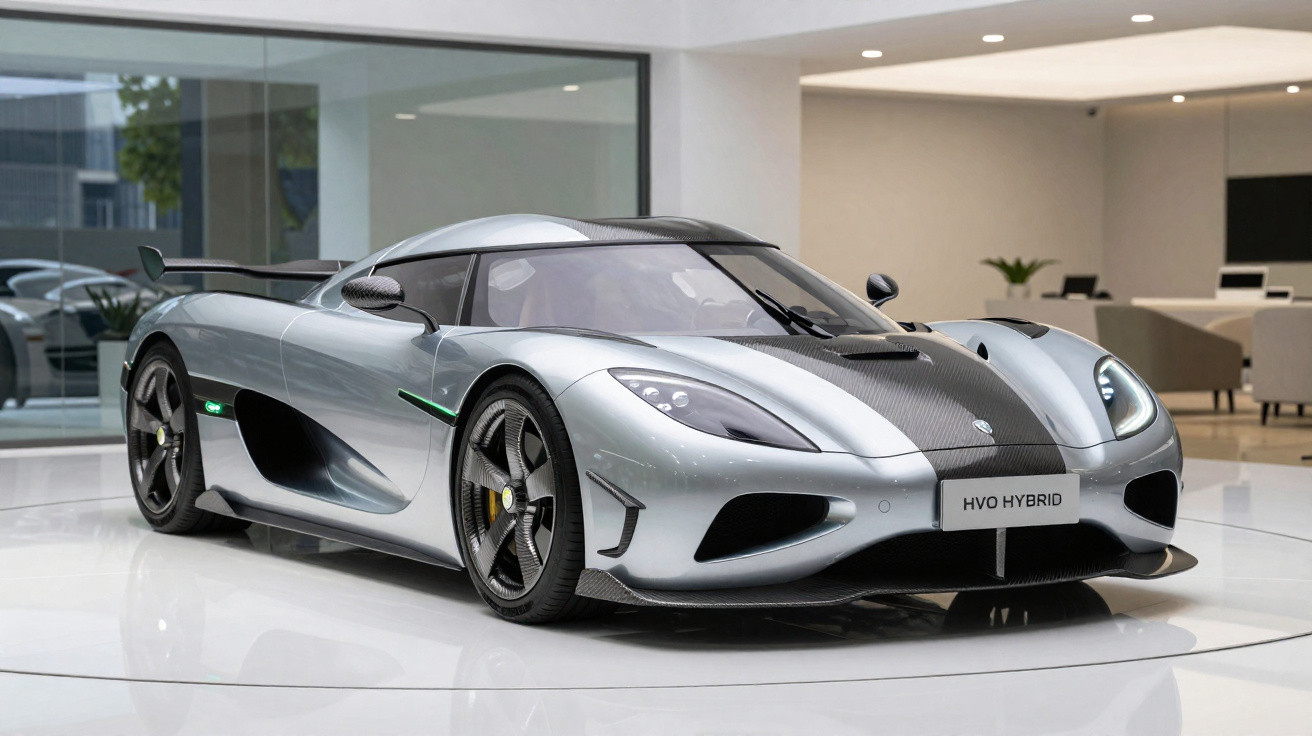
When the debate about whether cars should go fully electric comes from someone like Christian von Koenigsegg, the founder and chief executive of Koenigsegg, it is worth listening closely - even if his interest in Diesel hybrids seems to run against the prevailing direction.
As with many of the unconventional engineering choices seen in his hypercars, there is a certain “method in the madness”.
Speaking to CarBuzz, he argued that Diesel hybrids could be a more sensible alternative to 100% electric vehicles, particularly if the aim is to cut real-world emissions rather than simply tick regulatory boxes.
Koenigsegg’s reasoning is straightforward: a hybrid using a Diesel engine alongside a relatively compact battery (less than a third the size of that found in a long-range EV) could handle the vast majority of driving in electric mode - around 95% - with the Diesel engine reserved only for occasional long journeys.
In that scenario, he says a car with this kind of powertrain could be up to 300 kg lighter than a long-range electric vehicle, while also leaving a smaller environmental footprint across its full life cycle.
Diesel, but not as we know it
For the emissions arithmetic to add up, one crucial ingredient is the fuel used by the Diesel engine. Instead of fossil-derived Diesel, Koenigsegg advocates HVO (Hydrotreated Vegetable Oil). This is a renewable fuel produced from organic waste and vegetable oils, and it can drastically reduce CO₂ emissions compared with fossil Diesel.
HVO is chemically stable and compatible with modern Diesel engines - several manufacturers have already confirmed their engines can use it - and it is already available in parts of Europe, even if it remains far from mainstream.
It could also be a way to “clean up” Diesel’s image, which is still paying the price for Dieselgate in 2015. That scandal led to widespread demonisation of Diesel, especially in Europe. Today, Diesel accounts for less than 8% of total sales (January to November 2025, source: ACEA), after once representing more than half the market. The tighter EU rules and targets introduced after the scandal forced manufacturers to redirect resources into electrification, accelerating Diesel’s decline.
Is it a more complex solution? Koenigsegg says no
Christian von Koenigsegg describes a hybrid set-up (plug-in or an electric vehicle with a range extender) paired with an HVO-fuelled Diesel engine as “fantastic”. Cutting 300 kg of mass and having only 5% of driving done using HVO “is much better for the environment and nobody is thinking about it.”
He maintains that the idea only appears more complicated: “If we look at it from a mass perspective, it is much lower. An electric car only has one battery pack, but it’s 7000 cells connected - that’s 7000 parts. If we cut that down to 2000 cells and add an HVO-fuelled Diesel engine, I bet it has a lower environmental impact after 10 years, as long as driving (with the Diesel engine) is not more than 5% of the total “.
Why does almost nobody take this route?
The answer is as political as it is technical. On the engineering side, Diesel hybrid systems are genuinely more complex and expensive, largely because they require additional exhaust after-treatment hardware, such as selective catalytic reduction (SCR), which depends on AdBlue.
At present, only Mercedes-Benz continues to offer Diesel hybrid options in the European market - a detail that speaks volumes about how risky it is perceived to go against the trend.
Recently, the industry has been showing renewed interest in interim solutions, with ever more capable plug-in hybrids and electric vehicles with range extenders. But these have almost always used petrol engines. Diesel, despite its superior efficiency on long distances, has been left out of the equation - not because it cannot be done, but because the narrative turned against it.
Christian von Koenigsegg does not overlook that reality, yet he ends with a provocation: if the true goal is to reduce total environmental impact, it may be worth reassessing Diesel without prejudice - provided it is paired with 21st-century fuels.
Comments
No comments yet. Be the first to comment!
Leave a Comment