
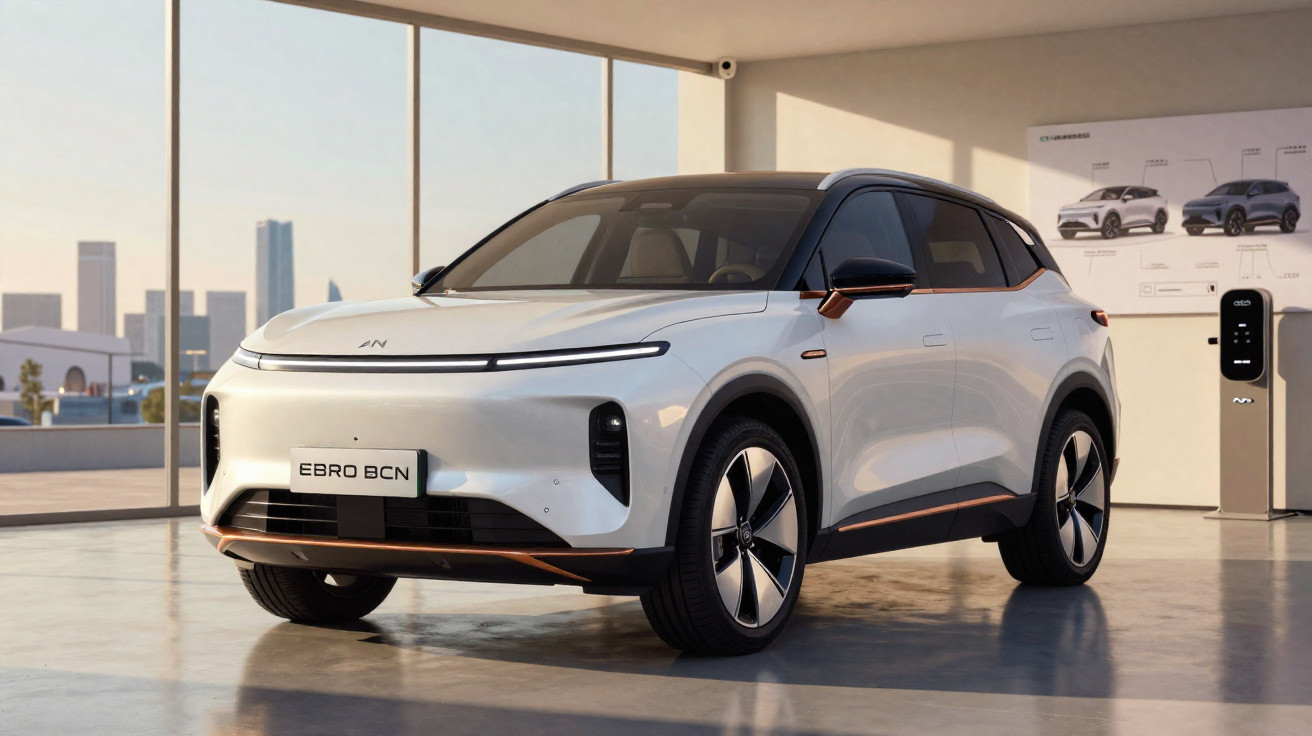
Just over a year ago, EBRO was little more than a forgotten name from Spain’s automotive past. Now it has a four-SUV line-up, a growing retail network and a Barcelona plant that has returned to building cars.
The revival got underway in April 2024. Spanish firm EV Motors, which had bought the rights to the brand in 2021, partnered with Chery to bring the former Nissan factory in Barcelona’s Zona Franca back to life after it had been shut since the end of 2021.
Chery joined as both technology partner and shareholder, taking 40% of the company and supplying platforms, powertrains and industrial know-how. Within a few months, the first vehicles wearing the EBRO badge were coming off the production line.
Nearly 70 years of history
EBRO’s story dates back to 1954, when Motor Ibérica adopted the name for tractors and commercial vehicles. In 1967, the business moved to Barcelona’s Zona Franca, which would go on to become one of the key hubs of the Spanish automotive industry.
Nissan’s arrival on the share register in the 1980s ultimately set the course for the brand’s disappearance. In 1985, the company became Nissan Motor Ibérica and, two years later, the EBRO name stopped being used.
Bringing back this badge-rather than launching a new name imported from China-helps frame the project as Spanish reindustrialisation: a historic factory operating again, jobs restored, and cars assembled inside the European Union.
From Spain to Portugal
EBRO sold around 14,000 cars in Spain during 2025 and aims to exceed 25,000 units this year. After strengthening its position at home, it began its international rollout via the Iberian Peninsula.
In Portugal, the brand arrived this year through a partnership with Grupo MCoutinho, with an initial network covering Porto, Aveiro, Viseu, Coimbra, Leiria and Lisbon. The target is to reach 10 dealerships by the end of the year.
The range includes the S400, a compact hybrid SUV, as well as the S700, the seven-seat S800 and the flagship S900. All of them use technology shared with Chery and, for the time being, none is offered as a fully electric model.
The first electric
That gap should be addressed in 2027 with the first electric vehicle developed for the new-era EBRO. Shown so far only as a prototype, it is set to be a five-door compact measuring about 4.2 m in length.
A 90 kW (122 hp) electric motor will be fitted to the rear axle, and two battery options are planned, with ranges close to 400 km. EBRO claims AC charging up to 11 kW and a 30% to 80% DC charge in between 20 and 30 minutes.
Planned equipment includes an 8.88-inch instrument display, a 15.6-inch central screen, 16 driver-assistance systems and six airbags. All specifications remain provisional until the production version is revealed.
Barcelona scales up
EBRO’s growth is closely tied to the factory’s overhaul. The new M1 line, opened this year, assembles the S400 and S700 almost entirely, while the larger S800 and S900 still arrive from China partially assembled and are finished on the M0 line.
The plant built 17,308 cars in 2025 and is expected to reach capacity of roughly 50,000 units by the end of this year. At present, the site’s maximum potential is around 130,000 vehicles per year.
Production is also planned for a first EV from Chery’s own brands, Omoda and Jaecoo, although the final choice has not yet been confirmed.
EBRO now wants to speed up its expansion from Barcelona, blending a Spanish name, Chinese technology and European production. It has already confirmed entry into three more markets: Bulgaria, where it launched this month; and Slovenia and Croatia, where it is expected to debut in October.
Comments
No comments yet. Be the first to comment!
Leave a Comment