
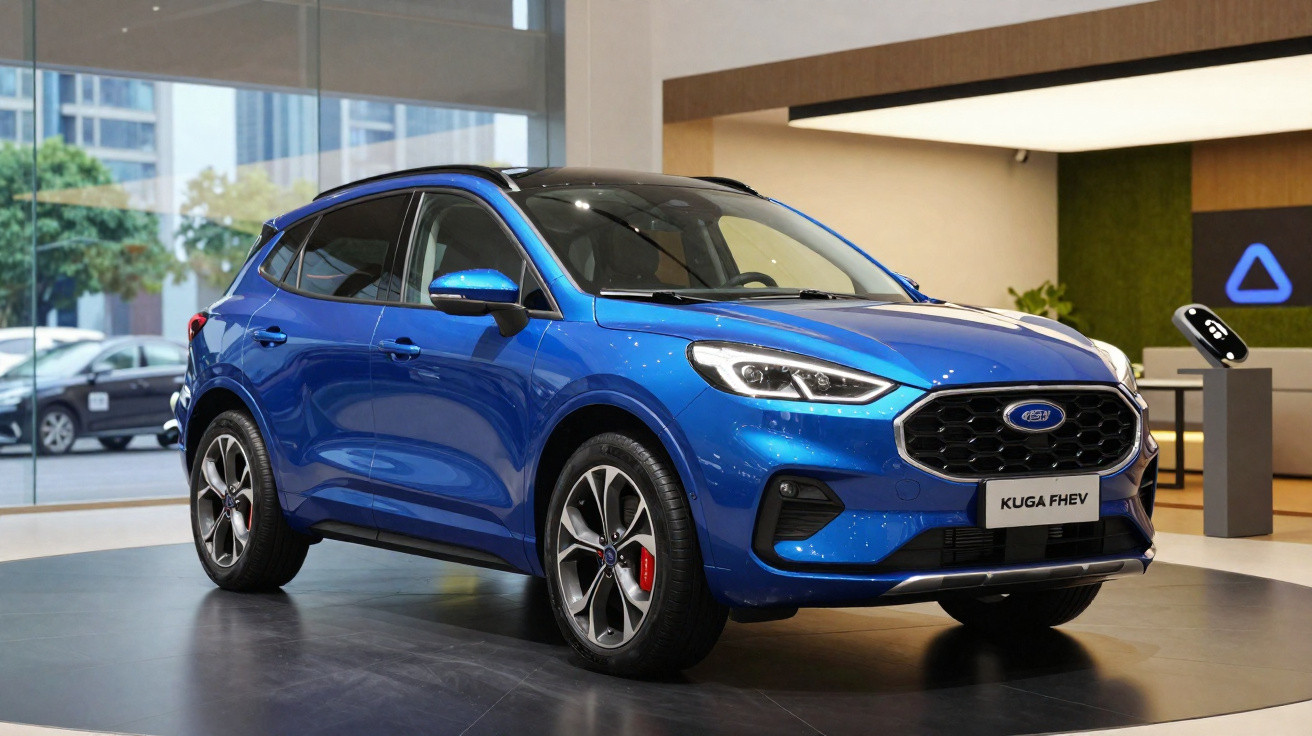
The new Ford Kuga, which arrived here around a year ago, could hardly be more different from the model it replaces. It adopts a sharper, more dynamic look that leans closer to the coveted crossover style, and it goes all-in on electrification, “offered” in three distinct “flavours”: 48 V mild-hybrid, Plug-in Hybrid (PHEV) and Hybrid (FHEV).
It was specifically this last option - Hybrid (FHEV) - that I drove. It carries the claim of being the most electrified Ford ever, and marks another step towards an all-electric passenger-car line-up in Europe from 2030.
In a segment long dominated by Toyota - with the RAV4 and the C-HR - and now featuring a major new contender in the Hyundai Tucson Hybrid, does the Ford Kuga FHEV have what it takes to succeed? Is it a choice worth considering? That’s exactly what I’ll cover in the next few paragraphs…
From the outside, if it weren’t for the Hybrid badge and the lack of a charging flap, it would be hard to tell this version apart from the others. The car I tested was in ST-Line X trim (with only Vignale above it), which gives it a slightly sportier presence.
That effect comes from the body-coloured ST-Line bumpers, 18-inch alloy wheels, tinted windows, a rear spoiler and, of course, the various black accents - notably the front grille and the roof rails.
Inside, there are plenty of similarities with the Focus, with which it shares Ford’s C2 platform. In this ST-Line X specification, the Alcantara trim with contrasting stitching adds a more sporting edge to the cabin.
Space isn’t an issue
Switching to the C2 platform allowed the Kuga to shed roughly 90 kg and increase torsional rigidity by 10% compared with the previous generation. This is despite the body growing by 89 mm in length and 44 mm in width, while the wheelbase stretched by 20 mm.
Unsurprisingly, the overall increase in size has paid dividends for cabin room - especially in the rear, where there is now 20 mm more shoulder room and 36 mm more hip room.
On top of that, even though this generation sits 20 mm lower than before, Ford still managed to “find” an extra 13 mm of headroom up front and 35 mm for passengers in the back.
It’s FHEV, not PHEV…
This Ford Kuga pairs a 2.5-litre, naturally aspirated four-cylinder petrol engine producing 152 PS with an electric motor/generator rated at 125 PS. However, because there’s no externally rechargeable battery, it isn’t a plug-in hybrid, or PHEV (Plug-in Hybrid Electric Vehicle). Instead, it’s an FHEV (Full Hybrid Electric Vehicle).
In this FHEV set-up, the battery is topped up via energy recuperation during braking and deceleration, and also by the petrol engine, which can operate as a generator.
Power from both units is sent to the wheels through a continuously variable transmission (CVT), and its behaviour surprised me in a good way - but I’ll come back to that.
With the Kuga FHEV’s hybrid system explained (and the key differences to PHEV systems made clear), it’s worth saying that this could well be the best answer for anyone who wants a hybrid but has no practical way to charge one (from a socket or charger).
Fill up and go…
One of the biggest upsides of this kind of hybrid is that you simply “fill up and go”. The system itself decides how to blend the two power sources, aiming to exploit the strengths of each.
In town, the electric motor will naturally be called upon more often, as that’s where it’s at its most efficient. On the motorway and under hard acceleration, the petrol engine will take on most of the workload.
Pulling away is always done in electric mode, and the overall experience is consistently smooth - something not every hybrid can claim. That said, driver control over which motor is doing what is limited and mostly comes down to selecting a drive mode (Normal, Eco, Sport and Snow/Sand).
You can feel the handover between petrol and electric, but it’s handled very neatly. A highlight is the “L” button in the centre of the rotary transmission selector, which lets you increase/decrease regeneration strength. Even so, it never becomes strong enough to allow true one-pedal driving.
As for the brakes, as with many hybrids they have a long pedal travel that you can almost split into two phases: the first part seems to rely mainly on regenerative (electric) braking, while the second phase brings in the hydraulic brakes.
Unlike the CVT - which stands out for being decisive and refined - this electric/hydraulic transition makes brake-pedal modulation harder to judge at first, so it takes some getting used to.
What about fuel consumption?
Where this version may make the most sense is fuel economy - and therefore running costs. In the city, without making a special effort, I was able to drive fairly easily at under 6 l/100 km.
On the motorway, where I expected the system to be a bit more “thirsty”, I still managed to hover around 6.5 l/100 km.
All told, when I handed the Kuga FHEV back at Ford’s premises, the instrument display showed that 29% of the distance I’d covered had been completed using only electric power or coasting. That’s an impressive figure for an SUV weighing 1701 kg.
How does it behave on the road?
It’s always debatable whether we should demand sharp dynamics from an SUV - after all, that’s not what it was designed for (even if sporty and… powerful versions are increasingly common). But since this is a Ford and it offers a combined 190 PS, I also wanted to see what the Kuga could do when driven at a quicker pace.
And, in truth, it delivered a pleasant surprise. It isn’t as playful or as agile as the Focus (nor could it be…), but it remains composed, feels very natural through corners and - the part that impressed me most - it communicates extremely well. It’s worth remembering the ST-Line X comes with sports suspension as standard.
In other words, the steering relays what’s happening at the front axle clearly, which isn’t always the case in SUVs of this size - many offer steering that feels almost anonymous.
Even with those positive signals, the high mass and weight transfer are obvious, particularly under heavier braking. And the ESC also steps in decisively and, more often than not, a little too early.
Is it the right car for you?
The Ford Kuga FHEV was a very welcome surprise, I have to admit. It’s not trying anything revolutionary or unheard of; we’ve all driven and tested similar hybrid systems in brands such as Toyota, and more recently Hyundai or Renault - Honda’s hybrid system works differently, but delivers comparable outcomes.
Even so, Ford’s execution is very well judged, resulting in a product that, in my view, offers real value.
For buyers who want to embrace electrification but don’t have somewhere to charge at home or work - or who don’t have the time (or desire…) to depend on the public charging network - the Kuga FHEV’s biggest strength is its low fuel consumption.
Add to that the generous space on offer, the extensive equipment list (especially in ST-Line X trim), and the driving feel, which is genuinely positive.
Comments
No comments yet. Be the first to comment!
Leave a Comment