
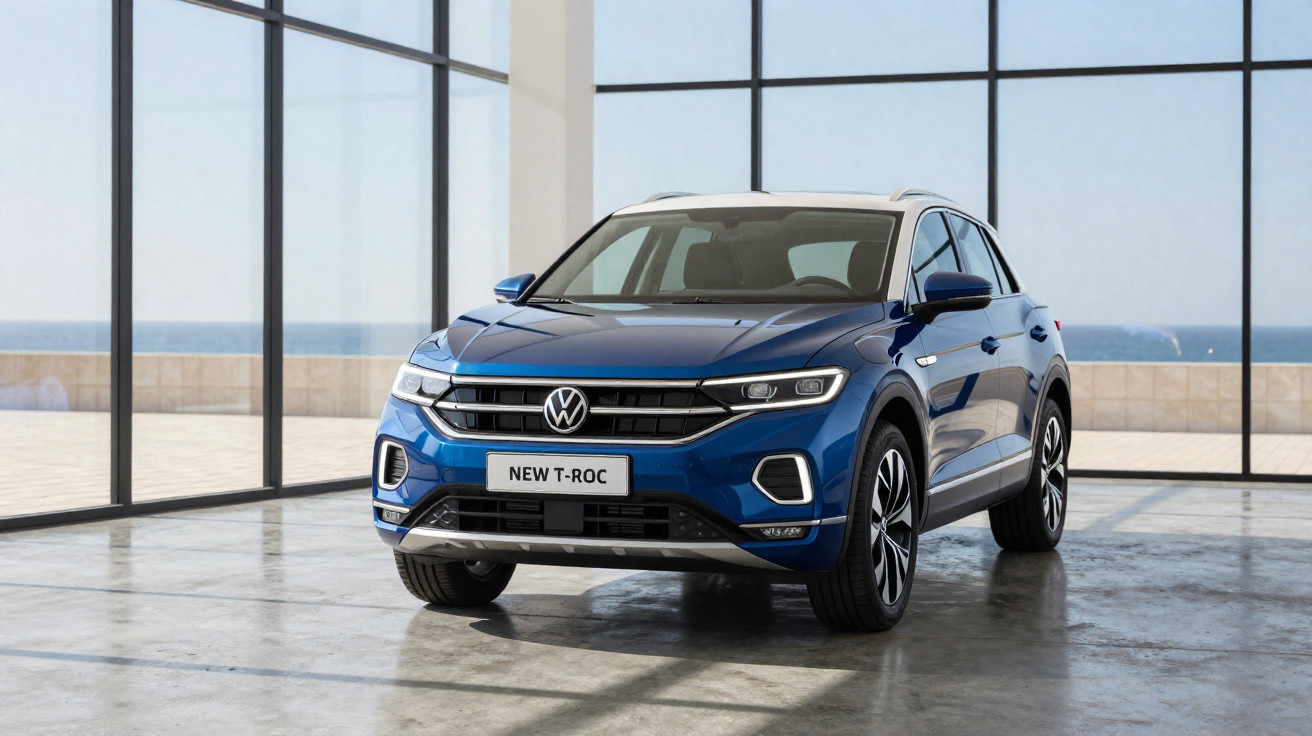
The 2026 Volkswagen T-Roc comes across like an SUV from the class above. We explain everything in the lines below.
This was our first drive of the new Volkswagen T-Roc, and it would have been hard to pick a more fitting backdrop. We started where it all begins: outside Autoeuropa in Palmela, the factory that sends hundreds of thousands of units out into the world every year.
From there, we moved on to the conditions the T-Roc will actually face day to day: the twisting roads of the Arrábida hills, the crossing over the Tagus, the run through Lisbon, and then into the deep green of Sintra. It was the perfect route to gauge just how far this “made in Portugal” model has progressed.
Only the weather failed to cooperate - you can thank Storm Cláudia… - bringing constant rain, gusty winds and slippery tarmac. Yet it was exactly in these less-than-ideal circumstances that the T-Roc showed what surprised us most: the instant impression that you’re driving something from a higher segment.
We break it all down in the video, which starts right where everything starts: on the production lines at the Palmela plant. You can see all the details there.
As you’ll have seen, I explain everything about the new Volkswagen T-Roc in that video. But I want to make one point absolutely clear in this article: the fact that this model is built in Portugal doesn’t earn it any special treatment. It wouldn’t be right.
I don’t tend to indulge in parochialism or empty patriotism. We judge every model for what it is, not by the postcode of its “birthplace”.
Just remember that the T-Roc is Volkswagen’s best-selling model in Europe - it has passed two million units since 2017. That’s not because it’s Portuguese, but certainly because it has been built well by Portuguese hands.
A huge step forward inside
The moment you open the door, it’s obvious the Volkswagen T-Roc has improved. There’s a clear jump in perceived quality. The dashboard is now covered in padded fabric, with ambient lighting shining through perforated trim pieces, removing the harsher feel of the previous generation.
The centre console has been completely rethought thanks to the new DSG selector on the steering column - the same solution we’ve already seen in the Golf and several of the brand’s electric models. The payoff is straightforward: more space, more storage, and less visual clutter.
Ergonomics have improved too, because almost everything sits where you’d expect. The wireless charging pad has active cooling, meaning it’s finally genuinely useful in the Portuguese summer. The MIB4 infotainment system is another clear leap: a 10.4” or 12.9” screen, a faster interface, fixed shortcuts, and an IDA voice assistant that integrates ChatGPT.
Volkswagen has reduced the number of buttons, but it hasn’t gone down the extreme minimalist route: there’s a physical multi-function controller on the console that lets you switch between volume, driving modes and temperature. It’s the balance the brand should have adopted earlier in other models.
In the featured video, you can better appreciate the extra space this new T-Roc generation brings. Compared with the outgoing model, the T-Roc is 12 cm longer and has an extra 3 cm in wheelbase.
It may not sound like much, but it makes a real difference. Anyone with children knows every centimetre matters…
The new T-Roc is playing in a different league
As you can probably tell, I know the current T-Roc generation - now heading into retirement - very well (we have one in the Razão Automóvel fleet). Next to the new generation, the age is starting to show.
The suspension tuning is more polished, cabin sound insulation has moved up a level, and the damping is more progressive. It drives as if it has climbed half a segment: more solid, more settled, and more comfortable. That’s no coincidence, because this T-Roc uses the same MQB-evo platform as the Tiguan and Passat.
Part of that added smoothness on the road also comes from a decision that fundamentally changes the T-Roc’s character. The 1.0 TSI three-cylinder has been dropped, and the T-Roc now comes only with four-cylinder engines.
You can feel the difference, particularly with the 1.5 eTSI, offered with 116 cv and 150 cv, which I had the chance to drive. Don’t get me wrong - the 1.0 TSI was very good - but this eTSI is better.
The car I drove, the 1.5 eTSI with 150 cv, makes that progress clear. It’s a familiar engine, but it feels different here: smoother, stronger at low revs, and working in a more seamless way with the DSG7 gearbox.
The 48 V mild-hybrid electric assistance helps with the first throttle response and gentle in-gear acceleration, taking away the “nervousness” that’s typical of small turbo engines when paired with automatic transmissions.
The poor weather and the shorter drive meant we couldn’t produce reliable fuel consumption averages. That said, knowing this powertrain from other Volkswagen models, it’s reasonable to expect between 5,5 l/100 km and 7,0 l/100 km, depending on the route and driving pace.
On driver assistance, the T-Roc has raised the bar as well: Front Assist, Lane Assist, cruise control and emergency braking are standard. Optionally, there’s Travel Assist with assisted lane changes, 360º camera view, and even parking manoeuvre memorisation - technology that used to be limited to the Group’s higher-end ranges.
Competitive pricing despite taxation
At first, there were concerns that replacing the 1.0 TSI with the 1.5 TSI would push the new T-Roc’s prices up significantly (because our ISV penalises engine capacity). On top of that, the T-Roc is now only available with an automatic gearbox.
In reality, the increase was smaller than expected: just 1249 euros more than the previous generation at the same equipment level. That figure was only achieved thanks to coordinated work between Autoeuropa and Volkswagen’s importer in Portugal - we explain how in this article.
The new Volkswagen T-Roc range is split across four trim levels: Trend, Life, Style and R-Line.
The Trend version includes:
- 16″ alloy wheels
- 10.4″ infotainment system
- Automatic air conditioning
- LED headlights
- Front and rear parking sensors
- Lane and blind-spot assistants
- Junction assist
- App Connect Wireless
- Leather multi-function steering wheel
The Life version adds:
- 17″ alloy wheels
- 12.9″ infotainment system
- Tinted rear windows
- Adaptive cruise control
- Rear-view camera
- Ambient lighting
- Cruise control
The Life and R-Line versions add:
- Three-zone air conditioning
- LED headlights with an illuminated logo at the front and rear
- Digital Cockpit Pro
- Heated front seats with massage function
- Heated steering wheel
- Ambient lighting with 30 colours
The R-Line also comes with 19″ alloy wheels.
Finally, it’s worth noting that every version will come with the DSG7 automatic gearbox as standard. In the near future, full-hybrid versions will join the line-up, without needing to be plugged in (also based on the 1.5 TSI unit), along with the most powerful and sporty T-Roc R, offering 333 cv from the 2.0 e-TSI (EA888) engine.
Comments
No comments yet. Be the first to comment!
Leave a Comment