
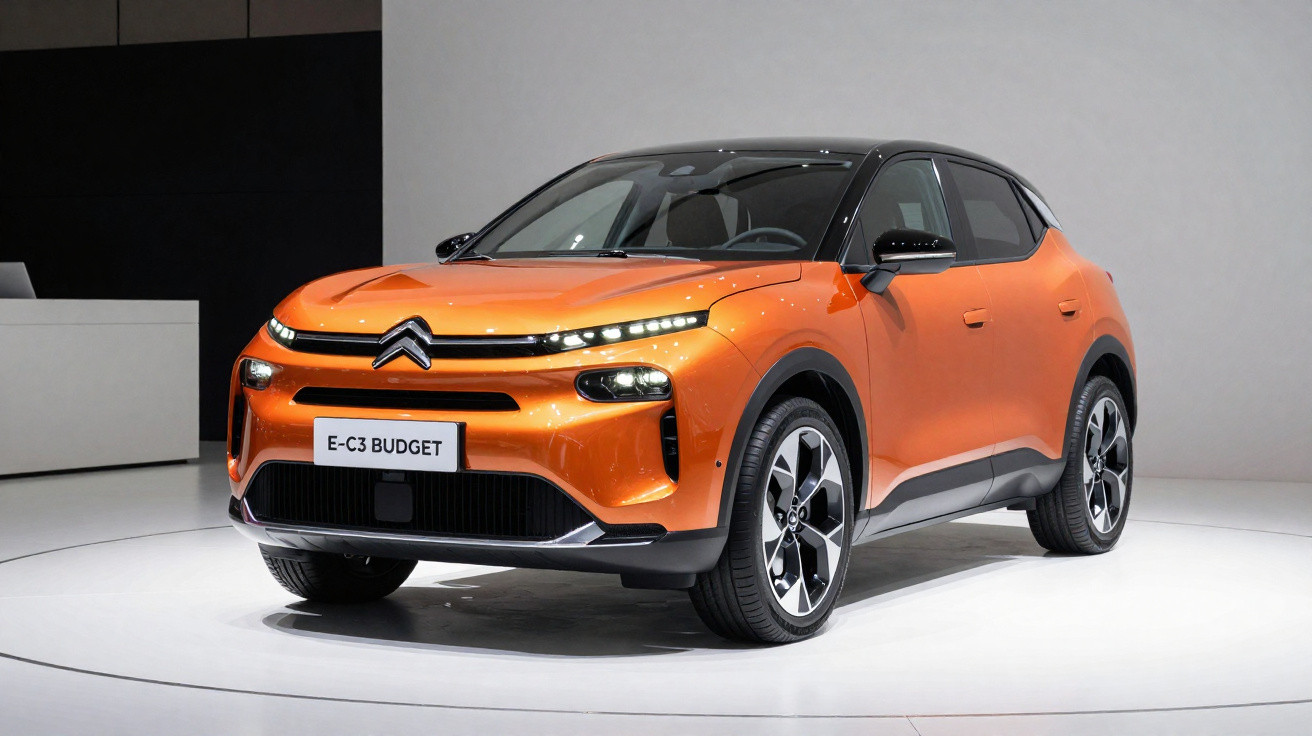
The electric Citroën ë-C3’s price is a real ace - but what do you actually get for it?
With more than 5.5 million sold since the first generation launched in 2002, the C3 supermini remains the French brand’s biggest seller - so its importance is hard to overstate.
Citroën is now rolling out a completely new fourth-generation model with strengthened credentials, and it stands out above all for the arrival of a fully electric version at a benchmark price: from 23 300 euros. That makes it the cheapest electric supermini (B-segment) on the market, and it is set to become even more attainable in 2025 - under 20 000 euros - when a smaller-battery variant joins the line-up.
As a result, expectations are high for the new Citroën ë-C3, which could play a decisive role in speeding up the mass adoption of electric cars across the European market.
Although it goes on sale in September, the European Car of the Year jury (which I’m part of) has already had the chance to drive the new Citroën C3. The route ran on roads between Vienna (Austria) and Bratislava (Slovakia), making this the first test published in Portuguese.
The recipe for a “knockout” price
To deliver the cost–benefit balance that defines it, the new Citroën ë-C3 (and the C3) is built on a new global architecture: the Smart Car Platform. It’s derived from the well-known e-CMP (Peugeot 208, Vauxhall Corsa, etc.), developed for compact models, and it is expected to underpin many more Stellantis vehicles - not only in Europe, but also in India and South America.
Its squarer styling moves it away from traditional supermini shapes and closer to the crossover look - it’s 9.3 cm taller than its predecessor, for example. Yet from the very first glance, the new ë-C3 raises a smile thanks to that blend of simplicity and a toughened-up stance, which comes through inside and out.
Another key factor behind Citroën becoming the first European brand to bring a B-segment EV in below 25 000 euros is the heavy use of existing, off-the-shelf group components - something that will have set off plenty of alarms at Volkswagen. In addition, many parts cost less because higher-performance versions were never part of the plan.
A further ingredient in the ë-C3’s headline price is its 44 kWh battery using LFP (lithium iron phosphate) chemistry, which is cheaper than the more common NMC (Nickel, Manganese and Cobalt) chemistry that dominates today’s lithium-ion packs.
Laurence Hansen, Citroën’s Director of Product and Strategy, told me that “LFP chemistry costs 30% less and has 15-20% lower energy density than NMC, but by accounting for that from the start of the project, it was simply a case of adding more cells to reach the target range and still keep the cost advantage - plus it uses fewer non-sustainable raw materials”.
The battery takes up part of the ë-C3’s floor, running from the driver’s seat to the second-row seats in a plank-like layout - in other words, it does not span the full width of the car’s floor. The 44 kWh capacity delivers an official 320 km range (WLTP combined). For 2025, a smaller pack of around 30 kWh is planned, with an expected 200 km range.
Up front sits an electric motor driving the front axle, producing 83 kW (113 hp) and 125 Nm. That makes it one of the least powerful EVs on the market, yet it still delivers acceptable performance for the role it is meant to play: an urban car.
A few limitations in the rear
I chose to climb into the second row of the new Citroën ë-C3 first. The rear doors could really do with opening a little wider, because it feels like only children will be able to get in and out without some squeezing.
Once seated, the back row is best suited to two passengers (a third in the middle will be very cramped). Two adults up to 1.85 m tall should be fine for space - especially headroom, and also legroom.
Even so, the floor sits a touch higher than ideal for lower-leg comfort, forcing knees into more bend than you’d want. Slightly taller rear seats would help, and would also improve the outward view for those sitting in the back (particularly children). Direct rear air vents are absent, as is typical in this class.
The rear seatbacks split-fold in two unequal sections, but they create a pronounced step relative to the boot floor. Boot capacity is only 310 litres (smaller in this segment are only the Toyota Yaris and Suzuki Swift), though the rectangular shape makes it easy to use. There’s space under the floor for charging cables, but there is also a high step between the loading lip and the load floor, which can make lifting heavier items in and out more awkward.
Sensible choices
In the driver’s seat, you’ll find the familiar gear selector used across most Stellantis brands, along with a straightforward cabin built from hard-touch plastics (on both the dashboard and door panels). That said, the overall solidity feels reassuring.
The piano-black style trim in the centre of the dashboard and the centre console looks effective and lifts the perceived quality. There’s also a pale grey textile insert made from recycled materials; it doesn’t excite, but it does stop the dashboard from looking too monochrome.
The glovebox lid drops down abruptly rather than lowering smoothly (normal for this class), a screw head is visible on the doors, and the whole interior seems to prioritise function and practicality over flourish.
That same thinking explains the very small steering wheel (though not quite as tiny as Peugeot’s), designed so the instruments are visible without obstruction - and it works. The display sits up against the windscreen and is called a head-up display, even if it isn’t one in the technical sense (nothing is projected onto the glass).
In the centre, the 10.25” infotainment touchscreen (Max version only) offers sharp graphics and good processing speed despite being simple: it can’t be split into sections and it doesn’t allow customisation. It is angled slightly towards the driver to make it easier to read.
How does it behave on the road?
Time to drive. The first dynamic takeaway from the new Citroën ë-C3 is just how comfortable it feels, thanks to the suspension’s twin hydraulic bump stops for each spring/damper unit. These manage compression and rebound independently, keeping vertical body movement in check without letting body roll get out of hand.
This is a system used on other Citroën models, but it deserves praise for being fitted to a lower-priced car - and for being standard on every version. The result is that whether on poor surfaces (potholes or bumps) or through sequences of bends and roundabouts, the C3 never leans excessively despite its tall stance. The fact that the electric version is 300 kg heavier than the petrol models also helps, as do the thicker anti-roll bars.
In terms of handling, the modest output of 113 hp/125 Nm actually brings an upside: you don’t run into the easy traction losses that often appear in EVs with high torque delivered instantly to the front wheels. As a result, the tendency to understeer or spin the tyres is almost non-existent as long as grip levels are good.
Equally, those modest figures don’t make the Citroën ë-C3 feel sluggish. In its natural habitat - the city - it certainly doesn’t. It feels lively and responsive up to 80 km/h, and it will keep going to 135 km/h - the ideal car for avoiding motorway speeding fines…
I’m still giving the steering a thumbs-up: it’s weighted appropriately for a city car, even with a relatively slow ratio (three turns lock-to-lock), which can demand more arm work than I’d like in a few tighter corners.
Even better is the braking. It feels progressive and responds from the very start of the pedal travel - something many EVs struggle with, including some far more expensive ones, because they fail to blend initial regenerative braking smoothly with the hydraulic system.
No driving modes
In the name of simplicity, there are no driving modes (which are becoming less relevant in the era of e-mobility). However, the driver can press a “C” button below the gearbox’s “D” position.
Citroën says that in “C” only the regeneration intensity is reduced (from 1.2 m/s2 to 0.8 m/s2), but I noticed that switching from “C” to “D” makes the ë-C3 accelerate slightly. When I pressed Thierry Blanchard, product manager for the new Citroën C3, on this point, he said that the other “symptom” could be specific to the calibration of the pre-series cars I drove.
Either way, it would make more sense for the ë-C3 to have no drag/regeneration at all in normal mode (“D”) - engineers consistently argue that free-rolling is the most efficient way for an EV to coast. Then you’d have a dedicated button to activate energy recovery - and, while we’re at it, labelled “B” (for Brake) rather than “C” (for Comfort).
It seems efficient
On this short drive of a little over 60 km, I recorded an average of 13.9 kWh/100 km - well below Citroën’s official figure (17.4 kWh/100 km), helped by predominantly urban sections and secondary roads.
That’s encouraging, and it strongly suggests the claimed 320 km from a full charge should be easy to achieve.
The maximum DC charging power of 100 kW suits both the car and its 44 kWh battery, allowing a 20% to 80% charge in 26 minutes under the right conditions. On AC at 11 kW - optional - it takes 2h50min, while at 7.4 kW it needs more than four hours.
Under 25,000 euros - but not the version I drove
The Citroën ë-C3 I drove was the top-spec Max, priced at 27 800 euros. The sub-25,000-euro electric C3 is the entry-level You (the only two trims available), which starts at 23 300 euros.
The You version does without the Max’s 10” central screen, but it comes standard with a Smartphone Station infotainment solution with an integrated mount. It launches a dedicated new app via wireless technology, giving access to navigation, radio, phone and music.
With the Max, you gain 17” wheels, roof rails, LED rear lights, dark-tinted rear windows, wireless charging, a reversing camera, among other items.
Also planned for 2025 is the smaller-battery model of around 30 kWh with a 200 km range, at a stated price below the psychological 20 000 euros threshold.
Alongside these electric versions, the new C3 also comes with a “pure” combustion option - a three-cylinder 1.2 l with 101 hp - which is cheaper still, with prices starting at 14 990 euros. But the powertrain news doesn’t end there. Find out more:
Comments
No comments yet. Be the first to comment!
Leave a Comment