
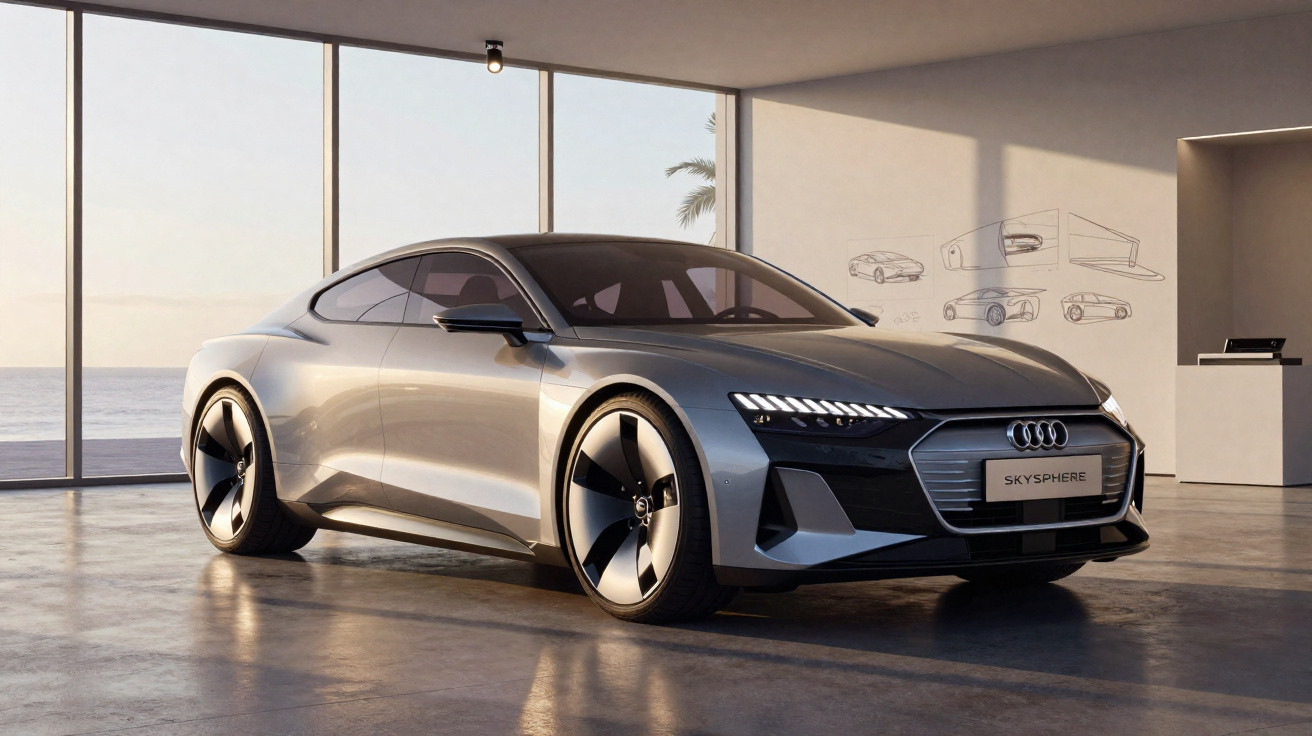
At Audi, the first sketch of a more-than-perfect future-one in which the car evolves from simple transport into a machine for special moments, an interactive companion and, later on, an autonomous partner-is the skysphere concept.
The central ambition is to give occupants genuine quality time while they are on board: not merely to take them from A to B, but to do so in two clearly different ways-either as a GT (Grand Touring) or as a sports car.
Two personalities of the Audi skysphere: GT and roadster
The key to this shape-shifting character is a variable wheelbase enabled by electric motors and a sophisticated mechanism. With it, body and structural components slide to alter the wheelbase-and the vehicle’s overall length-by 25 cm (effectively shrinking from the length of an Audi A8 to roughly that of an A6). At the same time, the ride height is adjusted by 1 cm to prioritise either comfort or sharper driving dynamics.
On days when you want maximum thrills, a press of a button turns the Audi skysphere into a fully electric sports roadster measuring 4.94 m in length.
Alternatively, you can choose to be calmly carried along by an autonomous chauffeur in a 5.19 m-long GT, looking up at the sky, enjoying extra legroom and using a range of services seamlessly integrated into its digital ecosystem. In this mode, the steering wheel and pedals retract, and the car becomes something akin to a sofa on wheels-encouraging occupants to share their journey with friends and family via social media.
The Audi skysphere can even collect a passenger who wants to experience something this special, as it can determine that person’s exact location and also park and charge its batteries autonomously.
A living, breathing look
Its long bonnet, short front overhang and pronounced wheel arches give the skysphere an almost living presence. At the rear, it blends speedster and shooting brake cues and can accommodate two small, stylish travel bags designed specifically for this model.
Up front, it keeps the familiar outline of today’s Audi single frame grille, even though cooling duties are replaced by lighting sequences (thanks to LED elements-also used in large numbers at the rear) and other functional features.
Level 4 autonomy and the digital cabin
Like the future Audi concepts in this sphere series-set to be called grandsphere and urbansphere-the interior (the sphere) has been designed to fully exploit Level 4 autonomous driving technology (in specific traffic situations, the driver can completely hand over responsibility for movement to the vehicle itself, without needing to intervene).
The most obvious change is the driver’s area, now effectively turned into a passenger space. With more room available, the occupant is encouraged to enjoy each moment more, freed from the vehicle’s control tasks.
Much like the production Mercedes-Benz EQS, this experimental Audi also features a dashboard made up entirely of a giant “tablet” (1.41 m wide). It displays all key information, while also being able to show internet content, videos and more.
Playing “at home”
The setting for the global debut of this futuristic concept, on 13 August, is the lush lawns of the exclusive Pebble Beach golf club during Monterey Car Week-an event the pandemic did not manage to cancel, unlike most of the world’s motor shows over the last year and a half (partly because almost all activities take place outdoors).
That means the Audi skysphere is “at home”, since it was designed and engineered at the Audi Design Studio in Malibu, California, a short distance from the legendary Pacific Coast Highway that runs along the edge linking Los Angeles suburbs with northern California.
The team led by studio director Gael Buzyn drew inspiration from the historic Horch 853 Roadster, which embodied the idea of luxury in the 1930s and even won the 2009 Pebble Beach Concours d’Elegance.
Naturally, the influence is primarily in design and proportions (the Horch was also exactly 5.20 m long, but much taller at 1.77 m versus just 1.23 m for the skysphere), because the model from the brand that seeded what we now know as Audi was propelled by an imposing eight-cylinder, five-litre engine.
In the Audi skysphere, by contrast, an electric motor delivering 465 kW (632 hp) and 750 Nm is mounted on the rear axle. It takes advantage of the roadster’s relatively low weight (for an electric car)-around 1800 kg-to deliver exceptional performance, as illustrated by the brief four seconds needed to reach 100 km/h.
Battery modules (with more than 80 kWh) are positioned behind the cabin and between the seats in the central tunnel. This helps lower the car’s centre of gravity and sharpen its handling. Estimated range is expected to peak at around 500 kilometres.
Another decisive technical feature underpinning how adaptable the Audi skysphere feels from the driver’s seat is its “by-wire” steering system-meaning there is no mechanical link to the front and rear wheels (all of which are steerable). This enables multiple steering settings and ratios, making it heavier or lighter, more direct or more geared down, depending on circumstances or the driver’s preference.
In addition to the rear-wheel steering-which substantially reduces the turning circle-it uses a three-chamber air suspension with independent chambers. A notable feature is the ability to deactivate chambers individually for a sportier “contact” with the tarmac (spring response becomes more progressive), reducing body roll and pitch.
The active suspension, working together with the navigation system plus monitoring sensors and cameras, allows the chassis to prepare for bumps or dips in the road before the wheels even reach them-raising or lowering as required.
Comments
No comments yet. Be the first to comment!
Leave a Comment