
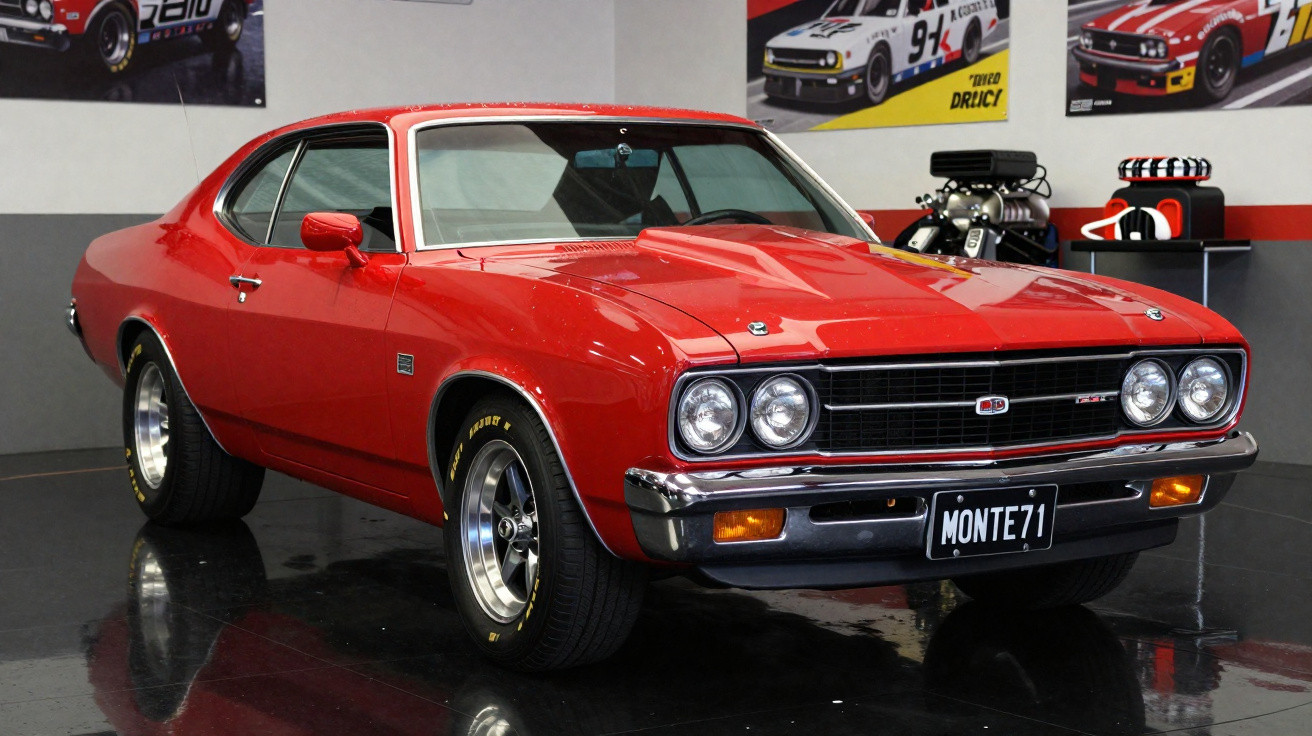
Although the 2006 film The Fast and the Furious: Tokyo Drift (released in Portugal as Velocidade Furiosa – Ligação Tóquio) puts the spotlight on JDM (Japanese Domestic Market) culture, the real star of this piece is a very American 1971 Chevrolet Monte Carlo.
The first race we see is a long way from the Japan in which most of the film is set: it’s a straight fight between two pure American “muscle” machines - a then still-new 2003 Dodge Viper SRT-10 and a classic 1971 Chevrolet Monte Carlo.
Why Tokyo Drift put Sean Boswell in a 1971 Chevrolet Monte Carlo
Even though it never exactly blends into the background on screen, this “Chevy” Monte Carlo hides a serious secret beneath that huge bonnet: a V8 with a massive 9.4 l of displacement. That detail has since been confirmed by Craig Lieberman, the technical adviser on the first three films in the Fast and Furious franchise.
Before getting into the hard numbers on an engine that comfortably clears nine thousand cubic centimetres, it’s worth explaining why the production went with this seemingly modest Monte Carlo rather than a more desirable, more polished Camaro or Dodge Challenger.
It all comes down to the character: Sean Boswell, played by Lucas Black, who owns the car in the film.
As a teenager with limited means but the ability to build and modify his own vehicle, a Monte Carlo - cheaper and more attainable than some of the bigger names in the muscle-car world - simply makes more believable sense, as Lieberman explains in his video.
(Almost) a lorry engine in a “small” car
Despite its worn, unfinished look, the Monte Carlo was a genuine monster, fitted with one of GM’s “big block” engines.
On screen, you can spot the number “632” cast on top of one of the cylinder banks, a nod to displacement in cubic inches (ci). Converting that figure to cubic centimetres gives 10 356 cm³.
According to Lieberman, however, the V8’s real displacement was 572 ci - a more “modest” 9373 cm³ - which rounds to 9.4 l. For context, the best-known “small block” that powers, for example, the Chevrolet Corvette may be called “small”, but it still displaces 6.2 l.
In other words, even acknowledging that the protagonist’s show-off rival is driving a Dodge Viper with a factory 8.3 l V10, the Monte Carlo still exceeds it by more than 1000 cm³ - which, at least in terms of sheer “firepower”, makes it a credible opponent for the far newer Viper.
Power, fuel and the key modifications
Lieberman also says that on regular petrol, this 1971 Monte Carlo could produce a very healthy 790 cv, and on racing fuel the output climbed to 811 cv - compared with the Viper’s just over 500 cv.
Because V8 “big block” engines like this are often bought as purpose-built “crate engine” units for modified cars, it would be surprising if the huge V8 were entirely stock. For instance, the carburettor - yes, it’s still a carburettor - is a Holley 1050, and the exhaust system is a Hooker-specific setup.
There were 11 at the start
As is typical for films like this, multiple Chevrolet Monte Carlo units were built. The former technical adviser reveals that 11 cars were used to shoot this scene - most without the 9.4 V8, with some serving only for specific stunts - and, by all accounts, five examples have “survived”.
One of the “hero cars”, fitted with the “big-block”, is owned by Universal Studios. The other Monte Carlos used for stunt work are scattered around the world, in the hands of collectors and fans of the Fast and Furious series.
Comments
No comments yet. Be the first to comment!
Leave a Comment