
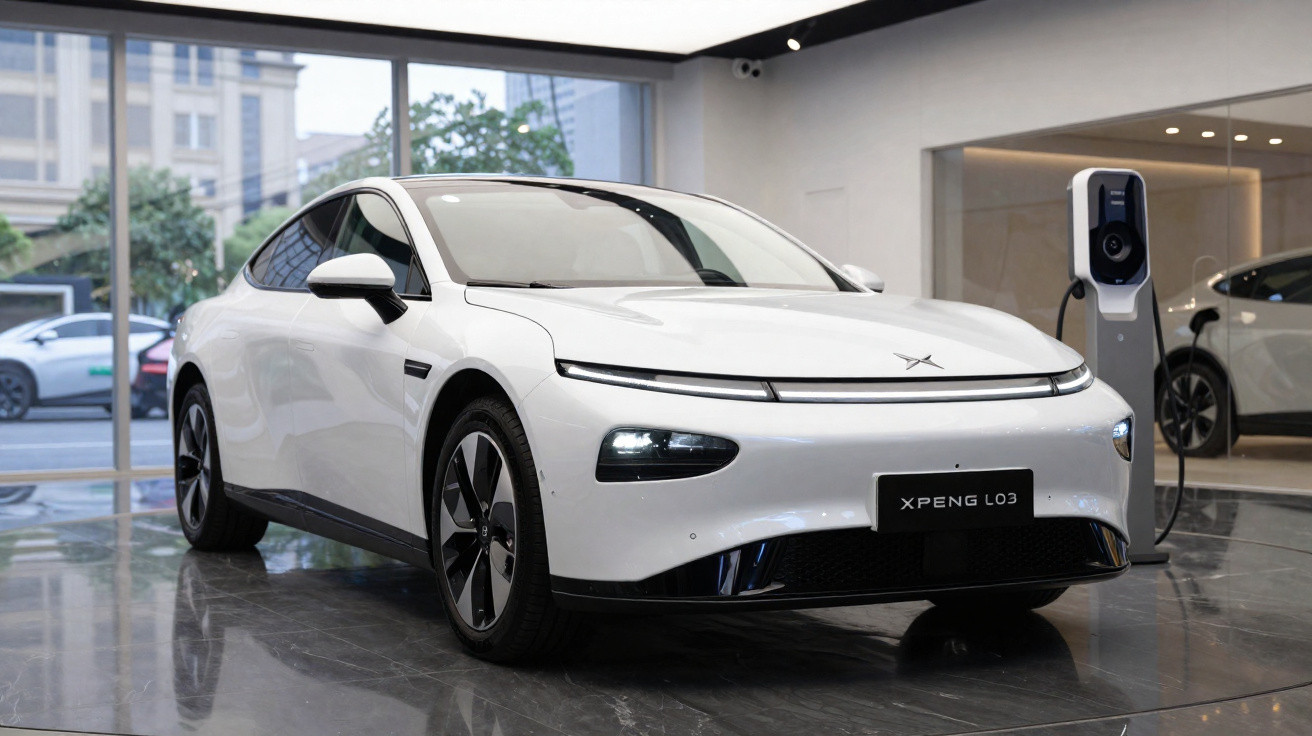
The Xpeng L03 is due to reach Europe before the end of the year, signalling the start of a new chapter for the Chinese brand. For the first time, Xpeng’s European line-up will include a model with EREV (Extended Range Electric Vehicle) technology, rather than being made up solely of 100% battery-electric cars.
That said, this does not mean Xpeng is moving away from pure EVs. The L03 will be offered with two distinct powertrains: one fully electric and another featuring an EREV range extender. In the latter, the petrol engine is not mechanically connected to the wheels; its only job is to generate electricity to charge the battery and extend the driving range.
Unveiled in Munich during the Xpeng Global Brand Event, the L03 also takes on the role of being the most affordable model the brand sells in Europe. Here is what we thought of it:
The new entry point
In Europe, the Xpeng L03 is set to become the company’s lowest-priced model, sitting beneath the G6 in the range. Measuring 4.65 metres long (11 cm shorter than the G6), it lines up as a rival to cars such as the Volkswagen ID.4, Skoda Elroq and BYD Atto 3.
Even so, it leans into a coupé-inspired profile, featuring frameless doors, semi-flush door handles, and a full-width rear light signature.
Aerodynamics were clearly high on the agenda for the team led by JuanMa López, formerly responsible for Ferrari’s exterior design. The result is a drag coefficient (Cd) of just 0.228-an appealing figure for a vehicle of this “size”.
Google Maps built in
Inside, the L03 sticks to Xpeng’s minimalist approach, with a 15.6-inch central touchscreen, an 8.8-inch digital instrument display, and a head-up display with a projection equivalent to 26.8 inches.
Depending on the trim, you can also get heated, ventilated and massage-capable front seats-equipment you do not often see at this price level.
One of the standout elements in the cabin is the XOS 6 operating system, which for the first time offers native Google Maps integration. The L03 also introduces Xpeng’s new in-house Turing processor, rated at 750 TOPS.
It is this new chip-fitted as a three-unit set-up on the Xpeng L03 Ultra-that powers the VLA 2.0 driver-assistance system. While the system is capable of delivering Level 4 autonomous driving (able to follow navigation-planned routes without driver input), legal constraints mean it will be limited to Level 2++ at launch.
Two powertrains to choose from
For the EREV option (PowerX), the L03 pairs a 37.25 kWh LFP battery with a 1.5-litre, four-cylinder petrol engine, supplied by a 42-litre fuel tank.
However, the combustion engine effectively acts like a power bank: it does not drive the wheels and runs purely as a generator to supply the battery. Propulsion is always handled by a rear-mounted electric motor producing 180 kW (245 cv).
Xpeng claims 215 km of electric-only range and more than 1000 km of combined range. Once the battery is depleted, the certified fuel consumption is 5.5 l/100 km.
In fully electric form, the L03 will be available with two LFP battery packs-58.3 kWh and 71.2 kWh-delivering up to 440 km and 520 km (WLTP), respectively. Rear-wheel-drive versions produce 180 kW (245 cv), while the AWD Performance variant delivers 285 kW (387 cv) and completes 0 to 100 km/h in 4.5 seconds.
How much will it cost?
The PowerX version of the Xpeng L03 will be the first to arrive in Portugal later this year, while the 100% electric versions are only expected at the start of 2027.
Final pricing for the Portuguese market has not yet been confirmed, but Xpeng is indicating a figure well below 40,000 euros for the pure electric L03, with the PowerX version likely to start slightly above that threshold.
The Xpeng L03 is already available for pre-order in some European markets. In Germany, for instance, the EREV version starts at 38 600 euros, while the 100% electric variant begins at 35 600 euros.


Comments
No comments yet. Be the first to comment!
Leave a Comment