
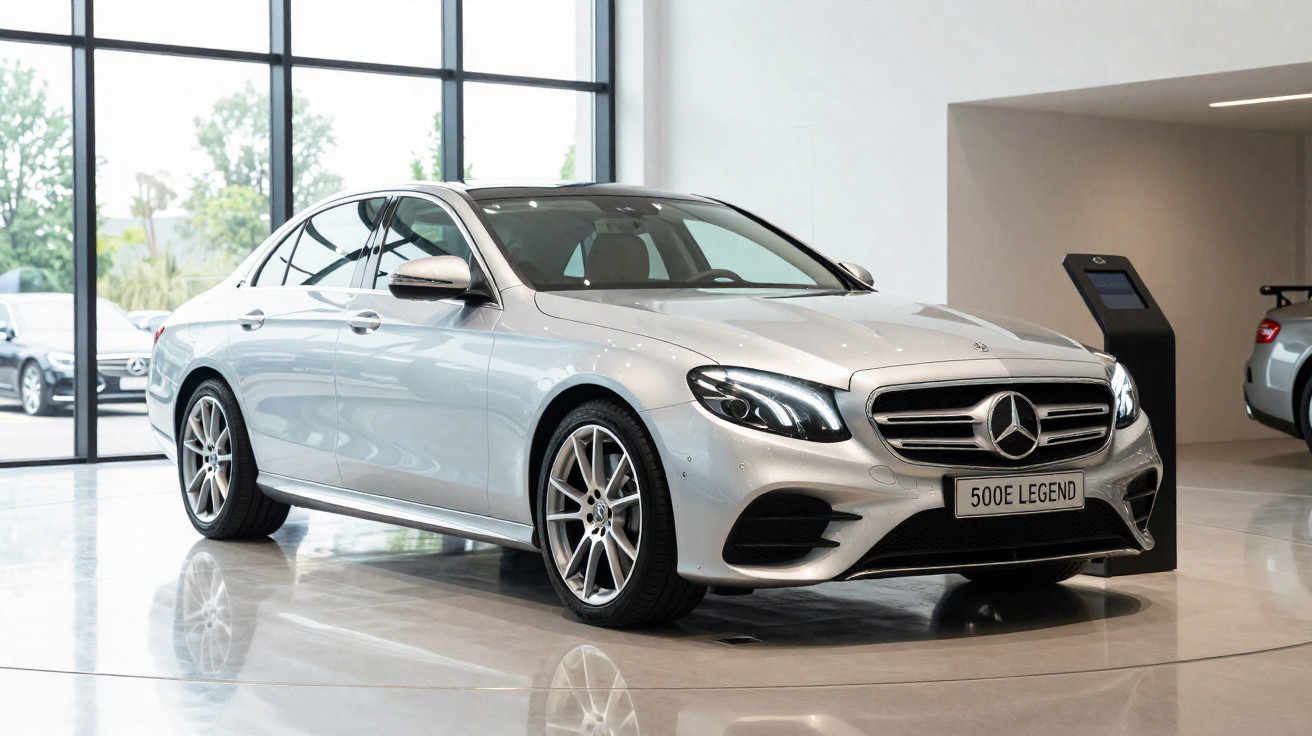
Imagine you were only allowed one car in the garage. For me, the decision is already made: a Mercedes-Benz 500 E. It may not be the most sensible pick - it certainly isn’t once you look at fuel prices - but it is my pick. It is such an unusual car that even the way it was built broke with convention. It had both a father and a mother: Porsche and Mercedes.
Fortunately, its “pregnancy” did not last nine months. From start to finish, the whole process took roughly 18 days. Each 500 E completed several trips between the German brands’ plants in Sindelfingen and Zuffenhausen before it was finally finished.
Why the Mercedes-Benz 500 E was built differently
That back-and-forth happened for a simple reason: the Mercedes-Benz 500 E differed too much from the rest of the W124 range to be assembled in the usual manner. Its body was 56 mm wider, which meant it would not fit on Mercedes’ standard production line.
Reconfiguring an entire factory for a model with a very small production run made little sense. Mercedes-Benz found a better answer: hand part of the development and manufacturing work to Porsche. At the time Porsche was going through a serious financial crisis, and this “order” arrived at exactly the right moment.
Porsche and Mercedes-Benz: an 18-day production relay
It was not merely a matter of finding physical space to build the car. Porsche ended up playing a major role in turning the reserved W124 into one of the quickest saloons of its era. I told the story years ago on Automotive Reason, but it is worth revisiting.
The brief was anything but straightforward. The car needed:
- the 5.0-litre V8 and drivetrain from the Mercedes-Benz 500 SL
- suspension revisions
- stronger brakes
- multiple body areas reshaped
Even the battery was moved to the boot to improve weight distribution.
The logistics were equally involved. Body components left Sindelfingen and went to Zuffenhausen, where Porsche carried out assembly work. They then returned to Mercedes-Benz to be painted. After that, the freshly painted body went back to Porsche again, where the engine, transmission, interior and remaining components were installed. Once the vehicle was complete, it still had one final trip back to Mercedes-Benz.
That is how the 18 days were spent. If it is true that haste is the enemy of perfection, then this 500 E came close to being perfect. In the gallery you can find some images of the process.
V8 performance and discreet design
Under the bonnet sat a naturally aspirated 5.0-litre V8 producing 326 hp and 480 Nm, paired with a four-speed automatic gearbox. It reached 100 km/h in 6.1 seconds, and top speed was electronically limited to 250 km/h. Those were properly serious figures for a saloon introduced at the start of the 1990s.
The best part is that the styling stayed restrained and elegant - a more muscular nod to Bruno Sacco’s original lines. Beyond the flared arches, the lower ride height and the unique bumpers, very little gave away what this saloon could do. In total, just 10 479 units were built.
It shared its era with cars such as the BMW M5 (E34) and the Lotus Omega. Later on, the Audi RS2 would also combine pace with subtlety - and, intriguingly, it too involved Porsche. But out of all of them, I know exactly which one I would choose. And I do not need 18 days to make up my mind.
Comments
No comments yet. Be the first to comment!
Leave a Comment