
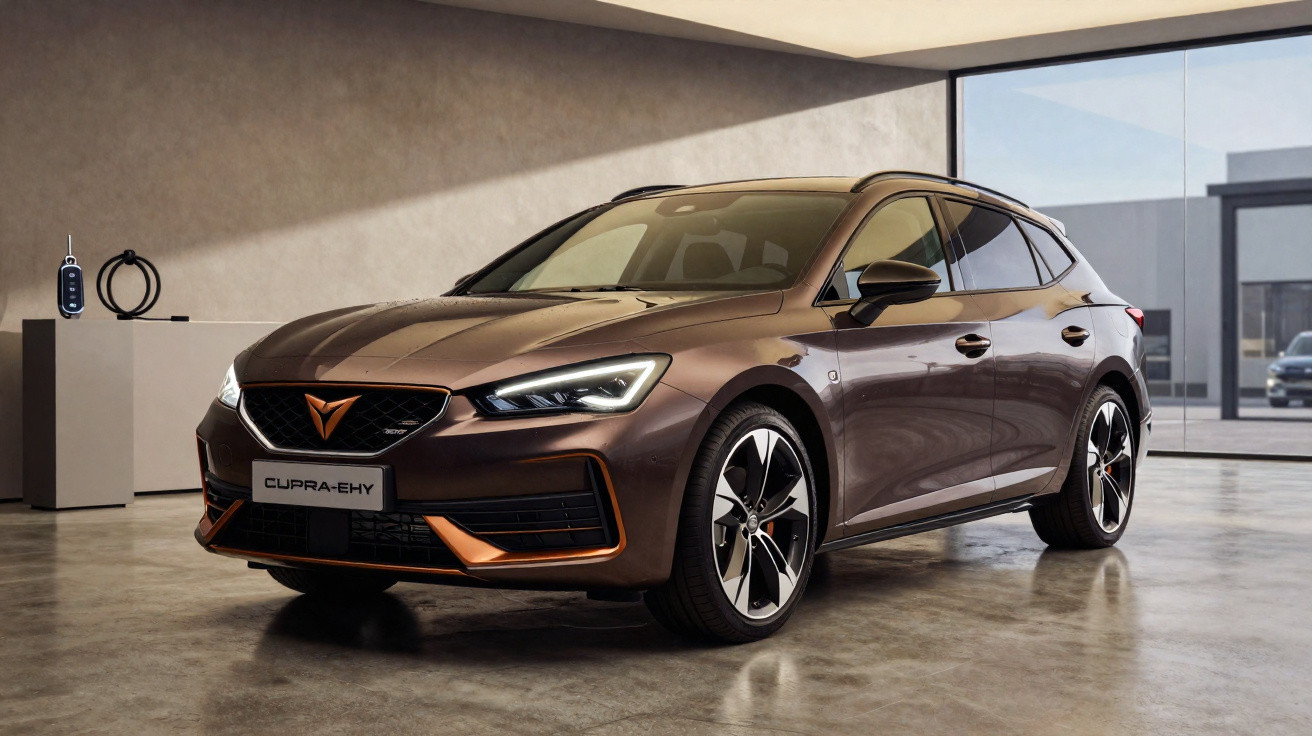
CUPRA’s standard-bearer may well be the Formentor - the first model designed from the ground up for the young Spanish brand - but there are plenty of other highlights across the CUPRA range. One of the most noteworthy is the CUPRA Leon (formerly the SEAT Leon CUPRA), which has recently embraced electrification through the e-HYBRID versions.
CUPRA and Leon are two names that have been closely linked for many years, and they have consistently been part of successful stories. They also have a sporty DNA to uphold, rooted in the first CUPRA-badged Leon versions from the early 2000s.
But after all these years - now operating under an independent brand - and with electrification on the scene, are the CUPRA Leon’s sporting credentials still intact? We drove the CUPRA Leon Sportstourer e-HYBRID and we have no doubts about the answer…
Rather than following the “usual rule” of starting with the exterior and then moving inside, I’ll begin with the hybrid powertrain in this CUPRA Leon, which is the same setup we find in the SEAT Tarraco e-HYBRID that I tested recently.
CUPRA Leon Sportstourer e-HYBRID powertrain and electric range
This system combines a 1.4-litre, four-cylinder TSI petrol engine producing 150 hp with an electric motor that “delivers” 116 hp (85 kW) - with both units mounted at the front.
The electrical side is supplied by a 13 kWh lithium-ion battery pack, enabling the CUPRA Leon Sportstourer e-HYBRID to claim a 100% electric combined range (WLTP cycle) of 52 km.
Working together, the two motors provide a maximum output of 245 hp and 400 Nm of peak torque (50 Nm more than the SEAT Tarraco e-HYBRID).
Thanks to these figures, the CUPRA Leon Sportstourer e-HYBRID needs just 7s to complete the 0 to 100 km/h sprint and reaches a 225 km/h top speed - already very appealing numbers.
And from behind the wheel, does it feel like a CUPRA?
The CUPRA Leon Sportstourer e-HYBRID uses a specific suspension tune that is very firm. It works particularly well when you find a stretch of twisty road with smooth, consistent tarmac. The downside of that stiffness shows up on poorer surfaces, where it can become somewhat uncomfortable, leaving this CUPRA Leon Sportstourer bouncing around a little too much.
On the other hand, when both motors are working together, I occasionally felt a lack of traction at the front axle. You can sense it through the steering which, although fairly communicative (and progressive as standard on this version), could be a touch more accurate and more direct.
Of course, the 1717 kg this version registers on the scales helps explain some of what I’ve described above. Don’t get me wrong: the CUPRA Leon Sportstourer e-HYBRID is a capable performance car, especially considering its family-focused qualities and the (generous) space it provides, both in the rear seats and in the boot.
Acceleration and in-gear pace are never an issue, but that extra ballast is most noticeable when it’s time to “attack” a few corners with your “knife between your teeth” - forgive the more automotive slang. Weight transfer becomes more evident and you feel the car being pushed towards the outside of the bend, which naturally makes it less agile and less precise.
The braking system also doesn’t flatter it when you drive more enthusiastically - more because of the feedback it gives than because of its ability to shed speed.
That’s because, initially, what you feel is essentially the regenerative braking. Only afterwards do the “real brakes” - in other words, the hydraulic ones - step in, and the handover between the two affects the pedal feel. This is, obviously, much easier to overlook in a SEAT Tarraco e-HYBRID than in a CUPRA.
But what do we actually gain with this hybrid version?
If the extra weight of the electrical system (electric motor + battery) makes itself known - with a direct effect on comfort, driving feel and dynamics in this CUPRA Leon Sportstourer e-HYBRID - it’s also that very system that allows this CUPRA to present itself as a more versatile proposition and appeal to a broader range of customers.
Unlike other performance cars of this type, the CUPRA Leon Sportstourer e-HYBRID can also hold its own in urban settings, where it uses the 13 kWh battery to claim more than 50 km in 100% electric mode.
Even so, based on the days I spent with this model, you need a good deal of patience and a very sensitive right foot - to manage throttle use - if you want to go beyond 40 km “emissions-free”.
What is beyond dispute is how smoothly this model can “glide” through the city, particularly in stop-start traffic, which - even so - becomes far less stressful in electric mode.
Is it the right car for you?
If you’re considering this model purely for its sporting ability, I can tell you straight away that there are several other options worth your attention - starting with the non-hybrid CUPRA Leon Sportstourer, with the same 245 hp but roughly 200 kg less weight, offering sharper dynamics and a more capable chassis.
But if, instead, you’re after a versatile estate that can deliver good moments on a mountain road and still “shine” in the everyday urban “jungle”, then it’s a different story.
It can cover 40 km (at least) in fully electric mode, although once the battery is depleted it’s easy to find yourself above 7 l/100 km - a figure that climbs beyond the 10 l/100 km threshold when you adopt a much faster and… more aggressive driving style.
And all of this without any major compromise to boot capacity or interior space, which continue to meet family demands very well.
To that, we must also “add” a distinctive image which, despite being recent - CUPRA was only founded in 2018 - is already emblematic.
It’s impossible to drive a CUPRA on the road without drawing a few curious glances, and this CUPRA Leon Sportstourer e-HYBRID is no exception - especially as the test car featured the optional Magnetic Tech Matte Grey paint (costing 2038 euros) and 19” alloy wheels with a darkened (matte) finish and copper accents.
Comments
No comments yet. Be the first to comment!
Leave a Comment