
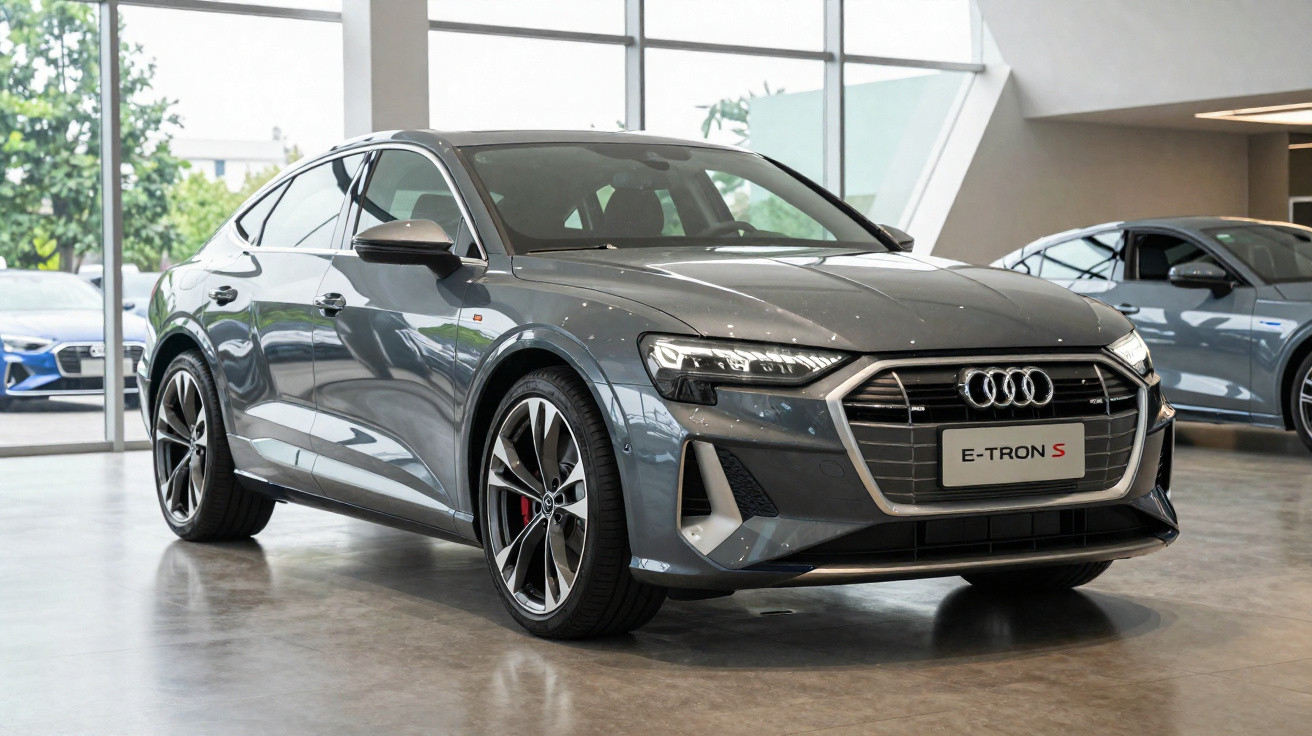
The Audi e-tron S Sportback (and the ‘standard’ e-tron S) is not only the brand’s first fully electric model to wear an “S” badge; more notably, it is also the first Audi to arrive with more than two driven electric motors: one on the front axle and two on the rear axle (one per wheel). In fact, Audi reached customers with this layout before Tesla did with the Model S Plaid.
None of the three motors is mechanically connected to the others. Each unit works through its own single-speed reduction gearbox, and the only thing coordinating their efforts is the software.
From the driver’s seat, though, you never sense any of those behind-the-scenes negotiations between motors. Press the accelerator and the response is clean, decisive and linear-almost as if there were just one motor doing the work.
Even so, giving each rear wheel its own motor opens up a huge range of dynamic possibilities. It allows torque vectoring to be exploited to the fullest, delivering an exceptionally accurate control of exactly how much torque reaches each rear wheel-something no conventional differential can truly mirror.
Finally, those two rear motors give the Audi e-tron S Sportback a clearly rear-biased character, with the rear axle contributing more newton metres and kilowatts than the front. That is not typical of the brand of the four “quattro” rings-only the R8 puts a similar emphasis on the rear driven axle.
Power is in plentiful supply
Adding a third motor compared with other e-tron models also brings extra output for the S. In total, it offers 370 kW (503 cv) and 973 Nm… but only with the transmission in “S”, and only for… 8s at a time. In the normal “D” position, available output drops to 320 kW (435 cv) and 808 Nm-still higher than the e-tron 55 quattro’s peak 300 kW (408 cv).
With so much electric ~~firepower~~, it feels seriously quick-at first. Launches are forceful, yet they stop short of the uncomfortable sensation some EVs deliver, repeatedly pinning you into the seat without mercy.
The official 0–100 km/h figure of 4.5s is even more striking once you remember you are dealing with an SUV weighing practically 2700 kg-it almost deserves to be written out in full… practically two thousand seven hundred kilograms… It is heavier than, for instance, the newer and even larger Tesla Model X Plaid (the one with more than 1000 cv) by over 200 kg.
Yes, the intensity of acceleration begins to taper off once you are well into triple-digit speeds, but the instant, hesitation-free punch you get from even the lightest throttle input never goes away.
Behind the wheel
If the extra performance is a clear draw of the “S”, my main interest in the e-tron S Sportback was the way it would drive. With the rear axle given centre stage-and with an “S” badge-I expected it to feel meaningfully different from the other e-tron 55 models, as a direct result of its mechanical layout.
It did not take long to realise it isn’t, at least not in everyday driving. In normal use, any distinctions between the “S” and an e-tron 55 are minor-there is a firmer damping feel, but little beyond that. Its stronger acceleration is the one truly obvious separator, though don’t misunderstand me: the e-tron’s driving experience is good in any version.
The steering is light (doing a convincing job of disguising the sizeable mass in motion), yet it remains very accurate-if not especially talkative-an impression echoed by the other controls.
Refinement in the cabin is simply outstanding, and comfort stays consistently high, whether you are dealing with battered urban surfaces or cruising on the motorway at higher speeds.
It borders on witchcraft how Audi’s engineers have banished wind noise and tyre roar (even bearing in mind the huge 21-inch wheels). The standard air suspension deals capably with broken tarmac, and you can even alter the ride height depending on what you need.
There is also an ever-present sense of solidity on the move which, combined with the careful sound insulation, makes this electric SUV an excellent long-distance companion-even if range ultimately becomes the limiting factor, but we’ll get to that…-in other words, exactly what you expect from an Audi at this level.
Looking for the “S”
Still, I will admit I was hoping for a little more “spice”. You have to raise the pace-a lot-and find a sequence of bends to understand what makes this e-tron S Sportback more special than an e-tron 55 Sportback.
Select Dynamic mode (and “S” on the transmission), press the accelerator with intent, and get ready for the next corner-arriving alarmingly quickly-while trying to forget you have 2.7 t changing direction at speed… Brake (and you may notice the initial bite could be stronger), place the nose where you want it, and then appreciate how the “S” turns in without hesitation.
You will notice limited body roll, and then it is time to go back on the accelerator… with conviction… and that is when the two rear electric motors make themselves known. The rear axle progressively “pushes” the front, scrubbing out any hint of understeer; and if you keep leaning on the throttle, the rear end will even “make an appearance”-an attitude we are not used to seeing from Audi… not even in very fast RS models.
The catch is that, to reach this point, you need to be travelling extremely quickly to really “feel” the effects of this unusual drivetrain arrangement. Back off slightly (still at a brisk pace) and you return to the brand’s familiar efficiency and neutrality. The “S” then loses much of its differentiation, only revealing its full breadth in a “teeth clenched” approach.
That said, the e-tron S Sportback honestly corners better than any SUV this big and heavy has any right to, showing an agility that genuinely surprises.
A big appetite
If it impressed in corners, it is on open roads and long distances that Audis at this level tend to shine. They often feel as though they were designed for a single mission: to go to the end of the world and back, preferably at very high cruising speeds on an autobahn.
The Audi e-tron S Sportback follows that tradition in refinement and sound suppression, as already mentioned, and it also feels impressively stable. But in that exact use case, the consumption figures I saw heavily undermine the idea. The e-tron S Sportback has a very large appetite.
On the motorway, at Portugal’s legal speed limit, 31 kWh/100 km was typical-an extremely high figure-and I can only imagine what it would be like on the German autobahns, its natural habitat, especially on unrestricted sections. It may force you to do some planning before setting off on a trip spanning several hundred kilometres.
You can, of course, choose smaller roads at 90 km/h, but even then the trip computer consistently showed close to 24 kWh/100 km. During my time with it, I never saw less than 20 kWh/100 km.
The 86.5 kWh net battery is reasonably sized, but with consumption rising so easily, the claimed 368 km range feels optimistic and it will require charging more often than other comparable EVs.
Is it the right car for me?
As I said at the start, the Audi e-tron S Sportback is one of the most intriguing models I have driven from the brand with the rings-whether because of its mechanical set-up or because of what its dynamic attitude suggests it could do. Yet what it promises on paper does not always translate into the real-world experience.
On the one hand, I expected an e-tron with more “attitude” than the rest and a more distinctive driving feel, but that only appears when you drive harder and at very high speeds; in most other situations it differs little from the e-tron 55 quattro.
On the other hand, despite its excellent long-distance qualities, its high consumption boxes it in, because you simply will not get very far.
As a result, the Audi e-tron S Sportback seems to end up in a kind of limbo, despite the many strengths it brings. It is difficult to recommend when there is a more capable e-tron 55 Sportback.
Price also matters: it starts north of €100,000 (around €11,000 more than the e-tron 55 Sportback), but our test car-true to “premium” tradition-added over €20,000 in options. Even then, I still found omissions such as the absence of adaptive cruise control.

Comments
No comments yet. Be the first to comment!
Leave a Comment