
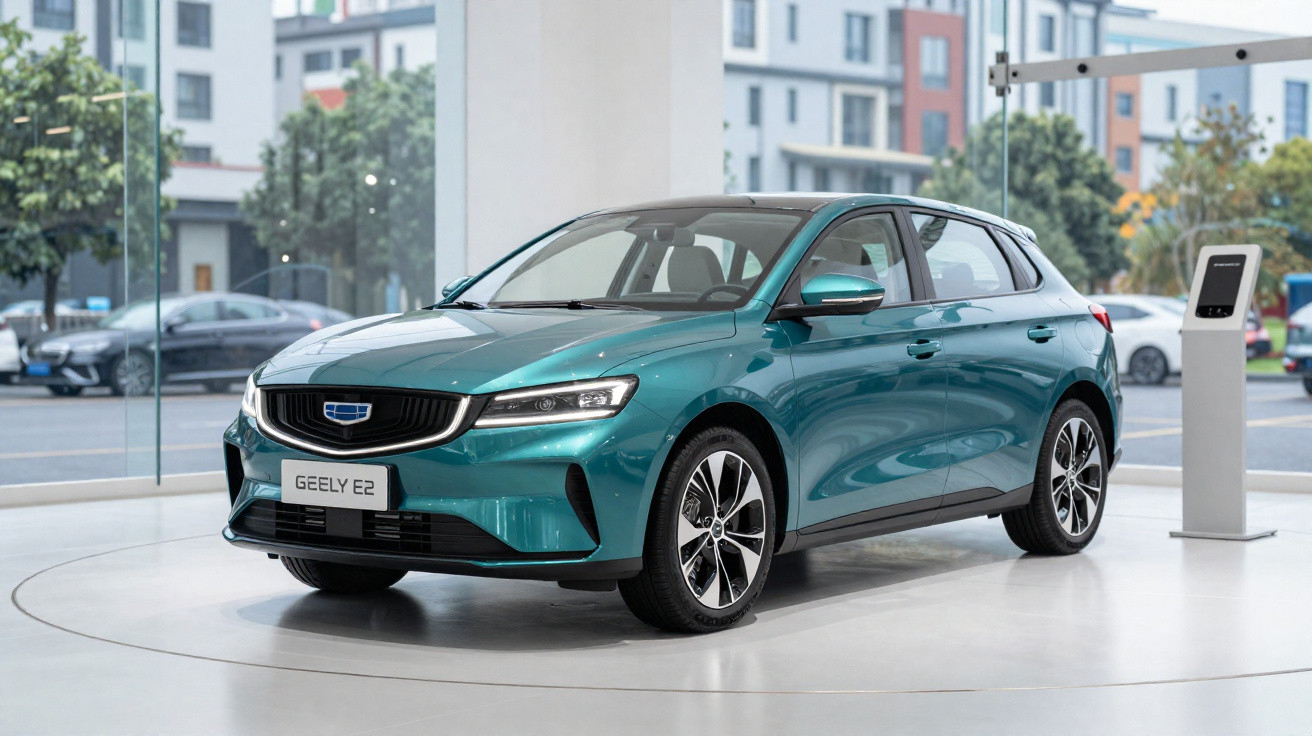
More than 55,000 units sold every month: that is the calling card of the Geely Xingyuan, China’s best-selling electric car, which is now preparing to arrive in Europe under a different name: Geely E2.
Portugal will only see it in 2027, but we have already taken a look at it during the summer testing for German Car of the Year (GCOTY), where the Chinese brand brought along a European-market E2 test vehicle.
After speaking with Geely Europe’s decision-makers, the message was unambiguous: the E2 will not be a simple rebadge of the Chinese model. It will come with its own specifications, a set-up tailored for European drivers and, as you would expect, a higher price. We explain everything in this video:
It’s not just another Chinese electric car
In Europe, the Geely E2 will land in one of the most hotly contested parts of the market. It will go head-to-head with models such as the Renault Twingo E-Tech, BYD Dolphin Surf and Citroën ë-C3, and later on it will also face the new Dacia Spring and Volkswagen ID.1.
It will, however, bring some less common talking points. One of the key ones is the Global Electric Architecture (GEA) platform, which places the electric motor on the rear axle-still a rarity among electric cars in this segment.
That layout delivers a more even weight balance, a small front boot under the bonnet, and interior packaging that puts it right up there with the segment’s benchmarks.
Above-average space
The E2 unit we saw is still a pre-production car, yet it was already clear that cabin room has been a major priority for Geely.
Rear passengers get more space than you would normally expect from a car measuring 4.13 m in length, and they also benefit from dedicated air vents-an uncommon detail among electric cars of this class.
As for the boot, Geely claims 375 litres of capacity, rising to 1320 litres with the rear seats folded. In other words, while it is designed with the city in mind, it should also be capable of handling a few family duties.
Up front, space is also generous, but the main highlights are the 14.6” central infotainment display and the 8.8” digital instrument cluster.
Inside, harder plastics are the dominant theme, which is hardly surprising for a model whose starting price in Portugal is expected to begin a little above €20,000.
Tuned for Europe
For the European market, the Geely E2 is set to be offered with two battery options (35 kWh and 47 kWh), an 85 kW (116 hp) electric motor and independent multilink rear suspension-yet the most important engineering work is not immediately visible.
During testing in Germany, Geely told us the E2 has been fitted with bespoke dampers and a dedicated suspension calibration to meet the expectations of European drivers, who are used to higher speeds and a more precise feel.
That is exactly why this test vehicle is not yet representative of the final version that will reach customers. Even so, the European development programme is already complete, and the first units intended for our market are now on their way.
Final range figures are still subject to homologation, but we can anticipate around 250 kilometres for the smaller battery and more than 310 kilometres for the longer-range version.
And the price?
In China, the Xingyuan has become a sales phenomenon, amassing more than half a million units sold in 2025. Part of that success is explained by its price: in its home market it is sold from figures that, at the current exchange rate, start at roughly €9,000.
In Europe, the picture will be very different. Competition has never been fiercer, and its success will depend as much on pricing as on how well Geely manages to adapt this model to European customer expectations.
In China, its appeal is no longer in doubt. Now it remains to be seen whether it can repeat the story on this side of the world. We have not driven it yet, but if the entry price sits around €21,000, as everything suggests, the Geely E2 will have the credentials to become one of the most compelling options among urban electric cars.
Comments
No comments yet. Be the first to comment!
Leave a Comment