
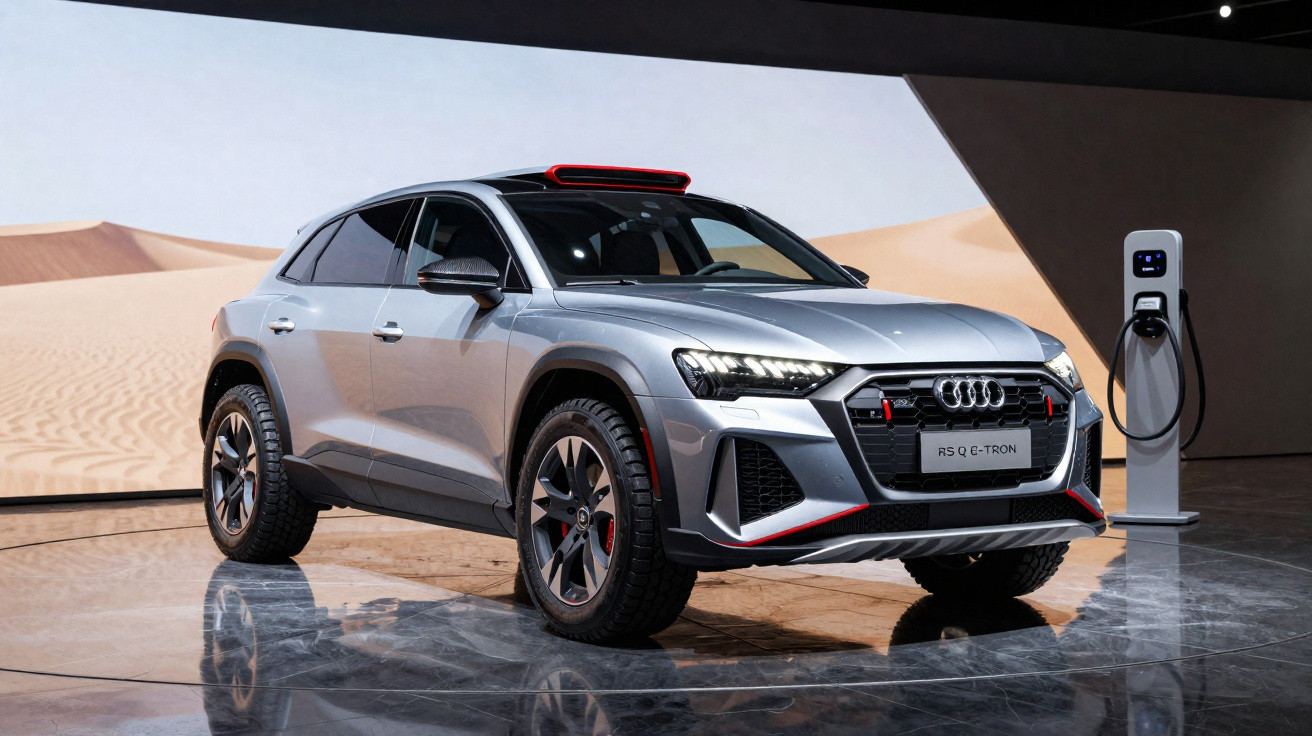
Whether automotive electrification can truly succeed in the toughest rally of them all - the Dakar - is exactly what Audi aims to prove with the RS Q e-tron: an electric competition prototype… but one that also carries an internal-combustion generator.
At first glance, the Audi RS Q e-tron feels like something dreamt up by Dr Frankenstein. Beneath bodywork that evokes other buggies - albeit peppered with futuristic touches - it brings together hardware drawn from very different machines.
Its electric motors (three in total) come from Audi’s e-tron FE07 Formula E single-seater (a series the brand is set to leave). Meanwhile, the combustion generator needed to replenish the batteries during the long stages is the 2.0 TFSI four-cylinder taken from the Audi RS 5 that raced in the DTM (German Touring Car Championship).
Charging the battery while driving
As you might expect, over the Dakar’s two-week duration there will be very few chances to plug the RS Q e-tron into a charger - and it is worth remembering that a single stage can be as long as 800 km. That is far beyond the reach of its relatively modest battery, developed in-house, which offers 50 kWh and weighs 370 kg.
To cover such distances, the only viable answer is to recharge the high-voltage battery on the move, which is why the 2.0-litre turbo engine is fitted for this purpose. Audi says the combustion unit will run between 4500 rpm and 6000 rpm - its most efficient operating window - resulting in CO₂ emissions comfortably below 200 grams for each kWh charged.
Before the energy produced by the combustion engine can reach the battery, it must first be converted into electrical energy, handled by an electric motor (MGU, or Motor Generator Unit). Supporting battery replenishment further, the RS Q e-tron will also use energy recovery under braking.
Up to 500 kW (680 hp) of power
Propulsion comes from two electric motors, one per axle - meaning four-wheel drive - and Audi says they required only minor changes from their Formula E specification to suit this new machine.
Despite having driven front and rear axles, there is no physical connection between them as there is in other electric vehicles. Instead, they communicate purely electronically, allowing torque to be apportioned more precisely to where it is needed. In effect, it can emulate a central differential - but with far greater freedom in how it is set up.
In total, the Audi RS Q e-tron delivers 500 kW of maximum power, equivalent to 680 hp, and like many other electric vehicles it does without a conventional gearbox - relying only on a single-speed reduction gear. Even so, we will still need to wait a little longer to learn how much of that output can actually be used, while the final regulatory revisions are completed.
Ambitious
The targets set for the RS Q e-tron are bold. Audi wants to be the first manufacturer to win the Dakar with an electrified powertrain.
However, given the project’s short development window - less than 12 months have passed and the Dakar starts in January 2022 - simply reaching the finish would already count as an initial victory. Sven Quandt, from Q Motorsport (Audi’s partner on the project), even goes so far as to compare Audi’s effort to the first Moon landing.
Audi is no stranger to successful technological debuts in motorsport: from the first Audi quattro in rallying to the first Le Mans win by a prototype with an electrified powertrain. Can it repeat the feat at the Dakar?
Comments
No comments yet. Be the first to comment!
Leave a Comment