
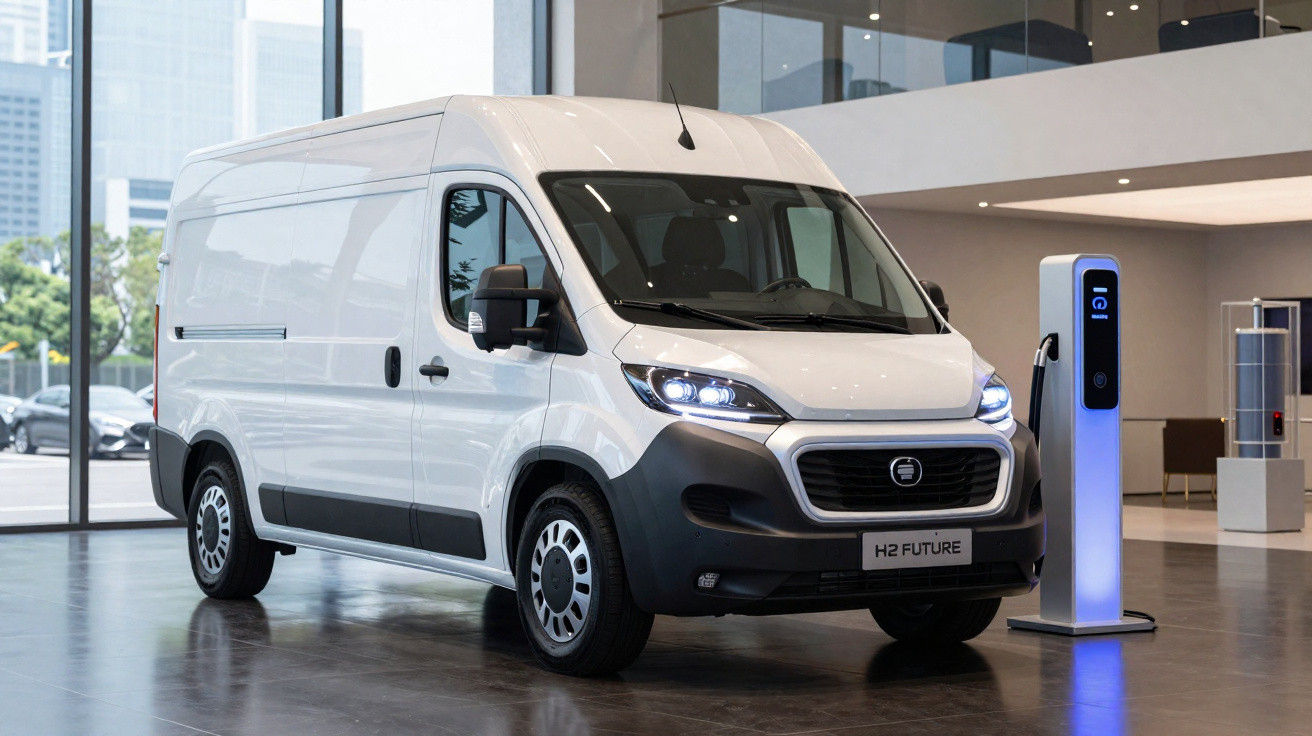
Stellantis Pro One has carried out a sweeping update of its entire van line-up in one go, covering small, medium and large models sold under Citroën, FIAT, Opel and Peugeot.
We went to see the full range in Rüsselsheim, Germany. In this refresh, Stellantis Pro One has placed particular emphasis on fully battery-electric vans, while also highlighting its fully hydrogen-electric models - in other words, vehicles that use fuel cell (fuel-cell stack) technology.
Although this technology is still relatively rare in the wider market, Stellantis has been selling hydrogen fuel-cell vans for some time - we first saw them in 2022 - in countries including Germany and France.
Up to now, the technology was only offered on the group’s medium-sized vans - Citroën Jumper, Fiat Scudo, Opel Vivaro and Peugeot Expert - but it will now also be available on the group’s large vans - Citroën Jumper, Fiat Ducato, Peugeot Boxer and Opel Movano - while sales will be extended to additional markets at the same time.
Not only is the hydrogen line-up set to broaden, it is also due to reach more customers. Alongside being offered in a greater number of European countries, this new large hydrogen fuel-cell van (payload capacity of 1300 kg and between 13 m³ and 17 m³) is also scheduled to arrive in the North American market in 2025, under the group’s Ram brand.
And, as that market demands, the hydrogen powertrain will also be made available for a new pick-up, which will be unveiled at a later date.
Less than five minutes to refuel
In this larger format, the fuel-cell system is paired with an electric motor producing 110 kW (150 cv) and 410 Nm of torque, as well as a (small) battery rated at 11 kWh (which can be charged externally).
As for the hydrogen itself, it is stored in four tanks mounted beneath the body, pressurised to 700 Bar. Altogether, it will be possible to carry around 7 kg of hydrogen (usable).
One of the key benefits of fuel cell technology is refuelling time, as it allows all four tanks to be filled in under five minutes. The claimed range exceeds 500 km (WLTP).
Who is it aimed at?
Even so, the use of hydrogen-powered vans remains dependent on the refuelling network available in each market. As Stephane Majka, development manager for the hydrogen business unit, told us, it is still a solution intended for very specific customers.
For now, models fitted with hydrogen systems are targeted at companies that are focused on new technologies and on eliminating pollutant emissions.
These include businesses involved in hydrogen production, with the option of refuelling on their own premises, as well as organisations that need vehicles for more intensive use and cannot afford the “luxury” of stopping for several hours to recharge.
Available hydrogen network
In Europe, according to information from Stellantis Pro One, there are currently around 150 public refuelling points operating at 700 Bar (the international standard). That picture is expected to change markedly by 2030.
This is because the European Union has set out the AFIR directive (Alternative Fuels Infrastructure Regulation), which aims to roll out a public hydrogen refuelling network, with stations every 200 km on the main road routes and at least one in each major city. The goal is to have more than 500 refuelling stations by 2030.


Comments
No comments yet. Be the first to comment!
Leave a Comment