
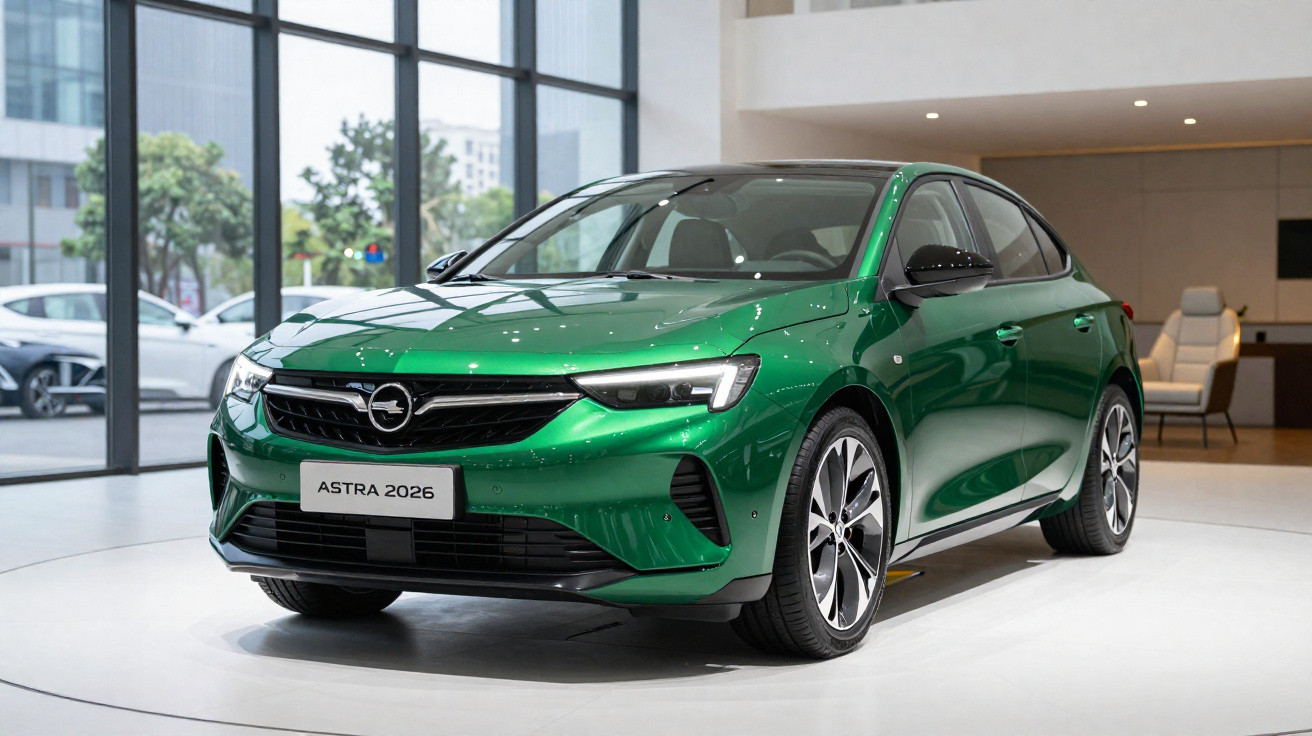
Opel has refreshed the Astra, but deliberately avoided reinventing it. Instead, the changes focus on areas where there was clear room to improve. The end result is a car that still looks instantly familiar, yet comes with updated selling points.
Opel Astra 2026 design and lighting tweaks
The most noticeable exterior updates are at the front. The Blitz badge is now illuminated for the first time.
Up front, the lighting can now be specified with the adaptive Intelli-Lux HD system (optional on the range-topping version). Each headlamp uses more than 50,000 LED elements, allowing it to light the road without dazzling other drivers by adjusting the beam in real time.
Beyond that, the Astra’s overall shape and styling keep the same character as before.
Cabin technology, comfort and practicality
Inside, the Astra 2026 changes are intentionally subtle. The dual 10″ displays remain (digital instrument panel and central screen). Climate control still relies on physical buttons, and Intelli-Seats are now standard across the entire range.
The infotainment system adds remote (over-the-air) updates, ChatGPT integration, a head-up display and-on the electric version-a connected trip planner.
When it comes to space, the Astra provides up to 422 litres of boot capacity, or 1339 litres with the rear seats folded. In the electric version, those figures drop to 352 litres and 1268 litres, respectively. The Sports Tourer (estate) offers between 597 litres and 1634 litres (516 to 1553 in the electric version), making it one of the largest boots in its segment.
Powertrains for every taste
Opel has kept a broad mix of powertrains for the Astra 2026: electric, plug-in hybrid, mild-hybrid and Diesel.
The line-up starts with the mild-hybrid option, pairing a 1.2 turbo petrol engine with a small 15,6 kW (21 hp) electric motor and a six-speed automatic gearbox, for a combined maximum output of 145 hp (107 kW).
For drivers after stronger performance, the plug-in hybrid version delivers up to 195 hp (144 kW), making it the most powerful model in the range. The key update is the battery, which has increased from 12,4 kWh to 17,2 kWh, extending electric-only range to up to 84 km on the WLTP cycle (almost 20 km more than before).
The Astra Electric, meanwhile, produces a maximum of 115 kW (156 hp) and gains a slightly larger battery, rising from 54 kWh to 58 kWh. Range is now up to 454 km (445 km for the Sports Tourer). With 100 kW DC rapid charging, it can recharge from 20% to 80% in around 30 minutes. It also introduces V2L, enabling the car to power external devices such as electric bicycles.
For those who still prefer Diesel, the 1.5 Diesel engine with 130 hp remains available, with consumption of 4,8 l/100 km. It is an increasingly rare choice in this segment, but one that still suits drivers who cover long motorway distances.
What price does it start from?
The Opel Astra 2026 is on sale in Portugal with prices starting at 30 990 euros for the car and 32 090 euros for the estate. Find out the full range pricing:
Comments
No comments yet. Be the first to comment!
Leave a Comment