
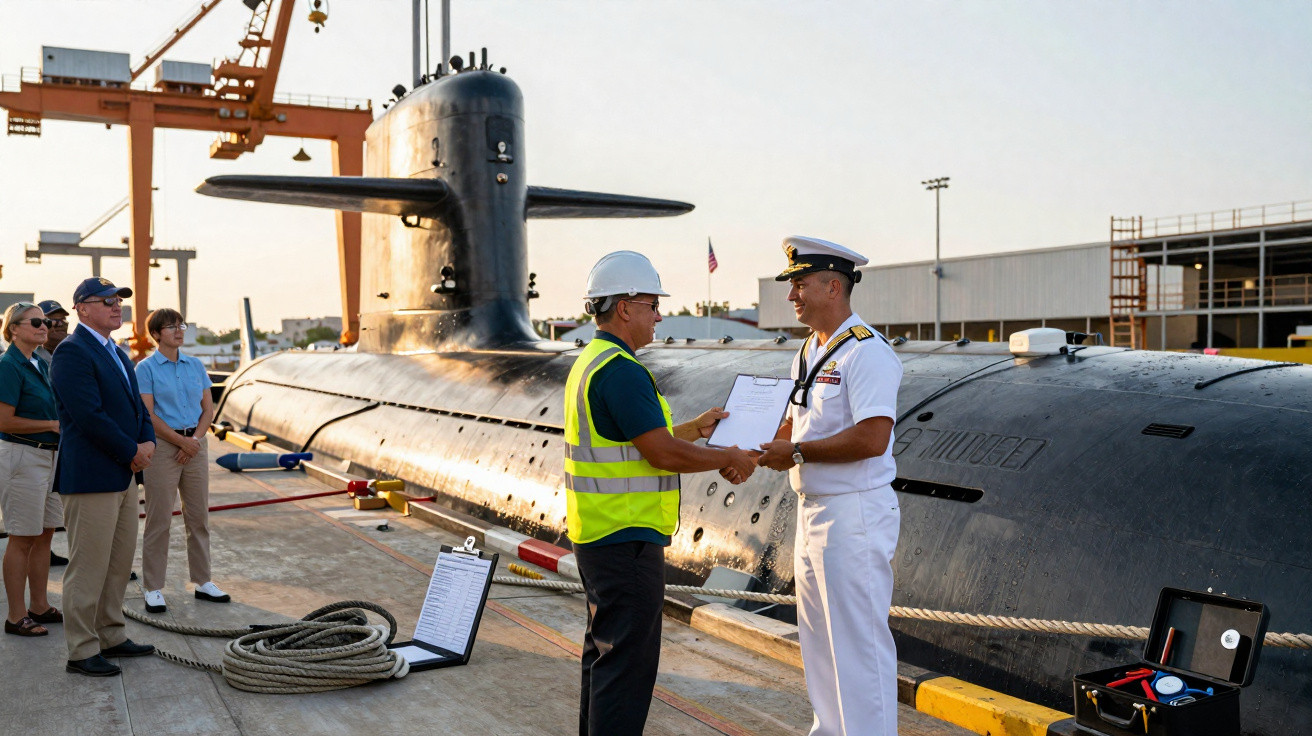
America’s undersea force has added a major new capability, with a long-anticipated fast-attack submarine now entering U.S. Navy service.
Following years of development and build work, HII’s Newport News Shipbuilding facility in Virginia has formally delivered the Virginia-class submarine Massachusetts (SSN 798) to the U.S. Navy. The handover is a noteworthy step for the industrial base that underpins the nation’s nuclear-powered fleet.
A milestone delivery for the Virginia-class line
Massachusetts is the 12th Virginia-class submarine delivered by Newport News Shipbuilding and the 25th finished under a long-standing teaming agreement with General Dynamics Electric Boat. Under that partnership, the two shipbuilders divide the design and construction effort for the class, which is the core of the Navy’s fast-attack submarine force.
Massachusetts (SSN 798) is the fifth U.S. Navy vessel to carry the name of the Commonwealth of Massachusetts, continuing a tradition that stretches back over a century.
HII says the boat passed a demanding programme of sea trials before the Navy accepted it. Those trials assess propulsion, combat systems, navigation, and major safety functions in real operating environments, frequently in challenging Atlantic conditions.
Kari Wilkinson, president of Newport News Shipbuilding, characterised the delivery as one of the yard’s key commitments for the year, and placed it within a wider effort to increase submarine output across the broader industrial base.
Industrial muscle behind a single submarine
Although SSN 798 presents a streamlined exterior, its construction required vast effort in people and manufacturing. HII states that more than 10,000 shipbuilders at Newport News and Electric Boat played roles in building the submarine, supported by thousands more across the U.S. supply chain.
That supplier base runs from major engineering businesses to smaller specialist producers. The company notes that over 20 suppliers are located in Massachusetts itself, delivering equipment, components, and services connected to the Virginia-class programme.
Each Virginia-class submarine reflects a nationwide manufacturing network, linking shipyards, component makers, and high-tech firms spread across dozens of states.
Newport News Shipbuilding sits on the James River in Virginia and is one of only two U.S. shipyards able to construct nuclear-powered submarines. It is simultaneously building Virginia-class boats and the next-generation Columbia-class ballistic missile submarines, which increases strain on timelines, staffing, and facilities.
Key facts about Massachusetts (SSN 798)
- Class: Virginia-class nuclear-powered fast-attack submarine
- Builder: HII’s Newport News Shipbuilding, under a teaming arrangement with General Dynamics Electric Boat
- Role: Intelligence gathering, anti-submarine warfare, strike missions, and special operations support
- Name: Fifth Navy ship named Massachusetts
- Christening: May 2023, with Sheryl Sandberg as ship’s sponsor
A high-profile sponsor and a modern ceremony
Massachusetts was christened at Newport News Shipbuilding in May 2023. Its sponsor is Sheryl Sandberg, founder of the Lean In initiative and former chief operating officer of Meta, the firm previously known as Facebook.
While the sponsor’s duties are mainly ceremonial, they are long established in naval custom. Sponsors commonly take part in christening events, where they name the ship and offer wishes for safe operations-often by smashing a champagne bottle against the hull.
By choosing high-profile sponsors from fields such as business, politics, or public life, the Navy often aims to connect frontline military hardware with the broader civilian community.
The christening for Massachusetts drew together Navy leaders, shipyard employees, politicians, and families, underscoring both the engineering milestone and the people behind it.
What the Virginia-class brings to the fleet
Virginia-class submarines are built for a broad mission set, from hunting opposing submarines to firing precision cruise-missile strikes. They can work in deep-ocean environments or nearer the shoreline, enabling intelligence collection and supporting special operations forces.
Even though details specific to Massachusetts remain classified, Virginia-class submarines typically share several defining capabilities:
| Feature | Purpose |
|---|---|
| Nuclear propulsion | Provides long-range, high-endurance operations without frequent refuelling |
| Advanced sonar suite | Detects other submarines, ships, and underwater threats at long distances |
| Vertical launch systems | Enables Tomahawk cruise missile strikes against land targets |
| Special operations support | Can deploy divers and special forces for covert missions ashore |
These boats are a central element of U.S. undersea planning, especially as maritime competition with nations such as China and Russia grows sharper. Low-noise, modern attack submarines give commanders adaptable options in contested theatres, from the North Atlantic to the Western Pacific.
Pressure to accelerate submarine construction
Wilkinson’s remarks about raising build tempo reflect an expanding concern in Washington over how quickly new submarines reach the fleet. The U.S. Navy has laid out demanding goals for the number of attack submarines it wants available, while also pledging to provide future submarines to Australia through the AUKUS security partnership.
The delivery of Massachusetts is seen as a positive sign that the industrial base can meet rising demand, even as it struggles with workforce shortages and complex parallel programmes.
Shipbuilders have had to work through issues including pandemic-related disruption, intense competition for skilled trades, and the inherent difficulty of nuclear construction. HII and Electric Boat have responded by recruiting thousands of staff, broadening training pathways, and funding modern facilities to increase throughput.
Why the name Massachusetts matters
U.S. Navy ship names often carry both history and symbolism. Massachusetts is the fifth vessel to use the name, following earlier ships that include a battleship that served in the Second World War.
For the Commonwealth, the submarine offers a visible connection to the Navy even though construction took place in Virginia. With more than 20 in-state suppliers contributing to the programme, the name also points to the state’s practical role in building the boat.
How sea trials shape a new submarine
Before SSN 798 could be transferred to the Navy, it had to complete an intensive at-sea test phase. Crews evaluate propulsion performance at varying speeds and depths. Engineers confirm that sensors, weapons, and communications systems perform as intended. Safety systems and emergency actions are practised, checked, and validated.
Navy inspection teams and shipyard specialists frequently participate in these trials. Problems identified are corrected alongside the pier or in dry dock before the Navy formally accepts the submarine.
Successful completion of sea trials signals that a submarine is ready for the demanding realities of operational deployment.
Understanding a few key terms
A “fast-attack submarine” is built chiefly to pursue enemy submarines and surface vessels, collect intelligence, and support strike operations. It differs from a ballistic missile submarine, which is designed to carry nuclear-armed missiles as part of strategic deterrence.
“Nuclear-powered” describes the propulsion method rather than the armament. A compact reactor generates heat that drives turbines and produces electricity. This allows the submarine to remain submerged for extended periods, with endurance constrained more by crew stamina and supplies than by fuel.
Potential scenarios involving Massachusetts
After it is fully integrated, Massachusetts could operate alongside carrier strike groups, moving ahead of surface forces to detect hostile submarines. It may also deploy alone to contested regions, collecting intelligence near foreign coastlines or observing undersea cables and maritime chokepoints.
In a crisis, a Virginia-class submarine may be tasked with firing cruise missiles at land targets while staying concealed beneath the surface. It can also insert special operations personnel close to shore, using stealth to lower risk to those involved.
These functions mean that adding SSN 798 modestly expands the Navy’s operational flexibility, particularly as older Los Angeles-class submarines leave service.
The delivery of Massachusetts illustrates how industrial capacity, regional suppliers, and naval strategy converge in a single platform. As additional Virginia-class submarines transition from build halls to operational duty, arguments over funding, shipbuilding tempo, and the next design steps are likely to sharpen, sustaining attention on what follows SSN 798 on the production line.



Comments
No comments yet. Be the first to comment!
Leave a Comment