
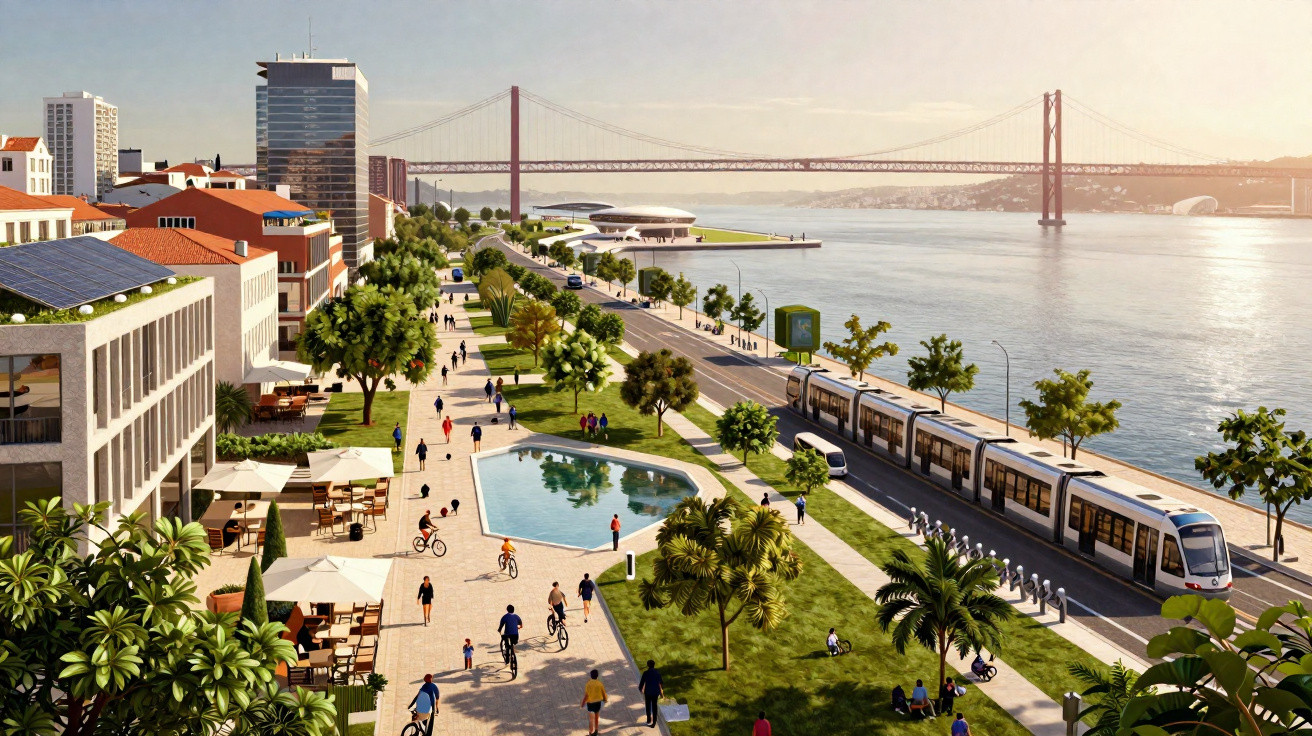
The Government has unveiled the Parque Cidades do Tejo project, a major urban-development and infrastructure programme designed to create a new “metropolis” within the Lisbon Metropolitan Area (AML). The most significant physical changes are planned for the municipalities of Almada, Seixal and Barreiro.
The plan is intended to reshape both banks of the River Tagus and make full use of the new crossings. According to the Government, the ambition is to “turn underused land on both banks of the Tagus into new urban, economic, housing and mobility hubs”.
At the heart of the proposal is a single guiding idea: the Tagus should function as a connector rather than a barrier. To deliver that shift, the Government is proposing large-scale investment organised around four strategic pillars.
Parque Cidades do Tejo: four strategic pillars
- Southern Riverside Arc (Arco Ribeirinho Sul) (Almada, Seixal and Barreiro);
- Ocean Campus (Oeiras and Lisbon);
- Humberto Delgado Airport (Lisbon and Loures);
- Airport City (Cidade Aeroportuária) (Benavente and Montijo).
The proposal was presented to the 18 mayors of the AML and to the mayor of Benavente, at a meeting chaired by Prime Minister Luís Montenegro, attended by the ministers responsible for Finance, Territorial Cohesion, and Infrastructure and Housing.
South Bank at the heart of the project
The South Bank is positioned as the programme’s focal point. In this area alone, the plan points to more than 28,000 new homes (8,000 in line with the PDM (Municipal Master Plan) and 20,000 as a future projection), 2,3 million m² allocated for economic activity, and 94,000 jobs. The main proposals by location are:
- Almada (Lisnave): housing, retail, and culture (including the future Ópera Tejo);
- Barreiro (former Quimiparque): tourism, housing, a conference centre, and a cluster of economic activity (shipbuilding industry);
- Seixal (former Siderurgia Nacional): an eco-business park, recreation and leisure uses, among other functions.
Taken together, the programme represents more than 4 500 hectares of intervention - 55 times the size of Parque Expo - with the construction of 25,000 new homes and more than 200,000 projected jobs. The stated aims are to ease housing pressure, stimulate skilled employment, and strengthen the public transport network.
Infrastructure and mobility
Infrastructure delivery is presented as one of the project’s foundations. Two new Tagus crossings are planned: the Third Crossing (TTT) between Chelas and Barreiro, and a subfluvial tunnel between Algés and Trafaria. In addition, the package includes:
- Lisbon Metro expansion: +30 km of lines, +35 stations (investment of 1,524 milhões de euros);
- South Tagus Metro extension: +50 km of lines (investment of 350 milhões de euros on the western side);
- LIOS (Sustainable Intermodal Line): +24 km of lines, +37 stations (investment of around 490 milhões de euros);
- SATUO: 9 km of lines, +14 stations (investment of 112 milhões de euros);
- Lisbon–Madrid High-Speed Line (Lisbon > Évora phase): investment of 2,8 milhões de euros.
The target is to lift the public transport mode share from the current 24% to 35%, supported by an additional 3,8 mil milhões de euros in transport investment and 328 milhões de euros per year to support fare policy.
New airport and Airport City
A key driver cited for this transformation is the New Airport. Spanning more than 3000 hectares between Benavente and Montijo, the future Airport City will be connected to the capital by high-speed rail and the main road network. It is also recalled that the new airport will have capacity of more than one hundred million passengers/year once fully operational.
Delivery and governance
To oversee the full process, the Government will create Sociedade Parque Cidades do Tejo, S.A., a company that is 100% publicly owned with an initial endowment of 26,5 milhões de euros. Management will be shared between central government and the directly involved municipalities.





Comments
No comments yet. Be the first to comment!
Leave a Comment