
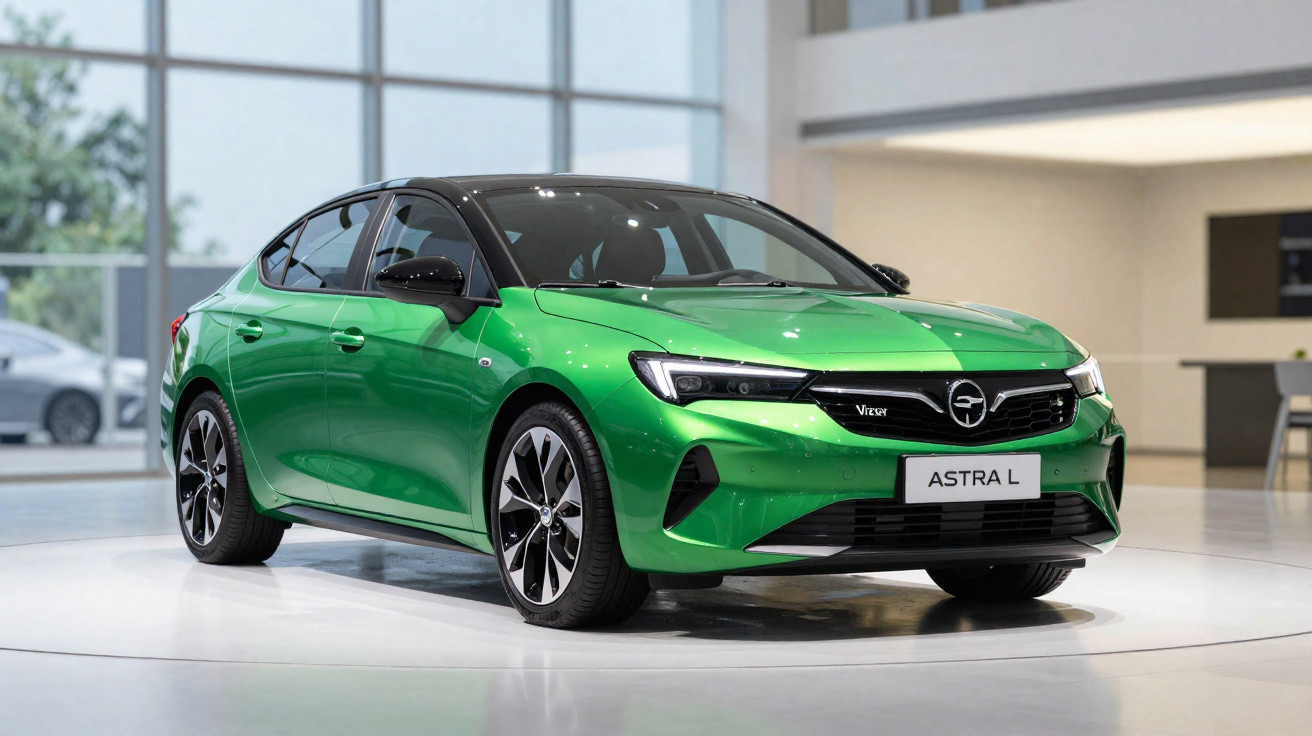
The completely new Opel Astra L is almost here. In engineering terms it sits very close to the Peugeot 308 and DS 4, as it adopts their latest evolution of the EMP2 platform - and it will be the last Astra offered with petrol and Diesel engines.
Another headline change is the arrival of plug-in hybrid powertrains, something this compact model from the German brand has never previously offered.
Opel would have liked to be the first Stellantis brand to unveil these systems and get them into customers’ hands, but it is understandable that the role of first mover went to the new Peugeot 308 shortly beforehand (within the Volkswagen Group it also took time before Skoda or SEAT received this kind of priority over the Volkswagen brand).
That said, the Astra L is by no means the poorer relation when it comes to styling - quite the opposite. Its proportions look more balanced and more upmarket, led by a front end where the headlights and grille are now linked by a continuous black horizontal strip that has a hint of a Zorro mask about it. It follows the theme introduced by the Mokka, known as the Opel Vizor, which has since been rolled out to the Crossland and Grandland SUVs.
With short body overhangs, a very steady waistline (giving it a tougher, somewhat premium stance), larger wheels and a striking rear pillar, the new Astra can easily be mistaken for a bigger car than its predecessor.
In reality, at 4.37 m long it is only 4 mm longer than before, and its wheelbase is also only slightly increased (2675 mm vs 2662 mm for the current Astra). Meanwhile, the extra body width (1860 mm vs 1809 mm) has helped lift boot capacity from 370 L to 422 L.
Limited engine line-up
It was recently confirmed that Opel will build only electric cars from 2028. In other words, this is not some distant, hard-to-imagine future - it is six and a half years after the launch of this model, which is a perfectly normal lifespan for a generation of car.
This also means it will be the last Opel to offer a range spanning petrol, Diesel and plug-in hybrid powertrains, before the car moves exclusively to running “on batteries”. For the Astra L specifically, the fully electric version is due at the beginning of 2023.
Against that backdrop, it is easy to see why Opel is not pouring major investment into combustion engines with a short sell-by date. That explains why the petrol range is limited to 1.2-litre three-cylinder units (with 110 PS and 130 PS) - and why the current 1.4-litre 145 PS will not carry over. This is plainly thin on the ground if the brand wants to take on the upper end of the segment where heavyweight rivals such as the Volkswagen Golf (GTI, R…) and Ford Focus (ST) operate.
There will be no OPC versions, then; the only automatic is an eight-speed torque-converter (which in everyday driving can be better than many dual-clutch gearboxes, albeit slower in sporty applications - and all signs point to those kinds of performance variants not appearing in the future line-up). There is also no sign of 4×4 and no adaptive dampers - features that “even” the first-to-market 308 did not receive.
On the Diesel side, the familiar 1.5-litre four-cylinder used across today’s Peugeot and Opel models (among others) continues, because European demand has not disappeared. It will be offered only with 130 PS and with two transmission choices: a six-speed manual or an eight-speed automatic.
Plug-in hybrids take centre stage
Opel’s efficiency push, as expected, is focused on plug-in hybrids. These pair the well-known 1.6-litre turbo petrol engine in 150 PS or 180 PS form (with 250 Nm) with an electric motor on the front axle delivering 110 PS and 320 Nm, producing two combined outputs: 180 PS and 225 PS.
The strategy reflects the growing preferences of buyers in the Opel Astra’s main market - Germany - even if the figures still sit behind direct competitors such as the Volkswagen Golf plug-in hybrid, which offers 204 PS or 245 PS (in the Golf GTE). In the Astra, the plug-in hybrid versions use a 12.4 kWh lithium-ion battery, enabling 60 km of all-electric driving (Volkswagen claims 63 to 71 km “smoke-free”).
Petrol consumption is expected to come in under 2 L/100 km, and because the combustion engine plays a smaller role in moving the car, the fuel tank has been cut from 52 L to 40 L (which also helped increase boot volume).
While there will be no high-output, combustion-only versions, a rumour persists that the Astra L could gain a 300 PS plug-in hybrid with four-wheel drive, mirroring the technically related Peugeot 3008 HYBRID4 - for now, it is nothing more than that: a rumour.
More digital, fewer buttons
Inside, the cabin is very clean - following the “Pure Panel” concept first seen on the Mokka - with far fewer physical controls than the previous generation. Even so, the most important functions in the Astra L still use physical buttons for quicker, more direct access.
The driver display is digital and configurable, as is the central infotainment screen; both are neatly housed beneath the same cowl and angled towards the driver.
As you would expect in this class, the Astra L is set to offer numerous driver-assistance systems and LED headlights. Stellantis engineers are particularly proud of the seats, which they say are especially comfortable and can be electrically adjusted, with massage and cooling functions - still unusual features in this segment.
There is no official pricing yet for the new Opel Astra L, which is due to reach the market later this year. Even so, it is likely not far off the mark to estimate an entry price around 25,000 euros for the base version (1.2 turbo, 110 PS, manual gearbox) and 30,000 for the most affordable plug-in hybrid.
Comments
No comments yet. Be the first to comment!
Leave a Comment