
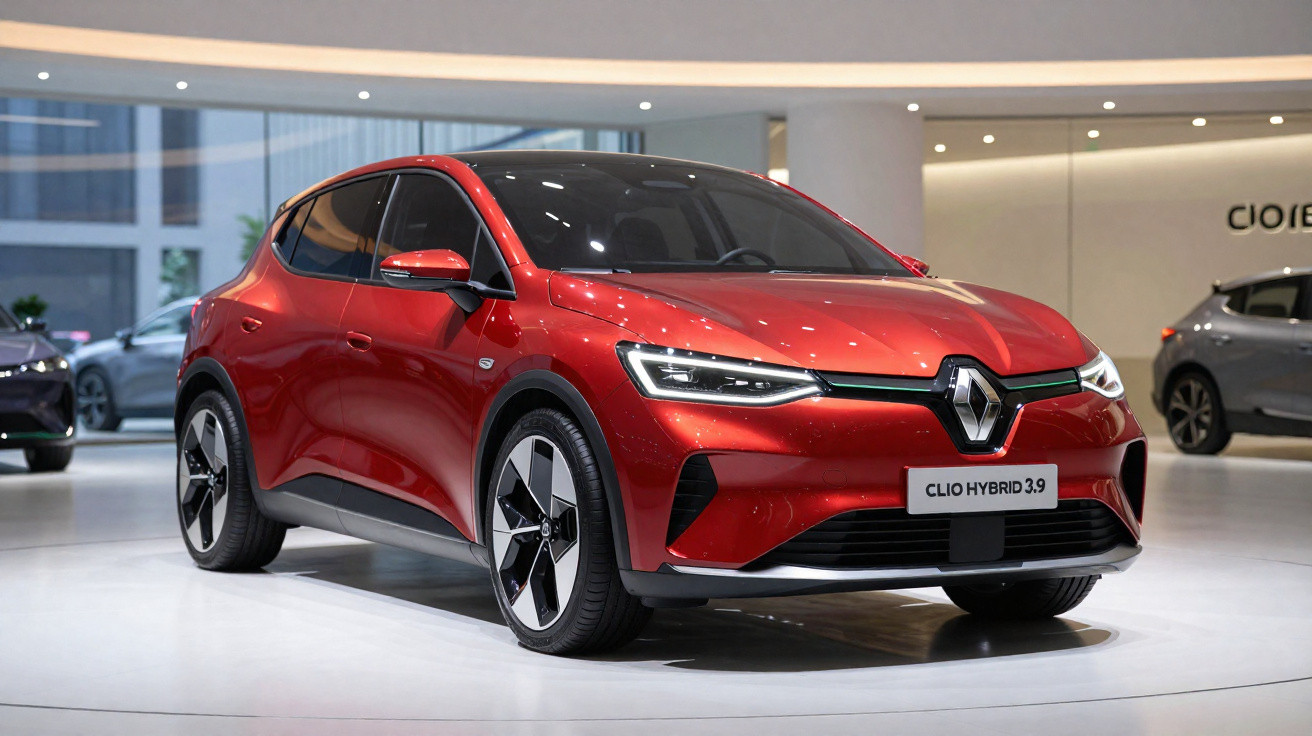
A fresh design, an easy-going drive, top-notch infotainment and fuel use that barely registers: can the new Renault Clio be as formidable as the generations before it? We found out with the brand-new 160 ch hybrid.
I’ll admit it: I’m not one for the "it was better in the old days" argument. So seeing the latest Renault Clio thoroughly transformed doesn’t bother me at all-unlike some of the wandering voices on social media. They complain? So what. This new generation of the diamond-badged supermini is sharpening its formula once again to win back French buyers, and this sixth iteration looks set to be just as brilliant as its predecessors.
A radical look: why the new Clio looks like nothing else
Where the fourth- and fifth-generation Clio shared a common visual theme, the newest one tears up the rulebook. Sculpted headlights, a gaping grille, a plunging bonnet and a tightly drawn rear end make it look more compact-yet it’s actually the biggest Clio in the line-up, measuring 4.12 m long and 1.77 m wide. Beyond the eye-catching makeover, this French hatch also consolidates its strengths in a very convincing way.
The comfort/handling balance remains excellent. Over speed bumps and poorly finished joins in the tarmac, the new Renault Clio thumps less than its predecessors despite the 18-inch wheels fitted to the Esprit Alpine trim. Through bends, body roll is still kept in check, helping it feel eager and tidy. The steering stays fairly precise and informative, and it gains a welcome dose of weight when you switch to Sport mode.
Quiet cabin and driver assistance: the small car that thinks big
Motorway miles highlight the progress too. Sound insulation is impressively strong for the class, keeping wind noise well under control, while the seats prove genuinely comfortable even without lumbar adjustment. Standard semi-autonomous driving on the Esprit Alpine specification does a decent job overall, although in rare situations there can be a slight weave in the lane.
In town, the Clio’s tight turning circle makes parking straightforward despite its increased dimensions. The trade-off is limited rear three-quarter visibility, caused by a chunky C-pillar. Thankfully, parking assistance arrives from the entry-level trim to help you avoid surprise encounters with obstacles. Better still, you get a reversing camera on the mid-range Techno model.
Life on board: the Clio gains useful centimetres, but mind the rear
The standout feature is undoubtedly the hands-free parking system with a 360° camera, priced at 600 €-ideal if you want extra reassurance about avoiding scrapes. There’s even a three-dimensional view available, just like in larger cars.
And larger is exactly what the new Clio feels like inside. Dimensions have been nudged up by a few valuable centimetres here and there, which pays off in cabin space. It still isn’t as wide as a Volkswagen Polo or a Skoda Fabia, but the improvements are clear.
Unsurprisingly, carrying three adults across the rear bench isn’t advisable. Shoulder room remains modest-typical for the segment-and a central tunnel gets in the way. The rear also feels a bit enclosed thanks to the small glass areas and an all-black headlining, with no panoramic roof option to brighten things up. Boot capacity of 391 l makes up for it, though (301 l in hybrid form).
Record fuel economy: we achieved 3.9 l/100 km with the 160 ch hybrid
With a larger displacement than before (1.8 l instead of 1.6 l), the new Renault Clio’s hybrid system is also stronger: the petrol engine produces 109 ch rather than the previous 94 ch. Combined output therefore reaches 160 ch-15 ch more than before-to offset the car’s extra weight. It’s also worth reiterating that this is a full hybrid, like the Toyota Yaris. The 1.4 kWh battery therefore allows more electric running than a mild hybrid. Thankfully.
Because the downside is that the petrol engine can be intrusive when it’s spinning "without load" to recharge the battery. The trick is to be gentle with the throttle so it quietens down as quickly as possible. The payoff comes in the form of very low fuel consumption. Over a 600 km journey made up of 80% roads and 20% motorway, we averaged 3.9 l/100 km, exactly matching the official WLTP figure. And that was on grippier winter tyres, no less.
Dog-clutch gearbox and braking: the small irritations around town
It’s even possible to drive a few hundred metres in electric mode at 130 km/h. But let’s be realistic: at that speed, petrol consumption can only rise. On fast roads it edges towards 6 l/100 km. With the cola-can-sized fuel tank (39 l), range then drops to roughly 600 km. A diesel would be better suited to this job-shame it’s no longer available.
Even so, the Clio’s range still beats the electric R5, which would need topping up every 200 km. In truth, it’s mainly in urban driving where the Clio feels less smooth than the R5. The dog-clutch gearbox can introduce occasional jerks and often makes the petrol engine flare before it changes ratio. As for the brake pedal, it feels like you’re squashing a cheesecake before the car abruptly comes to a halt.
Interior finish: why perceived quality has slipped this generation
The complete opposite applies to the 10.1-inch touchscreen, which should worry rivals. Responsiveness, smoothness and clarity are all first-rate. Running on Android Automotive, the whole system is excellent, pushing the Clio to the top of the class for infotainment.
Crucially, Renault hasn’t sacrificed usability: the climate controls remain physical, as do the steering-wheel buttons. Better still, there’s a small switch that lets you disable driver-assistance systems in an instant. That’s the right call.
Now for the sore point: build and material quality. Where the previous Clio-especially in its phase 1 form-set a benchmark, this new one takes a step back. The plush materials are gone. Nearly every surface is hard, scratchy plastic. Only a velvet-like trim tries to lift the dashboard and front door panels on Esprit Alpine versions. The rest feels fairly basic, even if the solid assembly work is reassuring.
Renault Clio pricing: is a 19,900 € entry point justified?
The new Renault Clio is far from cheap, with a starting price of 19,900 €. That’s a lot for a supermini, but the base engine now makes 115 ch, compared with 65 ch in the previous Clio. Equipment levels are also improved: Evolution trim includes an electric parking brake, 16-inch wheels, a 10.1-inch touchscreen, a 7-inch digital instrument display, manual air conditioning, four electric windows, and LED front and rear lights.
The mid-range Techno, from 23,900 €, makes more sense thanks to worthwhile extras for styling (alloy wheels, gloss wheel-arch trims, a diamond-pattern grille, and more) and comfort (automatic climate control, a reversing camera, keyless entry and start, and so on). Esprit Alpine is inevitably even better equipped, but it’s too expensive to recommend at 27,600 € minimum. Even so, its sworn enemy-the Peugeot 208-is pricier still with a 145 ch mild-hybrid engine.
Our verdict on the new Renault Clio
It isn’t flawless, but it’s close. Still right at the top of its game, the new Renault Clio remains enjoyable to drive, updates its infotainment, modernises its cabin design, improves practicality and keeps consumption impressively low. Yes, the hybrid system has its weak spots, and the price isn’t the gentlest. But those drawbacks don’t spoil an otherwise admirable all-round package. Unsurprisingly, the French supermini earns a very good rating without breaking a sweat.
Renault Clio Esprit Alpine E-Tech 160
29,300 €
9
Verdict
9.0/10
What we like
- The comfort/dynamism balance
- Top-class infotainment
- Usability kept intact
- Low fuel consumption
- Comprehensive equipment
What we like less
- The gearbox lacks smoothness
- Braking is hard to modulate
- Interior material quality has slipped
Subscribe to CyberGhost

Comments
No comments yet. Be the first to comment!
Leave a Comment