
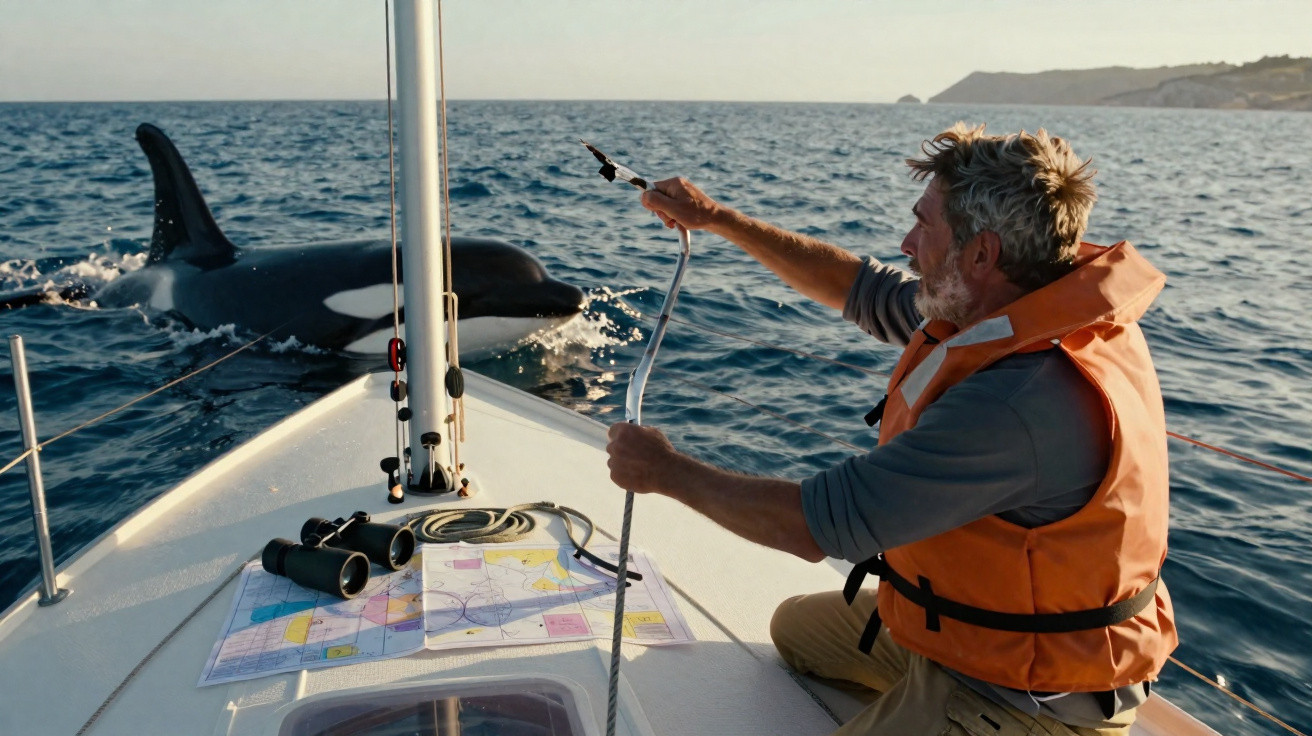
Sailors shut down their engines and go quiet as black-and-white shapes glide beneath the hull, looping around like living question marks. Then comes the jolt: a blunt impact, a tremor up the mast, and the rudder begins to judder and grind as though something below has taken hold.
Online, wobbly phone footage captures orcas striking yachts, cracking fibre-glass, worrying at rudders - and then drifting off with unnerving calm. Insurance reports climb. Sailing forums swing between swagger and genuine alarm. Is it play, trauma, revenge, or a behaviour we haven’t properly named yet?
For once, the plot doesn’t place humans neatly at the top of the food chain - and that uncertainty sits badly with us.
When the sea stops playing by our rules
Anyone who has sailed the Strait of Gibraltar over the past two years tends to sound slightly different when they talk about it. They’ll start with wind, swell and currents, then drop their voice when the subject turns to orcas. This is no longer a distant wildlife sighting. It is interaction.
Since 2020, researchers have documented hundreds of incidents, most involving smaller sailing boats. The same sequence turns up again and again: orcas focus on the rudder, push at the hull, and sometimes hold position alongside for up to an hour. The unsettling part is not just the force - it is the sense of purpose in a space we assumed we controlled.
The figures, incomplete though they are, still paint a clear picture. From mid‑2020 onwards, scientists have recorded more than 500 “disruptive” encounters between orcas and boats around the Iberian Peninsula alone. At least four yachts have gone down after repeated blows to their steering gear. Many more have made it back only with assistance, towed into harbour by rescue services, with skippers rattled and struggling to process what happened.
These are not cruise liners or tankers. They’re the sorts of boats people set off in for retirement adventures or a gap‑year voyage. On a small yacht, three or four orcas hitting the rudder can feel like being shunted by a lorry. You are close enough to make out the bright white eye patches - close enough to grasp that the impacts are not random.
Biologists generally push back against the tidy headline of “killer whales turning on humans”. There are indications the behaviour may have begun with a small number of animals and then spread through social learning. An injured female often referred to as White Gladis comes up repeatedly: some scientists think she may have had a traumatic experience involving a boat, and that others then mirrored her fixation with rudders.
There is also an uncomfortable reality: orcas are intelligent, capable predators living in seas reshaped by humans. Fewer fish, more noise, more traffic. A rudder moving through the water may be the most interesting “toy” for kilometres. When a 6‑tonne mind decides your vessel is worth investigating, the gap between curiosity and catastrophe can become vanishingly small.
Protecting both species when things get real at sea
For skippers, this is not a philosophical puzzle. It is a practical one: what are you supposed to do when orcas appear? The guidance currently offered by marine authorities can feel backwards in the moment. Reduce speed, drop the sails, and stop the engine. Allow the animals to examine the boat. Don’t scream, don’t jab at them with poles, and don’t set off fireworks.
The logic is straightforward: aim to make the encounter dull, calm, and brief. A stationary boat is harder to shove around “for fun”, and a quiet crew is less likely to trigger escalation. Increasingly, sailors are also adjusting passage plans - routing around known hotspots, or timing crossings for daylight so they can at least see what’s happening near the stern.
Human fear, however, tends to demand immediate, blunt fixes. On forums, suggestions regularly surface about sonar repellents, electric shocks, or even weapons. But these approaches do not simply “teach orcas a lesson”. They can harm the wider marine environment, from dolphins to fish larvae, and they may transform a puzzling curiosity into genuine aggression.
Maritime agencies are testing measures that are intended to be less damaging: non‑lethal acoustic deterrents, modified shipping lanes, and temporary “no‑go” zones during peak periods. Some crews now sail with hydrophones, logging visits and sharing recordings with researchers. It is messy, imperfect, very human science unfolding in real time. And it suggests coexistence will depend more on small, unglamorous routines than on dramatic gestures.
On bad days, the argument around orca strikes takes on the tone of a familiar culture war: one side insisting “protect the whales at all costs”, the other demanding “human lives first”. Out on the water, it is rarely that binary. The orcas off Iberia are a small, vulnerable population. Many bear scars from fishing gear and propellers. They are legally protected - and killing them would not address the underlying issue: this is still their habitat, and our boats still cut through it.
At the same time, waving away sailors’ anxiety as “rich people complaining” ignores something fundamental. Being in a flooding cabin while orcas hit the hull above you is not a minor annoyance. On a long passage, losing steering can become life‑threatening within minutes. Across the sailing community, there is now a low, persistent apprehension that did not exist before; on a rough night watch, every dull thump can feel charged.
One marine biologist I spoke to on the phone said it bluntly:
“If we turn this into a battlefield - whales versus humans - everyone loses. The question is not who we protect, it’s how we reduce the need to choose.”
That point of view matters when rules are drafted, insurance premiums are recalculated, and nervous crews decide whether to report what happened at all. The emotional current cannot be smoothed away with a few lines of legal wording or a leaflet pinned up in a marina office.
- Report every encounter, including minor ones: researchers need patterns, not only worst‑case incidents.
- Run “orca drills” with your crew before you enter hotspot waters.
- Store emergency grab‑bags by the companionway, not buried at the bottom of a locker.
Rethinking who “owns” the sea
The stories of orcas and damaged rudders rub against something deeper than broken kit. They challenge the quiet assumption that the sea is essentially a motorway we are entitled to manage: shipping lanes, regattas, cruising routes, offshore wind farms. Whales and dolphins are expected to be scenic background, not characters who alter the storyline.
When a 4‑metre predator decides your boat is its focus for the day, that script flips. You get a sharp sense of what it means to travel through someone else’s living room. That is not an argument for romanticising danger or shaming people for sailing. It is, however, a nudge towards larger questions about how crowded we have made coastal waters - with noise, netting and carbon.
On the practical side, these orca–boat clashes are also a stress test of how fast we can adapt. Limits on particular fishing gear near orca areas. Incentives for quieter hull and propeller designs. More accurate, real‑time mapping of pod movements, shared with leisure sailors through standard navigation apps. They are unexciting policy levers, but they influence how many collisions - literal and social - we end up with.
Most of us have experienced the moment when a headline strikes a nerve we didn’t know was exposed. “Killer whales sink yacht” is not only clickbait. It pushes people to choose a side instantly: animals or adventurers, nature or humans. That forced choice is very 2020s, very social media - and it hides the uncomfortable middle ground where most of life is actually lived.
Let’s be honest: nobody truly does this kind of recalibration every day. No one gets up, makes their morning tea, and rewrites their relationship with the wild before breakfast. We respond gradually and inconsistently, as stories stack up. Perhaps you decide against hiring that boat this year. Perhaps you start following a whale researcher on Instagram. Perhaps you sign a petition or give to a rescue centre. Small, almost invisible shifts in attention - yet they still accumulate.
Orcas will not read our opinion pieces. They will continue teaching their calves whatever seems useful or entertaining, whether that is a hunting technique or a new game involving carbon‑fibre rudders. The question remains with us: are we willing to get bored of outrage and do the tedious work of sharing the sea with minds that are not our own?
| Key point | Details | Why it matters to readers |
|---|---|---|
| Where encounters are exploding | Most disruptive orca–boat interactions are concentrated around the Strait of Gibraltar, the Gulf of Cádiz and the north-west coast of Portugal, with a smaller cluster reported near Galicia. | If you sail or plan coastal trips there, you’re entering a known hotspot and can plan routes, timing and insurance with eyes open. |
| What to do if orcas approach your boat | Reduce speed, furl sails, place the engine in neutral and keep people away from the stern. Record the time, GPS position and behaviour, then report it to local authorities once safe. | These steps lower the chance of serious damage, protect the animals from panic reactions and give researchers the data they need. |
| Non‑lethal protection options | Some crews carry non‑harmful acoustic devices, reinforce rudders, or adjust sailing seasons to avoid peak months (often late spring to early autumn in Iberian waters). | Practical tweaks like these reduce risk without calling for lethal control or illegal harassment of a protected species. |
FAQ
- Are orcas really “attacking” boats, or is it just play? Researchers think much of the behaviour resembles intense play or socially learned attention to rudders. However, the power involved can still break steering gear and sink yachts, so crews understandably experience it as an attack.
- Has anyone been killed by these orca encounters? So far there are no confirmed deaths linked to the Iberian orca incidents, although several crews have abandoned their boats and been rescued after losing their rudders.
- Is it legal to scare orcas away with weapons or fireworks? In European waters these orcas are strictly protected, meaning harming them or deliberately disturbing them can be illegal and may result in heavy fines or prosecution.
- Can governments move the orcas to another region? Relocating a wild orca population is highly risky, technically difficult, and widely viewed by scientists as unrealistic and unethical for the Iberian group.
- What can a regular sailor do to help resolve the situation? Read the latest guidance before departure, report every encounter with accurate details, avoid harassment, and support organisations working on quieter vessels, safer fishing gear and improved mapping of whale areas.






Comments
No comments yet. Be the first to comment!
Leave a Comment