
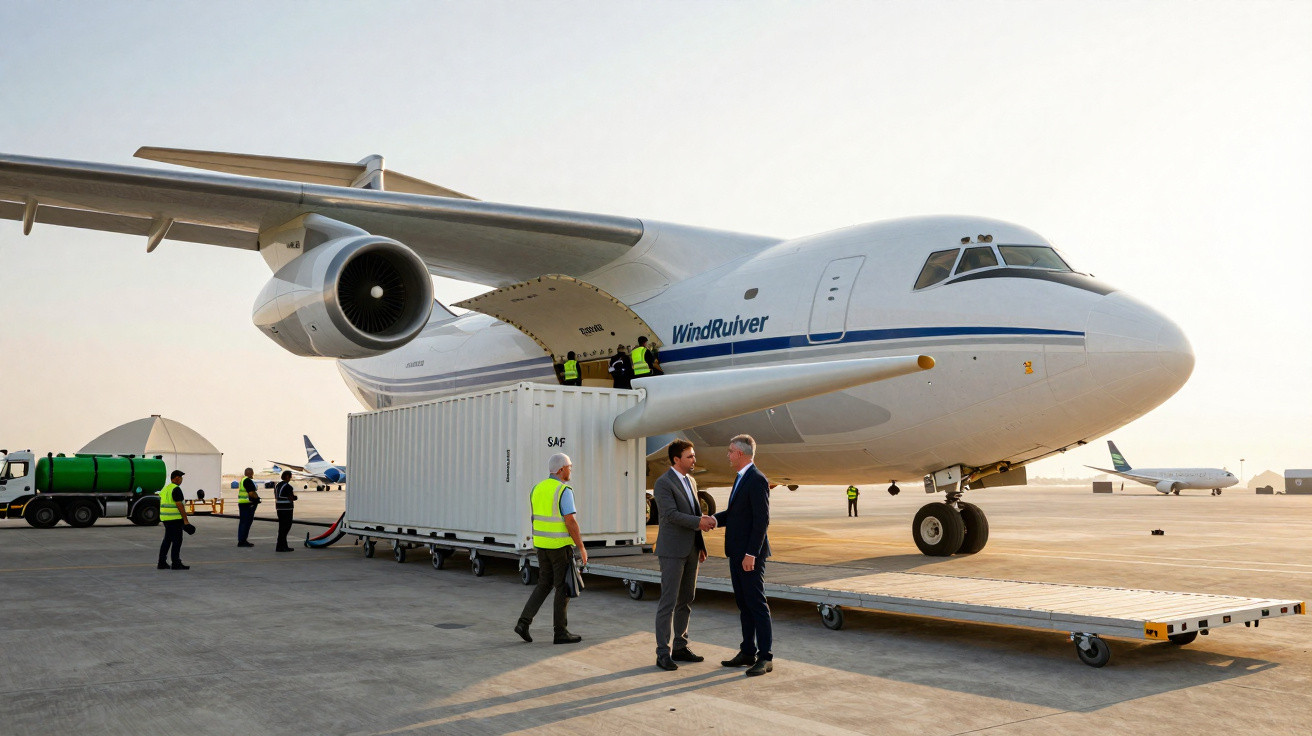
Against a backdrop of stretched infrastructure, a colossal aviation project is promising to reshape the global movement of special cargo.
In air logistics, a quiet but potentially historic shift is taking shape: an aircraft of unprecedented proportions has just secured a strategic partner with real-world experience in demanding operations-an alliance that could turn an ambitious engineering idea into a profitable business.
A giant built to carry what barely flies today
Known as WindRunner, the aircraft is being developed by the US company Radia with a straightforward goal: to move loads so large that, at present, they usually have to go by ship, via special road convoys, or through lengthy multimodal planning.
Based on the specifications released by the company, WindRunner was initially designed to transport next-generation wind-turbine blades measuring tens of metres in length. Radia’s claim is an internal volume up to six times that of the Antonov AN‑124, the Ukrainian aircraft that became the global benchmark for outsize freight.
In practical terms, that would allow a single flight to carry items such as:
- complete offshore wind-turbine components;
- rocket structures and space modules;
- heavy military vehicles or short railcars;
- pre-assembled industrial units.
The central idea behind WindRunner is simple: compress weeks of road and sea transport into a few hours in the air, even in regions without extensive infrastructure.
One of the project’s most striking claims is the ability to use semi-prepared runways of around 1,800 metres-closer to a military or regional airfield than a major international hub. If that capability is proven, countries with limited infrastructure could receive oversized equipment without having to build monumental airports.
Deal signed in Dubai: Radia finds its “operational arm”
Dubai Airshow as the stage for a marriage of convenience
The project’s most recent turning point came at Dubai Airshow 2025, one of the most important events on the aerospace calendar. It was there that Radia and Maximus Air, from the United Arab Emirates, formalised a strategic agreement.
On one side is Radia, leading WindRunner’s development-still in an integration phase, but with its mission and broad configuration already clearly defined. On the other is Maximus Air, a seasoned outsize-cargo operator with years of experience running special charters across the Middle East, Africa and Asia.
The intent goes beyond signing a commercial letter of intent. The announced plan is to start shaping real-use scenarios immediately: specific routes, target customer profiles, and a service-entry ramp-up that enables the aircraft to reach the market with contracted flights and demand already mapped.
Who Maximus Air is-and why it matters so much
Established in 2005 and linked to the Abu Dhabi Aviation Group, Maximus Air operates aircraft such as the Antonov AN‑124‑100 and the IL‑76TD, both icons of heavy air freight. The company has supported:
- humanitarian missions in conflict zones and disaster-affected areas;
- military and government charters;
- offshore logistics for energy and oil;
- large-scale emergency projects.
That track record is about far more than flying big aircraft. It includes negotiating with governments, securing overflight and landing clearances in sensitive regions, coordinating with armed forces, and managing loads that fit no standard template-precisely the type of operational environment WindRunner aims to master.
Rather than relying only on spreadsheet forecasts, Radia gains a partner who understands, in detail, the pain points and constraints of outsize transport.
Pent-up demand for oversized cargo
Industries driving the race
The niche of out-of-gauge charter-as out-of-dimension transport is commonly referred to-has been expanding, driven by five main forces:
- Energy: offshore wind, turbines for hydroelectric plants, transformers, grid-scale batteries.
- Defence: armoured vehicles, mobile radars, missile systems, communications structures.
- Aerospace: rocket stages, station modules, large satellites.
- Industry: modular factory units, distributed-generation plants, compact chemical facilities.
- Crisis response: field hospitals, desalination installations, temporary power stations.
At present, much of this equipment moves by sea, which means weeks in transit and a higher risk of delay from port congestion, adverse weather and bureaucracy. In emergencies-blackouts, conflicts, natural disasters-time becomes the most valuable resource.
At the same time, the world’s fleet of ultra-heavy freighters is ageing. The remaining Antonovs face complex maintenance and scarce parts. Soviet-era designs such as the IL‑76 need modernisation. And the availability of new aircraft purpose-built for extreme volume is virtually non-existent.
How WindRunner is meant to work in practice
Specifications designed for operations-not just records
WindRunner has not yet reached flight testing, but Radia’s published requirements outline several key points:
- A modular configuration, with enlarged rear access to simplify hoisting and aligning long loads.
- The ability to operate from semi-hard runways of around 1,800 metres.
- An internal bay intended to accommodate pieces up to roughly 30 metres long by 5 metres high.
- A conventional cockpit concept that keeps pilots central to decision-making, allowing integration into civilian air corridors without demanding an entirely new regulatory framework.
In other words, this is not a futuristic airship or a fully autonomous drone. The proposition is a “classic” aircraft in concept, but scaled and engineered around cargo that today barely fits into most logistics planners’ assumptions.
| Element | Current heavy-freighter fleets | WindRunner proposal |
|---|---|---|
| Focus | High weight with limited volume | Extreme volume with substantial length |
| Runways required | Military airports or major hubs | Medium-size semi-prepared runways |
| Average fleet age | High, with rising costs | New design aligned with current standards |
| Use profile | Occasional, expensive operations | More frequent network, with predefined routes |
What could work-and what still raises concerns
The Radia–Maximus partnership addresses a crucial part of the puzzle: who will operate the giant, where it will fly, and for which customers. Even so, the programme still carries significant risks.
An aircraft of this scale demands multi-billion investments across development, certification, engines, systems and support infrastructure. The business model has to ensure enough utilisation to cover those costs in a market sensitive to economic cycles, geopolitical conflict and environmental policy.
Regulation is another pressure point. Flying very large aircraft over densely populated areas involves specific negotiations with civil aviation authorities, route definition, noise assessment and emergency planning. Maximus’s experience working with governments may reduce friction, but it does not remove the underlying regulatory complexity.
If WindRunner delivers on its promises, it could become an “air shortcut” for energy, defence and infrastructure projects that currently depend on long logistics timetables.
Potential impacts and terms worth understanding
What “out-of-gauge” transport means in practice
In logistics jargon, an out-of-gauge load is one that does not fit standard dimensions for lorries, ships or conventional aircraft-because its height, width, length or weight exceeds what transport networks were designed to handle.
To move a single component, it can sometimes be necessary to:
- close entire roads for a few hours;
- temporarily strengthen bridges;
- redesign routes to avoid tunnels and flyovers;
- negotiate with multiple local authorities along the way.
An aircraft like WindRunner would not remove every barrier, but it would shorten the road portion of the journey. Cargo could leave a factory near a regional airfield, fly directly to another airfield closer to the final site, and then travel by road over a much shorter distance-with less disruption to towns and highways.
Plausible scenarios if the programme takes off
It is easy to picture, for example, an offshore wind farm being assembled in half the current time because blades and generators arrive by air instead of waiting for the ideal window in maritime transport. Or a country hit by an earthquake receiving complete modular hospitals within days, ready to connect to a temporary power network.
From a military and geopolitical standpoint, a freighter of this size also creates the ability to reposition strategic equipment quickly, which is likely to appeal to governments and international alliances alike. That capability can accelerate contracts, but it also prompts debate about shifts in power balance and the environmental impact of flights on such a scale.



Comments
No comments yet. Be the first to comment!
Leave a Comment