
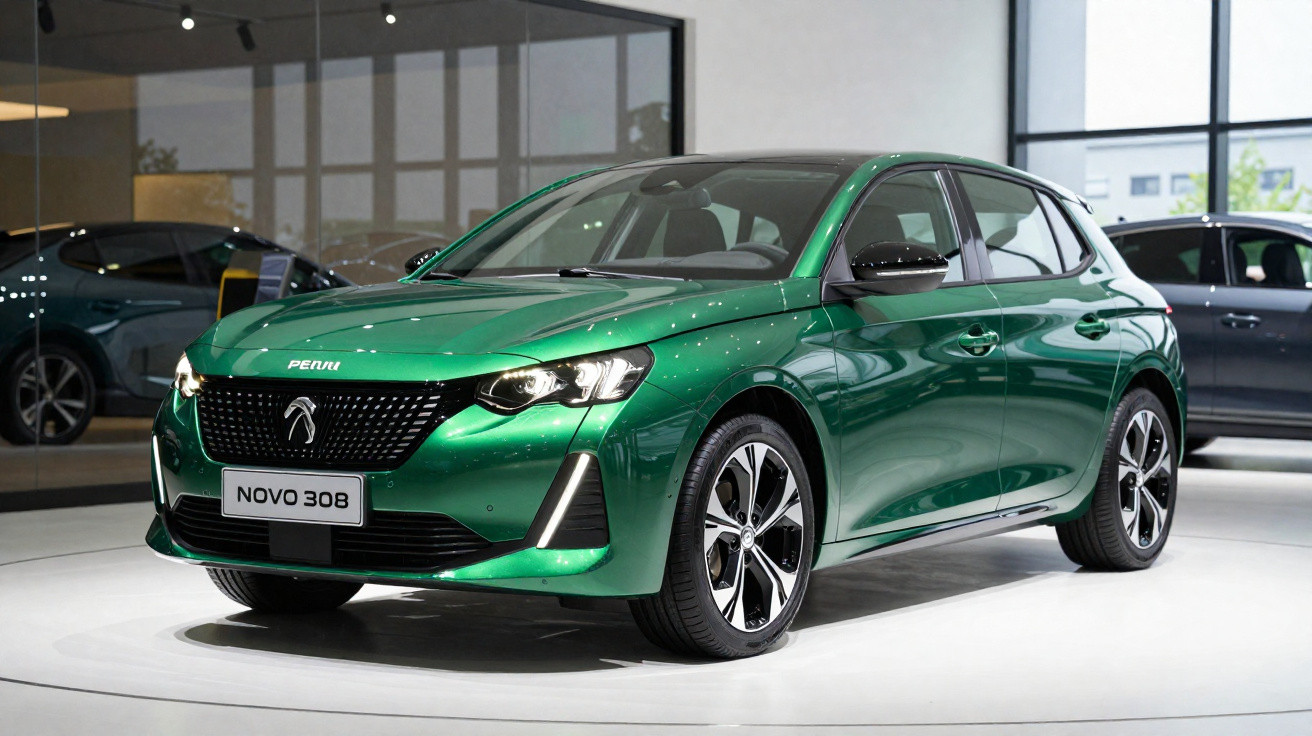
The Peugeot 308 hardly needs a formal introduction. Year after year, it has strengthened its position as one of the Portuguese public’s favourite cars and, in 2026, it returns with an even stronger set of arguments to keep its undisputed lead in the segment in Portugal.
Offered both as a saloon and as the more flexible SW estate, the key to its ongoing success lies in a recipe that pairs striking design with a breadth of drivetrain choice that few rivals can match.
There are options to suit every taste and requirement, from Diesel to 100% electric, without overlooking the 48 V mild-hybrid and the plug-in hybrid (PHEV), with prices starting at 28 285 euros. In this video you can get to know it in detail, and straight away in one of the most desirable configurations: the e-308 GT.
Peugeot DNA remains clearly defined
The first impact comes from a look that feels, at the same time, more assertive and more sophisticated than ever. It is easy to tell this new iteration from the previous model, because the front end has undergone a major stylistic rethink.
The lighting now adopts a split design, with a light signature that stretches across the full width of the assembly, giving it an even more distinctive road presence. Taking centre stage is the brand’s new lion badge, now backlit-an eye-catching detail that reinforces this model’s more premium positioning.
In GT form, that character is pushed further by new 18″ wheels with low-profile tyres, lifting the visual dynamism without sacrificing the ride comfort expected of a family car from the “French school”.
No room for compromises
Peugeot’s focus on the 308’s cabin began even before this generation entered development. The French brand’s engineers spent time studying materials and usage trends, aiming to understand how the interior could age without showing obvious wear.
The outcome is a sturdy, well-assembled cabin, using materials that can cope with more intensive use. That is precisely why the changes are subtle: the underlying formula remains intact, even if there is a clear effort to raise the overall perception of quality.
So much so that the materials used do not fall short of what you would expect from brands with a traditionally more premium reputation, delivering an excellent balance of comfort and minimalism, without compromising day-to-day practicality.
i-Cockpit as part of the driving experience
That is also why, even with the i-Cockpit still at the heart of the experience-featuring a 10” digital instrument panel with a 3D effect (a segment first)-there are still physical buttons on the steering wheel and beneath the central infotainment screen for essentials such as adjusting the volume, switching on the hazard lights, or setting the climate control.
This is complemented by the familiar i-Toggles digital shortcuts, which can be tailored to the driver’s preferences and set up to show the functions used most often-so they are always close at hand.
Depending on the equipment level chosen, the 308’s cabin can feel more or less sporty, with the GT versions offering the most radical expression. Here, Adamite green stitching on the steering wheel, seats and dashboard adds extra bite to a model that never gives up its versatility.
Space tailored to purpose
Regardless of the version or engine you choose, the 308 is designed to carry four adults in genuine comfort. For parents who need to fit one or two child seats in the rear, it should not present an issue either.
What does change is boot capacity, which grows noticeably if you opt for the SW estate. In the saloon, load space ranges from 314 litres to 412 litres (the PHEV versions are the most affected); in the SW, it spans from 467 litres to 599 litres).
These are very different figures, suited to very different uses. If space is not high on your priority list, then taking the saloon home makes sense. But if you fall asleep thinking about the Tetris required to pack away children’s gear and the dog’s things, there is only one move to make: choose the estate.
To drive-and to be driven
Beyond the overall refinement of the package, the Peugeot 308 leans on a strong selection of technology and safety equipment to make any journey more pleasant.
From adaptive cruise control to the emergency braking system, including lane-keeping assistance, blind-spot detection and rear cross-traffic alert, nothing has been left to chance.
In addition, and as is already the case with other models in the brand’s line-up, the 308 now offers ChatGPT integration-capable of helping you put together a shopping list for the next supermarket run, or making it easier to pick a restaurant.
A commitment to variety
Under the bonnet, Peugeot continues its strategic commitment to diversity, refusing to restrict the customer’s options. As a result, the 308 remains a stronghold of energy flexibility, with solutions for virtually every need and usage profile.
The range starts with a Diesel engine, but the real push comes through electrification, with three distinct systems: mild-hybrid 48 V, plug-in hybrid and 100% electric.
The Peugeot 308 BlueHDi, with a 1,5-litre four-cylinder engine producing 130 cv, positions itself as the best fit for drivers who cover a lot of kilometres each year and value longer range. Paired with an eight-speed automatic gearbox, it suits customers who regularly do long journeys, especially on the motorway.
Choices for every taste
The 48 V mild-hybrid versions sit as the first step into electrification and deliver a real impact on consumption, particularly in urban driving. This system, which does not need to be plugged in, pairs a 1,2-litre three-cylinder petrol engine with a 29 cv electric motor and a 0,89 kWh battery.
The Peugeot 308 PHEV-combining a 1,6-litre 150 cv engine with a 125 cv electric unit-follows a different logic, as it supports charging and enables an electric range of up to 86 km (thanks to a 17,2 kWh battery). This means many drivers can handle daily journeys without using a single drop of fuel.
At the top of the 308 line-up is the fully electric version, with 156 cv, capable of travelling up to 450 km on a single charge. It uses a 58,4 kWh battery and supports charging at up to 11 kW on alternating current (AC) and 100 kW on direct current (DC).
As a complete first for the range, the Peugeot e-308 now includes V2L (Vehicle-to-Load), allowing you to power external electrical equipment with output of up to 3,5 kW.
These are four distinct solutions that allow this Peugeot 308 to fit into practically any usage scenario. Naturally, it is worth remembering that both the PHEV and 100% electric versions come with tax benefits that make them obvious choices for business customers. For private buyers, depending on how the car will be used, it may make more sense to consider the other offerings in the range.
Peugeot 308 saloon range prices*:
- Peugeot 308 Hybrid 145 cv: from 28 285 euros
- Peugeot 308 Diesel 130 cv: from 30 920 euros
- Peugeot 308 Plug-in Hybrid 195 cv: from 35 760 euros
- Peugeot e-308 Electric 156 cv: from 34 695 euros
Peugeot 308 SW* range prices:
- Peugeot 308 Hybrid 145 cv (Style): from 29 385 euros
- Peugeot 308 Diesel 130 cv (Style): from 32 020 euros
- Peugeot 308 Plug-in Hybrid 195 cv (Allure): from 38 860 euros
- Peugeot e-308 Electric 156 cv (Style): from 35 795 euros
Promotional prices
Comments
No comments yet. Be the first to comment!
Leave a Comment