
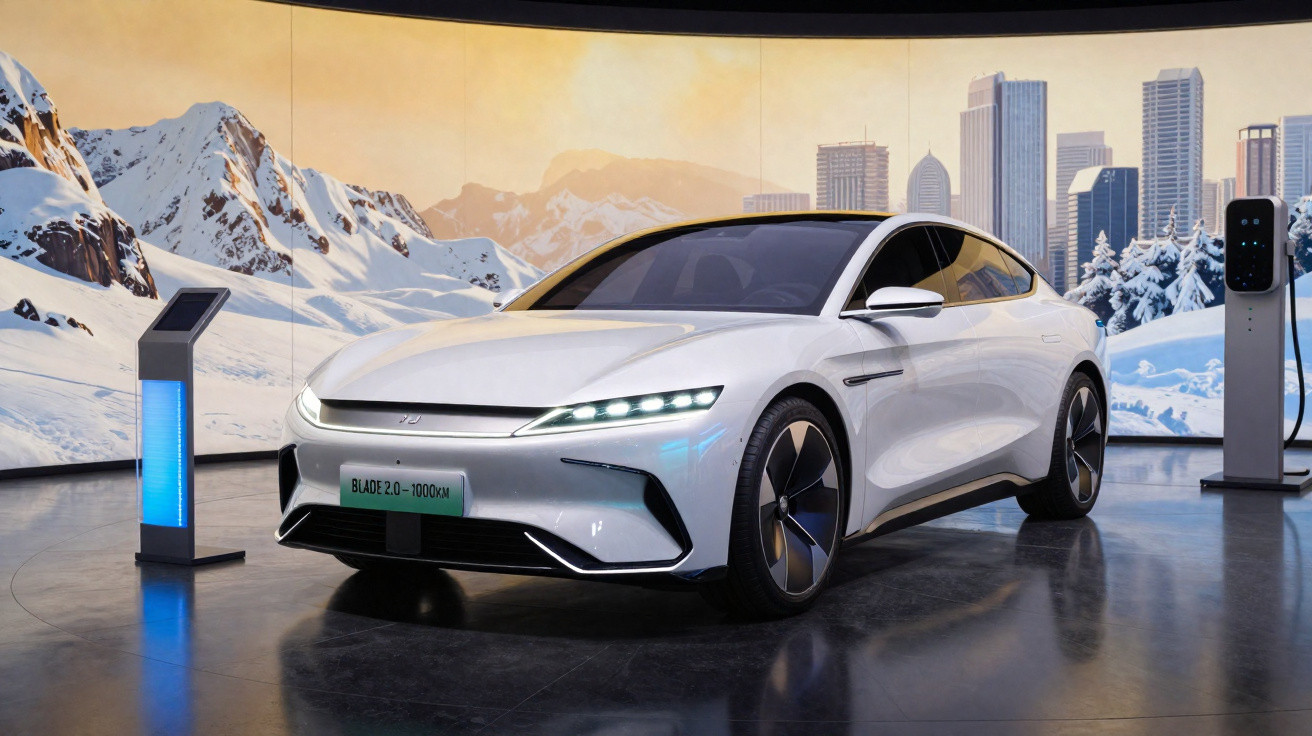
The Chinese manufacturer has just unveiled the second generation of its Blade battery, focusing both on higher energy density and on improving fast-charging performance in cold weather. From 20% to 97%, it is said to take only 12 minutes - even at –30°C.
Presented today at BYD’s automotive headquarters in Shenzhen, the “Blade” battery is entering a new phase. This updated pack will first be fitted to luxury models, with the aim of delivering 1,000 km of range. Beyond efficiency, however, BYD president Wang Chuanfu stressed that the biggest shift is a “revolutionary” new charging approach, designed to sustain extremely high charging power even when temperatures drop well below freezing.
Why BYD is pushing charging power so hard
BYD has moved quickly on the charging front, revealing its first “mega-charger” in 2025. This will be upgraded again in 2026, with charging power set to exceed 2,000 kW by using two cables connected to the vehicle (or 1,500 kW with a single cable plugged in).
For the fleet to take advantage of those rates, the battery itself must avoid becoming the limiting factor in low temperatures. Blade’s LFP chemistry may be safer than NMC, but it is also more sensitive in sub-zero conditions.
Only 12 minutes of charging at –30°C
According to BYD, which showcased its new battery at a special event on Thursday 5 March, the target is to go from 20% to 97% charge in just 12 minutes in an environment at –30°C. Across that window, the car would be able to recover 777 km of range.
The claimed breakthrough is significant: with today’s LFP batteries, charging performance starts to be affected below 10°C, and charging is heavily reduced once temperatures fall below 0°C.
Wang Chuanfu also explained why BYD is now talking about 97% rather than 100%: the brand wants to keep a 3% buffer for regenerative braking. He noted that if the battery could not take any more charge, the regenerative system would not work during the first minutes of driving, forcing the car to rely on conventional braking - and causing unwanted wear.
BYD Blade 2.0 battery: which models will get it
The first vehicles set to receive this second-generation Blade battery are the Denza Z9GT and the Yangwang U7, from BYD’s premium and luxury brands. Their 1,000 km range is said to have already been confirmed, but the figure is based on China’s CLTC cycle, which typically produces higher numbers.
With the associated new charging system, these models are expected to outpace rival offerings - unless suppliers such as CATL match the capability and bring an equivalent solution to market.
Additional vehicles will also adopt the Blade 2.0 battery. BYD announced a new BYD Seal 8 at the same Shenzhen event, with sales planned for the second half of the year. Within BYD’s Ocean line-up, the Sealion 6 and the Seal 7 are also set to receive it in future. The same applies to the Fangchengbao brand and its Tai 7 and Tai 3 models.
“Flash” charging network and rollout plans
As for the “flash” chargers linked to the “mega-chargers”, BYD says it has now passed 4,000 charging posts. By the end of 2026, the target is 20,000 equipped stations, including 2,000 located along motorways.
At temperatures around 20°C, BYD claims it will be possible to go from 10% to 70% in only 5 minutes. These ultra-fast chargers are also planned to arrive in France.

Comments
No comments yet. Be the first to comment!
Leave a Comment