
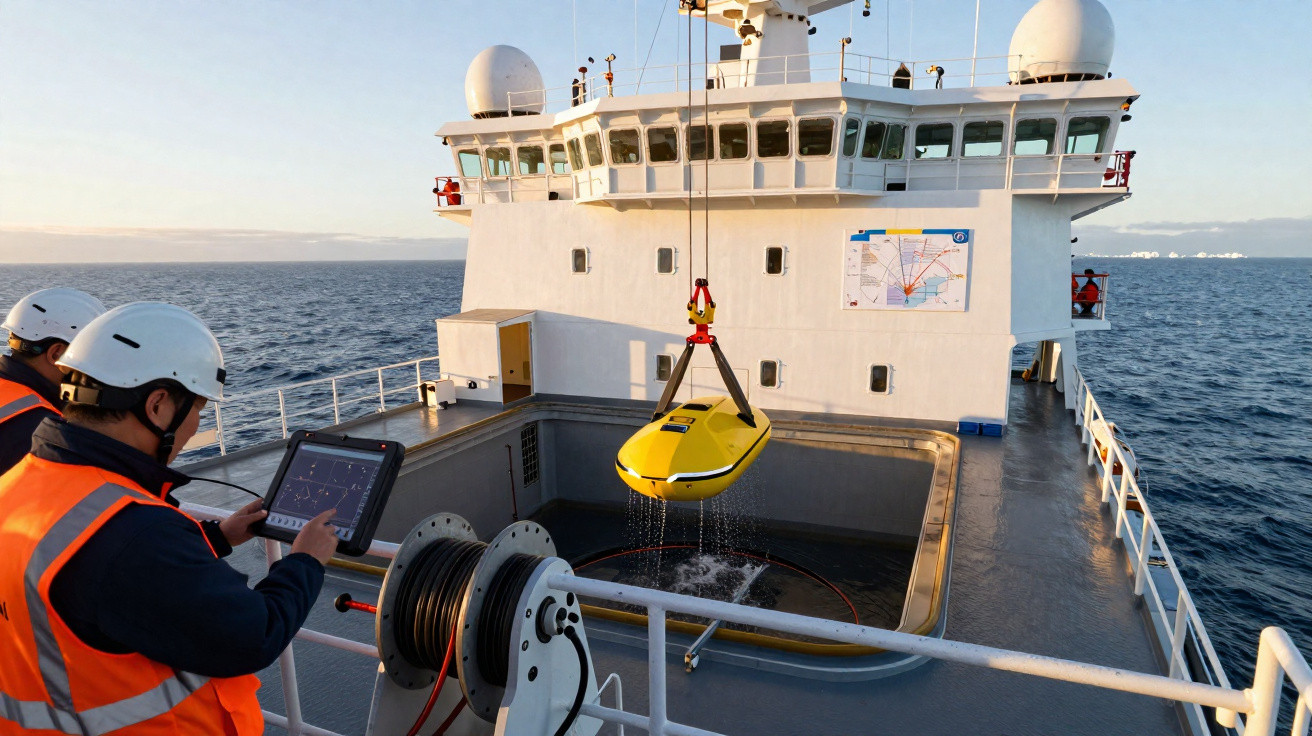
Built for some of the planet’s harshest seas, China’s newest ocean-science flagship is both laboratory and strategic asset. With long reach, high endurance and heavy-duty equipment, it places Beijing in a select group once largely led by the US, Russia and a small number of European states.
A ship built for the long game
At the centre of this change sits the Tansuo‑3, an ocean research vessel formally brought into service in late 2024. On paper, it resembles another large, state-backed science ship. In reality, it represents the payoff from more than ten years of steady funding, capability-building and political intent.
From the late 2010s onwards, Beijing elevated the oceans to a major national priority. In 2018, it even labelled itself a “near‑Arctic state”, making clear that polar waters were firmly within its strategic outlook. That year also saw Chinese officials promoting a “Polar Silk Road”, pitched as a northern branch of the Belt and Road Initiative aligned with prospective shipping routes through an increasingly ice-free Arctic.
Policy messaging was matched by investment in assets. China increased the number of its research icebreakers, including the Xuelong line and additional support vessels designed for extended, long-range deployments. Tansuo‑3 is the most advanced outcome of that drive so far: large enough to work well beyond home waters, capable enough to host complex scientific operations, and tough enough to cope with polar ice.
The Tansuo‑3 is less a one‑off showpiece than the visible tip of a carefully assembled maritime strategy.
Underpinning this long-term effort is a tightly linked network connecting state institutes, major shipbuilders and technology companies. National laboratories set out scientific requirements; naval designers translate them into hull forms and propulsion; and electronics specialists supply the sonars, navigation systems and deep-ocean robotics that provide a decisive edge.
Tansuo‑3: a floating laboratory with polar teeth
Measuring 104 metres in length and displacing about 10,000 tonnes, Tansuo‑3 is closer in scale to a small commercial vessel than to a conventional research ship. Its unrefuelled range is roughly 28,000 kilometres-sufficient to depart a Chinese port, operate for weeks in the Arctic or the western Pacific, and return within a single mission cycle.
It can make close to 30 km/h at top speed, notable for such a substantial hull, and it accommodates up to 80 people on board. That headcount covers ship’s crew along with the scientists and engineers needed to operate its labs, instrument suite and submersibles.
A standout design element is the large “moon pool”: a 6 by 4.8 metre opening set within the centre of the hull, linking the ship’s interior directly to the sea beneath.
The moon pool gives the Tansuo‑3 a protected vertical shaft through which it can launch robots and recover equipment even in rough seas or floating ice.
Its core technical fit includes:
- Next-generation multibeam sonar systems for seabed surveying and detecting targets within the water column
- Launch and recovery arrangements for crewed submersibles, including the deep-diving Fendouzhe
- Specialist laboratories dedicated to geology, biology and environmental monitoring
- Bidirectional icebreaking capability, enabling operations in pack ice either bow-first or stern-first
Constructed at a major Guangzhou shipyard and put through sea trials in 2024, the vessel is run by the Institute of Deep‑Sea Science and Engineering in Sanya, part of the Chinese Academy of Sciences. This relationship gives it priority access to some of China’s most sophisticated underwater vehicles and leading research teams.
Beyond science: from trenches to ancient wrecks
China frames Tansuo‑3 primarily as a scientific workhorse. Its planned agenda is extensive: high-detail surveys of deep-ocean trenches such as the Manila Trench at more than 5,000 metres, monitoring how climate change is altering ocean circulation, and examining delicate ecosystems around hydrothermal vents.
The ship is also equipped for underwater archaeology-an area Beijing increasingly links to national prestige. Using the moon pool and heavy cranes, it can retrieve vulnerable artefacts from wreck sites or historic trade routes and bring them to the surface with reduced risk of damage for conservation.
A further stated focus is environmental monitoring. Sensors on board can measure temperature, salinity, chemical contaminants and microplastics, while submersibles inspect coral communities and deep-sea species. The resulting datasets support climate modelling and feed into national evaluations of marine resources.
By covering geology, biology, archaeology and climate science in one platform, Tansuo‑3 grants China a high degree of research autonomy far from its own shores.
A science ship that unsettles rivals
Tansuo‑3 might attract limited scrutiny if the oceans were not fast becoming a focal point for strategic competition. But they are-and that setting shapes how each voyage is interpreted.
In 2025, the ship joined a 98‑day Arctic expedition that used crewed submersibles. Officially, the mission aimed to collect information on ice conditions, seabed characteristics and polar ecosystems. Western security circles read it differently: as a real-world assessment of how Chinese personnel, systems and logistics hold up in high-latitude, high-risk operating environments.
For states such as the US, Canada and Norway, the moment is significant. Retreating sea ice is steadily shortening routes between Asia and Europe, and Arctic continental shelves may contain undeveloped oil, gas and mineral deposits. Any country able to operate routinely in these waters gains influence over future shipping corridors and resource-related claims.
Chinese officials emphasise compliance with international maritime law and present Tansuo‑3’s deployments as transparent, cooperative research. They point to joint cruises with overseas institutions and note that other major powers also blend national interests with ocean science.
Opponents-including some defence analysts cited by international agencies-counter that such voyages generate dual-use insights. Seafloor mapping, long-distance communications trials, under-ice work and practising at-sea resupply can all support both civilian objectives and military planning.
For sceptics, every “scientific” chart of the seabed is also a potential navigation aid for future submarines or undersea cables.
Deep data and soft power
Alongside security debates, Tansuo‑3 serves as an instrument of science diplomacy. By hosting international researchers, releasing ocean datasets and contributing to UN-supported observation programmes, Beijing can position itself as a constructive participant in global governance.
At the same time, possession of extensive, high-resolution data brings leverage in climate negotiations, fisheries talks and rule-making for deep-sea mining. States and firms seeking access to that information may find themselves pulled towards partnerships shaped and led by China.
Why this ship matters for the deep ocean race
To non-specialists, the attention focused on a single research vessel can look excessive. Yet Tansuo‑3 connects directly to a growing contest over who defines the rules and norms governing the seabed.
The deep ocean contains polymetallic nodules rich in cobalt, nickel and rare earth elements that are essential to batteries, electronics and wind turbines. Under the UN Convention on the Law of the Sea, many nodule-rich regions lie in international waters overseen by the International Seabed Authority, which is still completing its mining code.
Countries that can dispatch ships and submersibles to these far-flung areas gain influence-and potentially an early advantage-when commercial extraction becomes feasible. The environmental baselines, species catalogues and mineral assessments compiled today will shape future licensing choices.
China already sponsors multiple deep-sea exploration blocks in the Pacific under ISA rules. A vessel like Tansuo‑3 strengthens its capacity to study and define those areas using domestic technologies and personnel, rather than depending on non-Chinese platforms.
| Key capability | Strategic relevance |
|---|---|
| Long endurance (28,000 km range) | Supports sustained presence in distant oceans and polar regions |
| Moon pool and heavy lift gear | Allows safe deployment of submersibles and recovery of equipment or artefacts |
| Icebreaking hull | Opens access to Arctic and Antarctic research zones |
| Advanced sonar suite | Enables high‑resolution seabed mapping and object detection |
What “moon pool” and “deep‑sea submersible” really mean
Some of the terminology used around Tansuo‑3 is worth clarifying. A moon pool-despite its evocative name-is essentially a large, watertight shaft built within the hull. Once the ship is on station, the opening is exposed to the sea, allowing instruments to be lowered straight down through the centre of the vessel rather than over the side. This reduces the effect of waves and ice and improves safety when conditions are rough.
Deep‑sea submersibles, including China’s Fendouzhe, are compact crewed capsules or uncrewed robots engineered to survive extreme pressures thousands of metres below the surface. They rely on thick titanium or steel structures, powerful lighting and strong thrusters to work close to the seabed. Deployed from a ship such as Tansuo‑3, they can collect rock, sediment and biological samples and record high-definition video for later study.
Risks, benefits and possible futures
For ocean science, the arrival of a capable new platform is usually positive. Increased measurements of deep currents, seabed geology and polar ice can improve climate projections and support coastal planning. Shared cruises and the open release of findings can also create scientific links at a time when trust is in short supply.
The danger sits in the space between stated aims and potential applications. As more nations deploy vessels equipped with advanced sensors and submersibles, it becomes harder for outsiders to distinguish a research mission from a strategic survey. That uncertainty can intensify suspicion, prompting others to invest in their own capabilities and impose tighter rules.
A more constructive path would involve integrating ships such as Tansuo‑3 more fully into genuinely multinational programmes, with joint planning, mixed teams and clear, transparent data practices. Under such a model, missions would still advance national interests, but in ways that also reduce friction at sea.
For the moment, Tansuo‑3 operates as both emblem and instrument: an emblem of China’s intent to be recognised as a serious maritime power, and an instrument enabling it to map, measure and operate in waters that once lay beyond its practical reach. How other countries react will shape whether the coming decade of deep-ocean activity leans towards cooperation or quiet confrontation.





Comments
No comments yet. Be the first to comment!
Leave a Comment