
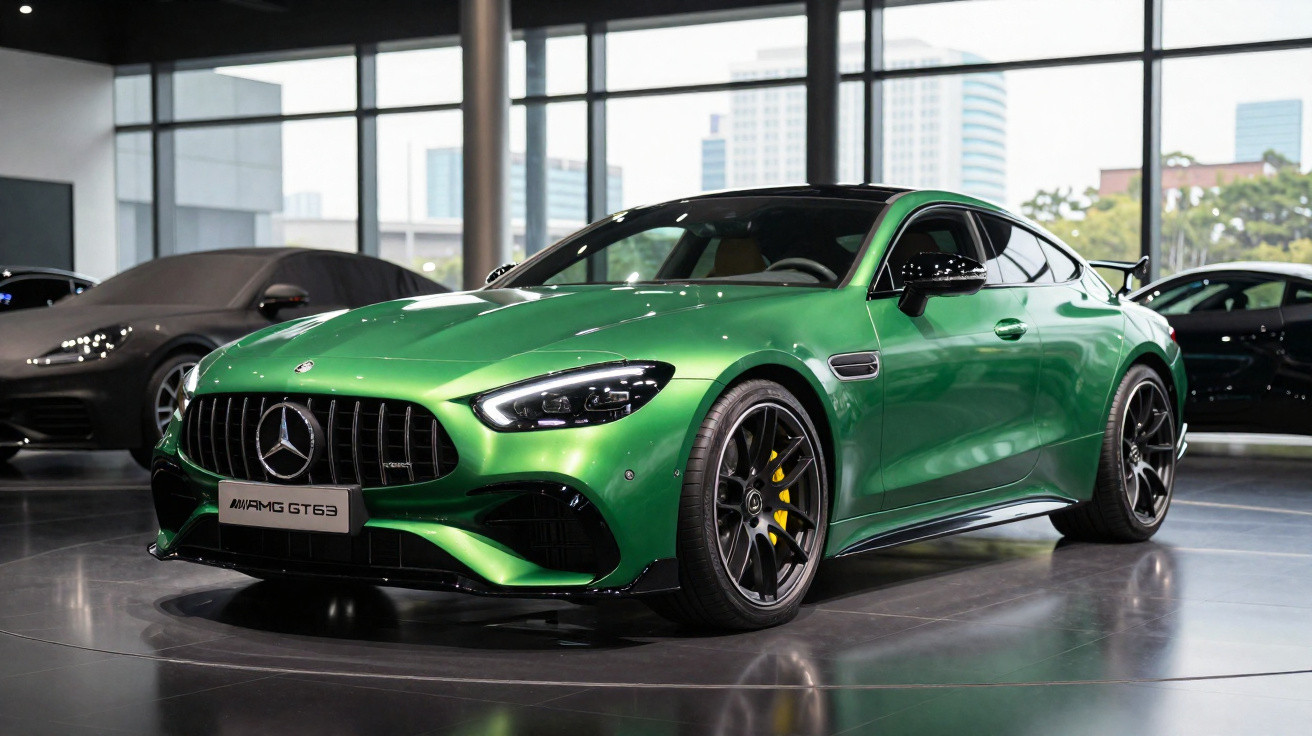
The Mercedes-AMG GT 63 Pro arrives in a niche where huge performance, serious money and status all converge. From the kerb, it looks like the sort of car you’d naturally weigh up against Porsche’s legendary 911. Internally at AMG, however, the message is that their customers aren’t even visiting Porsche dealers.
Two-door coupe, two very different mindsets
On paper, the GT 63 Pro and the 911 appear to match up neatly. They’re both low-slung two-door coupes, both can be configured as a 2+2, and both chase attention with eye-catching performance stats. AMG’s view is that the similarities end once you move beyond the brochure.
At the car’s Australian launch, Mercedes-AMG executives pointed to a customer group that is already heavily invested in the marque. Many buyers, they said, are coming out of cars such as the G63 SUV or the E63 saloon and want something that feels sharper and more emotionally charged to park alongside what they already own.
The GT 63 Pro is pitched less as a Porsche alternative and more as the next step for hardcore AMG loyalists.
Seen that way, the purchasing decision looks different. A driver moving from a G63 into a GT 63 typically isn’t losing sleep over 911 options lists. They’re staying for the badge they know, the particular character of AMG’s V8, and the loud, unapologetic attitude that comes with it.
Front engine versus rear engine: the character divide
Mechanically, the two cars are built around very different ideas. The Porsche 911 remains faithful to its rear-engine formula, with the flat-six positioned over the rear axle. That layout delivers strong traction, a recognisable handling balance, and a silhouette that’s instantly familiar worldwide.
The AMG GT 63 Pro takes the opposing approach. Its twin-turbo V8 is mounted up front, set back behind the front axle line in a traditional grand tourer-style arrangement. Drive is sent to all four wheels via AMG’s 4Matic+ all-wheel-drive system.
Identical segment on paper, different philosophies on the road: the AMG is a front-engined bruiser, the 911 remains a rear-engined precision tool.
That difference shapes the experience. A 911 tends to feel tight, agile and rear-led. The GT 63 Pro comes across as longer and more broad-shouldered-more of a high-speed continent-crossing machine that still has the bite to intimidate on a circuit.
610 hp: AMG aims straight at Stuttgart’s performance targets
Even if AMG downplays direct rivalry, the figures make it clear Porsche is part of the benchmark set. Beneath the long bonnet is AMG’s familiar 4.0-litre twin-turbo V8, developed here to produce 610 hp and 850 Nm of torque in GT 63 Pro specification.
- Engine: 4.0-litre twin-turbo V8
- Power: 610 hp
- Torque: 850 Nm
- Drivetrain: 9-speed automatic, 4Matic+ all-wheel drive
- 0–100 km/h: 3.1 seconds
- Top speed: 317 km/h
Compared with the regular GT 63, that’s a worthwhile lift: 26 extra horsepower and an additional 50 Nm. It also places the AMG neatly within Porsche’s own performance ladder-more potent than the hybrid-assisted 911 GTS (535 hp, 609 Nm), while sitting just under the 911 Turbo S (711 hp, 800 Nm).
Purely on pace, AMG isn’t shying away from the comparison. A 0–100 km/h run of 3.1 seconds and a 317 km/h maximum speed move the GT 63 Pro into a bracket traditionally associated with full-blown supercars, rather than merely fast GT machinery.
Sound and sensation: flat-six versus V8 thunder
There’s also an element that isn’t rational, yet often decides everything: the way the car sounds. The 911’s flat-six is steeped in motorsport history and delivers a distinctive wail as the revs climb-part of the model’s identity for many fans.
AMG counters with something no less characterful: a heavy V8 bassline, turbo rush, and crackles and pops through the exhaust. For committed AMG owners, that sound is a major part of the appeal-and a key reason a Porsche key fob never really enters the conversation.
For many GT 63 Pro buyers, the V8 soundtrack is not a detail; it is the emotional hook that keeps them in the AMG camp.
Why AMG customers are staying put
From Mercedes-AMG’s standpoint, the GT 63 Pro is presented as the obvious progression for people already in their ecosystem. Owners of fast SUVs and high-performance saloons often want something more extreme, but they want it delivered with the same badge, the same cabin feel and the same general interface they’re used to.
That attachment isn’t only emotional; it’s behavioural as well. Long-term AMG customers already know the dealer setup, the ordering process and the interior design language. Moving to a 911 would mean adapting to a different ownership cadence, different ergonomics, and even a different kind of reputation in the office car park.
In AMG terms, the GT 63 Pro plugs an important hole: supercar-level numbers combined with everyday usability, familiar technology, and a brand story their buyers already buy into.
Porsche still stands alone as a benchmark
None of this is to suggest the 911 is being written off. Across the wider industry, it continues to be a reference point for steering feel, chassis precision and track performance. Its rear-engine design gives it a balance competitors still find difficult to emulate.
AMG’s argument is simply that plenty of its customers can admire the 911 without feeling the need to own one. They respect what the Porsche represents, but when it’s time to spend, they stick with the three-pointed star.
Reading the spec sheet: enthusiasts versus real buyers
Online, it’s common for enthusiasts to fixate on lap times, drivetrain layouts and acceleration data. Buyers in the real world often prioritise different things. Someone stepping out of a £150,000 G63 could be juggling school runs, winter weather and image, as well as the occasional weekend blast.
By that measure, the GT 63 Pro has a strong day-to-day case. It brings four-wheel drive, an infotainment system that feels familiar to Mercedes owners, and the comfort and convenience kit expected in a modern Mercedes. It also delivers supercar speed without the trade-offs typically demanded by a mid-engined exotic.
| Aspect | AMG GT 63 Pro | Typical 911 (GTS/Turbo) |
|---|---|---|
| Engine position | Front-mid | Rear |
| Main customer path | Existing AMG owners | Sports car enthusiasts, mixed brands |
| Character | High-speed GT, big V8 feel | Compact, track-focused |
| Image | Muscular, luxury performance | Iconic sports car |
What “2+2” and “AMG 4Matic+” really mean for owners
Two phrases come up repeatedly with cars like the GT 63 Pro and the 911: “2+2” and “all-wheel drive”. They read like jargon, but they change what living with the car is actually like.
A 2+2 setup means two proper seats up front and two smaller rear seats. In reality, the back row is best for children, short hops, or extra bags. For AMG customers coming from an E63, it can feel like a step down in practicality. For anyone used to a strict two-seat sports car, those extra seats can feel like genuinely useful flexibility.
AMG’s 4Matic+ is an all-wheel-drive system capable of varying how power is split between the axles. In the dry, it helps deliver savage launches. In the wet or cold, it makes the performance easier to access safely. For a high-output, front-engined coupe, that reassurance matters to owners who drive all year, not only on sunny weekends.
How a typical AMG garage could evolve
Imagine a common AMG household: a G63 as the daily, perhaps an E-Class or S-Class for work, plus room for one dedicated “fun” car. Rather than swapping any of that for a Porsche, the GT 63 Pro can slot in as the sharper plaything while keeping the same badge on the nose.
That owner also keeps one servicing relationship, one connected-car environment and a consistent set of controls and design cues across the fleet. For wealthy buyers, that sort of simplicity has genuine value, even if it doesn’t headline a launch presentation.
Looked at through that prism, AMG’s insistence that GT 63 customers aren’t truly cross-shopping a 911 makes more sense. The cars may chase similar numbers and attract similar headlines, but for many buyers the decision is effectively made before they’ve even opened a configurator: loyalty to the brand, preference for the driving character, and everyday needs pull them firmly towards the AMG keys.

Comments
No comments yet. Be the first to comment!
Leave a Comment