
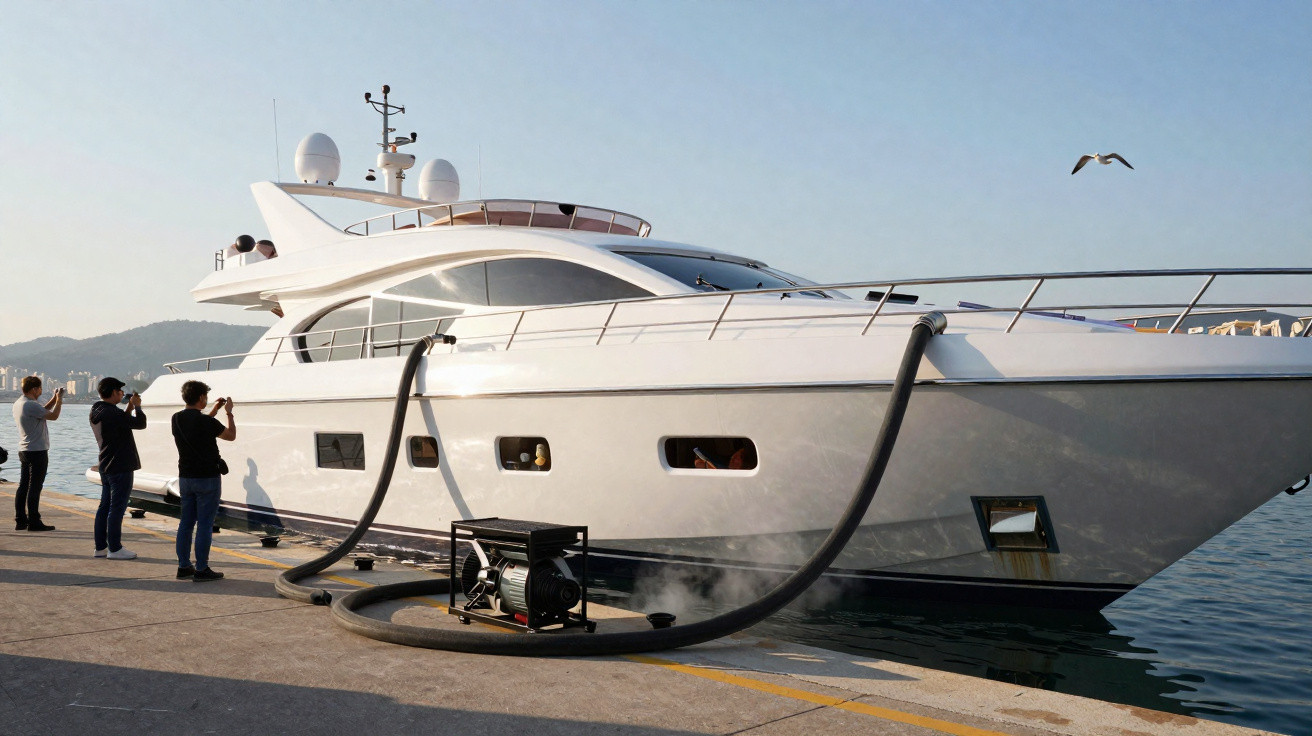
The superyacht lay utterly motionless in the harbour, a glass-and-chrome illusion made real. There were no deck parties, no jet skis carving up the water-just a floating palace that wasn’t going anywhere. And yet, from the quay, you could still hear it: a steady, industrial thrum, generators droning as they battled the Mediterranean heat. Crew members drifted about with practised quiet, reading dials, buffing metalwork nobody would notice, protecting a kind of emptiness. The owner hadn’t been aboard for months.
What did keep arriving, without fail, was the fuel truck.
The $500 million freezer that never left the dock
For three years, a 90-metre superyacht stayed tied up in the same European marina, barely ever easing its lines. People nearby started to tease that it wasn’t really a boat at all, but a five-star office block afloat. Most days the gangway remained raised, but the air conditioning ran as if it were peak season. Diesel generators worked close to constantly, simply to hold the interior at a controlled 21°C-ready “in case the owner flew in on short notice,” as one former crew member put it.
The sea alongside it barely stirred. The exhaust, however, carried on regardless.
On paper, the yacht counted as “inactive”. In practice, it was swallowing thousands of litres of fuel every week. Marina workers grew used to the routine: bunkering lorries pulling in, hoses uncoiling across the quay, huge tanks being topped up-not for ocean passages, but for cooling hot tubs and climate-controlling marble-lined suites. Estimates for comparable vessels suggest that, even at the dock, a large yacht can burn 500 to 1,000 litres of diesel per day just to cover hotel load. Across three years, that becomes hundreds of tonnes, almost unnoticed.
The most jarring detail was how rarely it was used: the owner came fewer than ten times.
What sustained the constant humming wasn’t necessity, but the logic of anticipation. With multibillionaire wealth, the yacht is expected to live in permanent readiness-like a private jet on standby, always “warm” in spirit if not in literal engine temperature. The crew can’t just shut the place down and walk away. Everything is linked: air conditioning, humidity management, navigation and communications electronics, galley refrigeration, surveillance and access control. Remove climate control and high-end materials can distort, mildew can take hold in soft furnishings, and sensitive systems can degrade.
Luxury resists being switched off. It prefers to idle, indefinitely.
How a moored superyacht quietly burns through a planet’s patience
Ask engineers who’ve maintained these floating mansions and you’ll hear the same point repeated: the biggest fuel drain doesn’t always happen while sprinting between Monaco and Mykonos. Often, it happens when the yacht is apparently doing nothing at all. An unseen “city” keeps running: chilled-water systems forcing cold air through multiple decks, watermakers standing by, batteries continually replenished, stabilisers working gently even while alongside.
In a spreadsheet it’s labelled “hotel load”. Down on the quay, it’s the smell of diesel.
One captain, speaking privately, recalled an extended standby stretch in the Middle East. The owner stayed away for eight months. Even so, the yacht remained fully staffed, exterior lighting on each night, and air conditioning flowing through every level. “We were burning about 700 liters a day, with no guests,” he said. “That’s just to keep everything pristine and at owner temperature.” He chuckled at the phrase “owner temperature”, but the figure lingered. Over eight months, that pace adds up to well over 160 tonnes of diesel.
No evening cruise. No voyage. Only the anxiety of being found unprepared.
Purchasing the yacht is the dramatic part; sustaining it is the quiet, expensive routine. The machinery and controls are so intricate that a full shutdown can feel like an invitation to trouble-or, at the very least, a major hassle. Engineers fret about condensation, corrosion, and electrical spikes when systems come back online. Management firms sell a guarantee of effortless perfection: step aboard and everything works, immediately, whenever you like. That promise carries an energy bill built into the fine print. This is where the fantasy of “ultimate freedom” meets a stubbornly physical, fuel-hungry reality.
It’s the side of the story that rarely makes it onto Instagram.
Between outrage and fascination: what this yacht really says about us
A quick way to make the scale legible is to bring it down to everyday life. Picture leaving the air conditioning running at full tilt all summer in a home you hardly enter, simply because you might fancy a weekend there. Now expand that “home” until it’s closer to the size of a small cruise ship. Add commercial-grade freezers, satellite and network systems, a complete gym, cinema, spa, lifts, dozens of cabins, and a garage for tenders. Every convenience “just in case” relies on wiring, pumps, fans, motors.
Then extend it across three years. The waste starts to feel almost unreal.
And still, there’s an awkward pull of curiosity. Because, in a smaller form, many of us recognise the impulse. We’ve left the car’s air con running while we waited. We’ve stayed under the shower longer than we should. We’ve flown for a quick weekend because the fare was cheap. Remove price sensitivity, remove anyone able to say “no”, and it’s not hard to imagine a 90-metre yacht cooling empty suites for an absent owner.
Be honest: almost nobody behaves like this each day when it’s their own money on the line.
Some owners do make efforts to reduce the footprint. Newer superyachts may include larger battery banks, shore-power capability, or hybrid propulsion. In a few high-profile destinations, port authorities now provide “cold ironing”, allowing yachts to plug into cleaner grid electricity and cut generator running. But when the prevailing expectation is constant readiness and flawless comfort, efficiency measures are always trying to catch up.
“The real luxury isn’t the yacht,” one environmental researcher told me. “It’s believing you can burn energy without ever noticing the burn.”
- Hotel load never sleeps - Even without guests, big yachts routinely keep power-hungry systems running 24/7.
- “Owner-ready” mindset - Crews are expected to maintain perfection at all times, quietly locking in heavy energy use.
- Invisible emissions - Because the yacht doesn’t move, locals may assume it’s benign, while generators run day and night.
- Technology can help - Shore power, improved insulation, and batteries can reduce harm, but they don’t change the culture driving the demand.
- Mirror effect - These accounts sting because, in smaller ways, they echo our own comfort-first habits.
What stays with you after the diesel smoke drifts away
Imagine that yacht once more: fixed in its berth, bright hull throwing back the glare of a hot afternoon. For visitors, it’s a glamorous backdrop for photos. For the crew, it’s a workplace that cannot be powered down. For the owner, it may be little more than another holding-an asset expected to remain perpetually “on”, awaiting a whim. The real engine isn’t only below decks; it’s the narrative that says we should be able to have anything, instantly, whenever we decide we want it.
You don’t need to own a superyacht to recognise the same storyline. Maybe it’s the gym membership that goes unused, the second home empty for most of the year, or the gadgets left on standby in every room. At a planetary scale, the superyacht is simply the most visible, most photogenic example of a pattern that spans incomes: comfort comes first, while the cost stays out of sight.
Next time you walk a marina and pass a silent giant quietly vibrating at the dock, you may hear it in a new way-not merely a rich person’s toy, but a question suspended in warm air. How much are we prepared to burn, simply so something can be “ready” for a moment that may never arrive?
| Key point | Detail | Value for the reader |
|---|---|---|
| Hidden fuel burn | Moored superyachts can consume hundreds of litres of diesel per day just for “hotel load.” | Helps you grasp the real impact of luxury assets that appear inactive. |
| Culture of readiness | Owners expect instant, perfect comfort, pushing crews to keep systems running nonstop. | Invites you to reflect on your own “always-on” habits around comfort. |
| Symbol, not exception | The idle superyacht is an extreme version of everyday energy waste. | Turns outrage into a chance to rethink smaller, personal choices. |
FAQ:
Question 1
How much fuel can a large superyacht burn while moored and not sailing?
For a 70–100 metre yacht, engineers often cite 500–1,000 litres of diesel per day for generators and essential systems, even if it never leaves the dock.Question 2
Why can’t crews simply switch off the air conditioning when the owner isn’t on board?
They’re concerned about humidity, mould, damage to timber and textiles, and vulnerable electronics. On top of that, many management agreements require the yacht to remain “owner-ready” at all times.Question 3
Do some ports let superyachts plug into cleaner electricity instead of running generators?
Yes. Major marinas in Europe and the US are adding shore power so yachts can connect to the grid, reducing local air pollution and noise depending on how the electricity is generated.Question 4
Are there superyachts designed to be more eco-friendly?
A newer generation uses hybrid propulsion, batteries, improved insulation, and even solar panels, but their overall resource use remains substantial because of their size and onboard luxuries.Question 5
Why do stories about idle superyachts provoke such strong reactions?
Because they combine fascination with anger: extreme wealth made visible, obvious waste, and an uneasy recognition that the same attitude shows up-on a smaller scale-in our own daily routines.




Comments
No comments yet. Be the first to comment!
Leave a Comment