
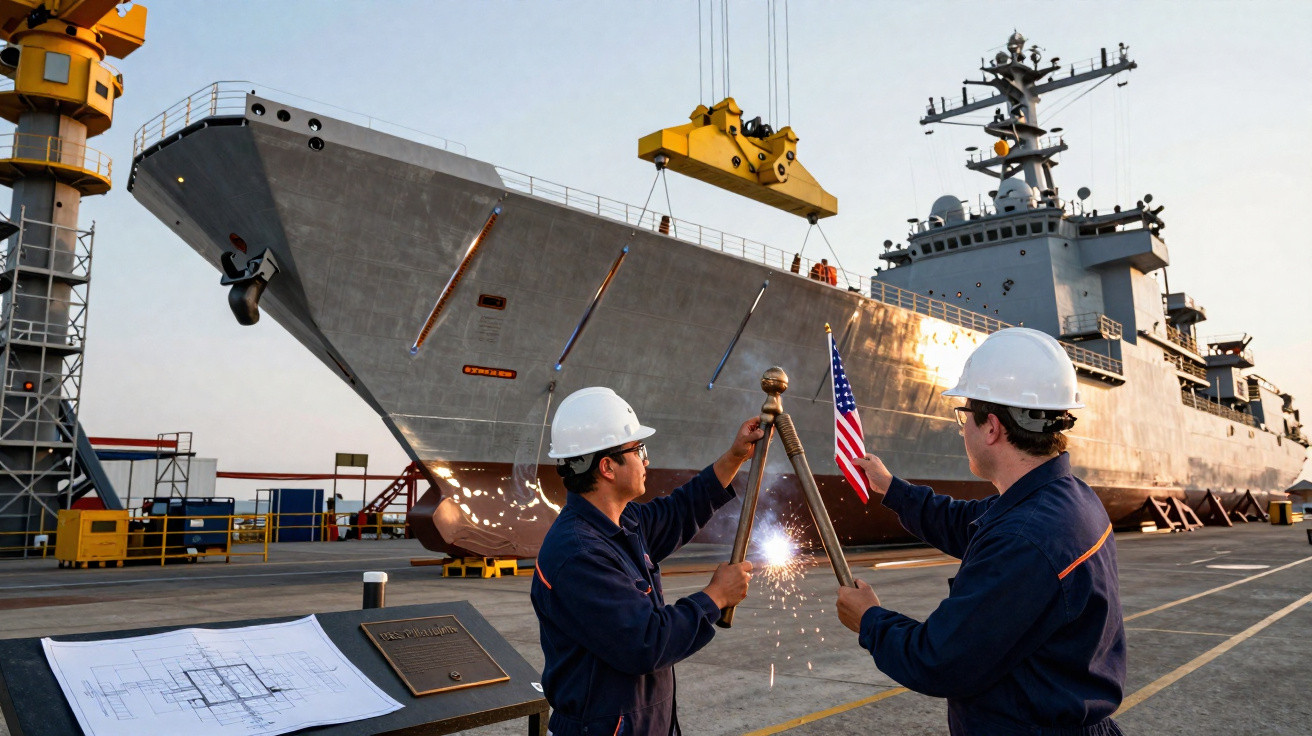
Keel-laying ceremony for USS Philadelphia (LPD 32)
The United States Navy (US Navy), working alongside industry partners, has recently held the keel-laying ceremony for the future USS Philadelphia (LPD 32)-the 16th amphibious transport dock of the new San Antonio-class. The event took place on 3 March at Ingalls Shipbuilding, the Huntington Ingalls Industries (HII) shipyard division.
This milestone represents a pivotal moment in the ship’s build, signalling the transition from plans and design work to the physical construction of the vessel, which is intended to join the US Navy’s amphibious fleet in the years ahead.
Why the ship is named Philadelphia
The ship takes its name from the city of Philadelphia, acknowledging the city’s historic and maritime contribution to the United States. Philadelphia is widely regarded as the birthplace of both the United States Navy and the United States Marine Corps (USMC). It was also home to the historic Philadelphia Naval Shipyard, which operated from 1801 to 1995 and built numerous warships for the US Navy.
Keel authentication tradition and the ship’s sponsor
Keel authentication is a centuries-old naval custom that marks an important stage in constructing a ship. For USS Philadelphia (LPD 32), the authentication was carried out when the initials of the ship’s sponsor, Maureen Paparo, were welded on to a steel plate that will later be permanently affixed to the hull.
Paparo is from Philadelphia and is the wife of Admiral Samuel Paparo, who serves as the 27th commander of United States Indo-Pacific Command (USINDOPACOM).
During the ceremony, Captain Matthew Tardy, Amphibious Warfare Programme Manager within the US Navy’s Programme Executive Office for Ships (PEO Ships), underlined the importance of the project. “The future USS Philadelphia honours one of America’s founding cities and its ongoing support for the Navy and the maritime domain,” the officer said, adding that “this keel-laying marks the ceremonial start of construction and we look forward to delivering this ship to the fleet”.
San Antonio-class ship characteristics
San Antonio-class (LPD) amphibious transport docks are designed to embark, move and land elements of landing forces across a range of expeditionary warfare missions. These ships can also be employed for humanitarian assistance and disaster relief, providing the US Navy and the USMC with modern, sea-based capabilities intended to operate alongside 21st-century systems.
They are built to integrate with assets such as Landing Craft Air Cushion (LCAC) hovercraft, modern helicopters, and vertical/short take-off and landing aircraft including the MV-22 Osprey (MV-22). Together, this mix enables San Antonio-class ships to function as amphibious power-projection platforms with a high degree of interoperability and survivability in complex operational environments.
Construction background and Flight II programme
Construction of USS Philadelphia (LPD 32) sits within the wider effort to expand the United States’ amphibious fleet. In January 2025, HII announced the start of the ship’s construction process, noting that it will be one of the vessels configured to the San Antonio-class Flight II standard.
The first ship of this variant was launched in October last year and is expected to join the US Navy shortly as USS Harrisburg (LPD 30).
At present, Huntington Ingalls Industries is the only shipbuilder responsible for constructing this class, having previously delivered ships from LPD 17 through to LPD 29. The company is simultaneously working on USS Harrisburg (LPD 30), USS Pittsburgh (LPD 31) and USS Philadelphia (LPD 32). Meanwhile, in September 2024, the US Navy signed an agreement worth more than US$5.8 billion to build three additional ships: LPD 33, LPD 34 and LPD 35.
Cover image for illustrative purposes.





Comments
No comments yet. Be the first to comment!
Leave a Comment