
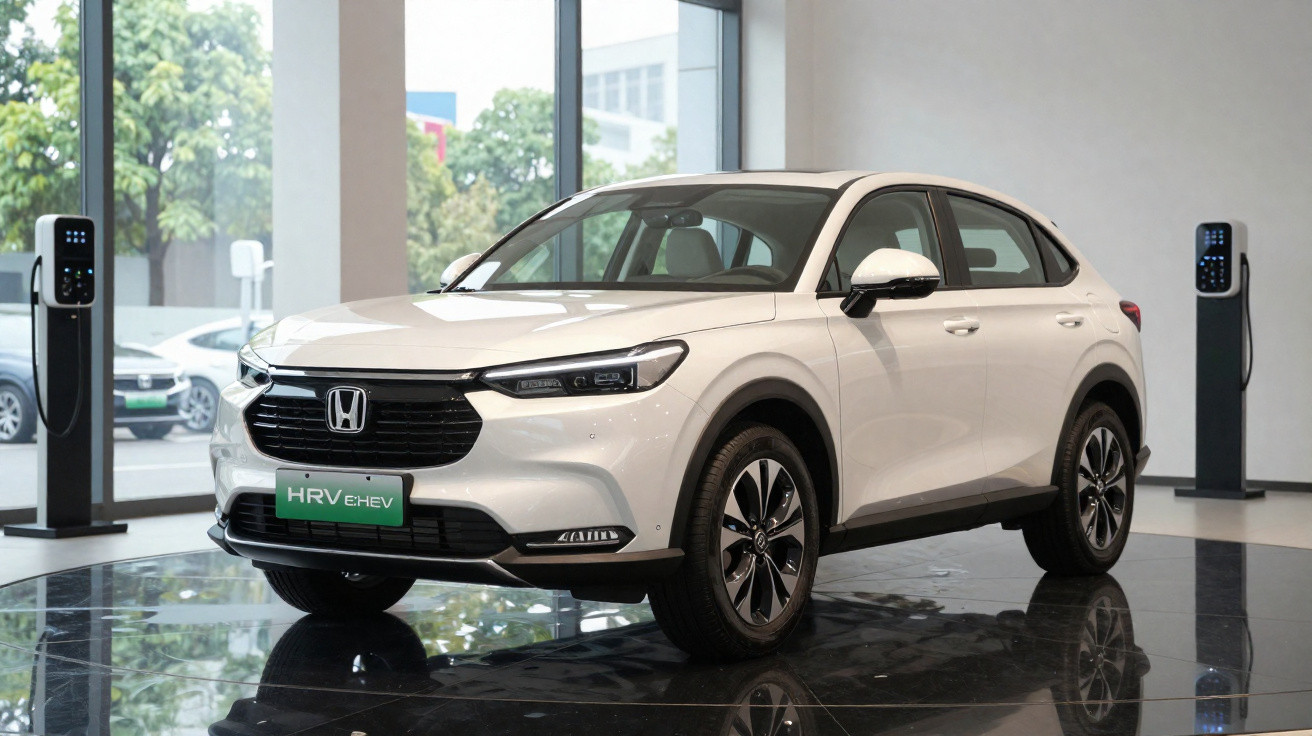
The new Honda HR-V was unveiled several months ago and is now edging closer to its launch in Portugal, which should only happen at the start of 2022. The semiconductor shortage affecting the car industry is to blame.
Even so, we’ve already had the chance to see it up close and get some hands-on time during a short drive on the outskirts of Frankfurt, Germany, where we were able to gauge the efficiency of the hybrid system - now, more than ever, one of its strongest selling points.
That’s because, in this third generation, the HR-V is available only with Honda’s e:HEV hybrid powertrain, familiar from models such as the Jazz. But was this the right move? To find out, I invite you to watch our first video look at this new Japanese SUV.
An almost-electric hybrid
Honda has already confirmed that in 2022 it will offer a fully electrified line-up in Europe, with the exception of the Civic Type R. That alone goes a long way towards explaining why the new HR-V comes exclusively with a hybrid powertrain.
In total, there are 131 hp of maximum power and 253 Nm of peak torque, delivered by the traction electric motor. The HR-V’s drivetrain also includes a second electric motor (generator), a 60-cell lithium-ion battery (the Jazz has only 45), a 1.5-litre i-VTEC petrol engine (Atkinson cycle), and a fixed-gear transmission that sends torque solely to the front wheels.
For much of the time, you can drive using only the electric motor, which is “fed” by the petrol engine acting mainly as a generator. Only at higher speeds - on the motorway, for instance - does the combustion engine take over from the electric motor to drive the front axle.
Here, there’s a less positive note regarding refinement: the noise becomes very noticeable, and vibrations can also be felt through the steering wheel.
Whenever extra shove is required - for an overtake, for example - the system immediately switches into hybrid mode (where it has more power and muscle). And, to be fair, I never felt a lack of “firepower” from this hybrid setup; it consistently responded very well.
Promising fuel consumption
It doesn’t take many kilometres to realise that this electric system’s priority is efficiency. During the first part of this (rather short) drive, I managed averages around 6.2 l/100 km, and that figure dipped slightly towards the end, when I recorded a result below the 6 l/100 km mark.
In normal use, I have no doubt it’s possible to achieve figures very close to the 5.4 l/100 km claimed by Honda - especially as, during this brief test, I wasn’t exactly “driving for economy”.
Revised steering and suspension
For this new HR-V generation, Honda increased overall rigidity and carried out several upgrades to both the suspension and the steering. The result is a more comfortable package that’s genuinely pleasant to drive.
That said, when you pick up the pace, there’s still some body roll in corners, even if the movement is predictable and very progressive. The steering, meanwhile, has the right weight and feels impressively direct and accurate.
Comfort is where the HR-V scores most heavily. In particular, I have to highlight the driving position: it’s not only comfortable, it also provides excellent outward visibility.
A more European look
It’s impossible to discuss the new HR-V without addressing its fresh design, which seems tailored to European tastes.
Horizontal lines, clean surfaces and a very low roofline - a clear contrast with the busier look of its predecessor - pair nicely with the 18” wheels and the increased ground clearance (+10 mm).
Inside, the styling follows the same approach, with several elements enhancing the sense of width on board.
The cabin is straightforward but smart, and the build feels pleasing overall, even though it’s relatively easy to find harder materials behind the steering wheel, on the upper sections of the doors and on the centre console.
Space and versatility
Ultimately, it’s the space inside that impresses most, particularly rear legroom. Even so, the coupé-inspired exterior line slightly compromises headroom. Anyone over 1.80 m tall will find their head very close to the roof.
The boot has also lost capacity compared with the previous-generation HR-V: 335 litres for the new model versus 470 litres for the old one.
Even so, what’s been lost in outright volume is still offset by solutions such as the Magic Seats (magic seats) and the flat load floor created when the rear seats are folded down, making it easier to carry bulkier items such as bicycles or surfboards.
When will it arrive?
The new Honda HR-V will only reach the Portuguese market at the start of next year, but orders are already open to the public. However, final prices for Portugal - and the range structure - have not yet been announced.
Comments
No comments yet. Be the first to comment!
Leave a Comment