
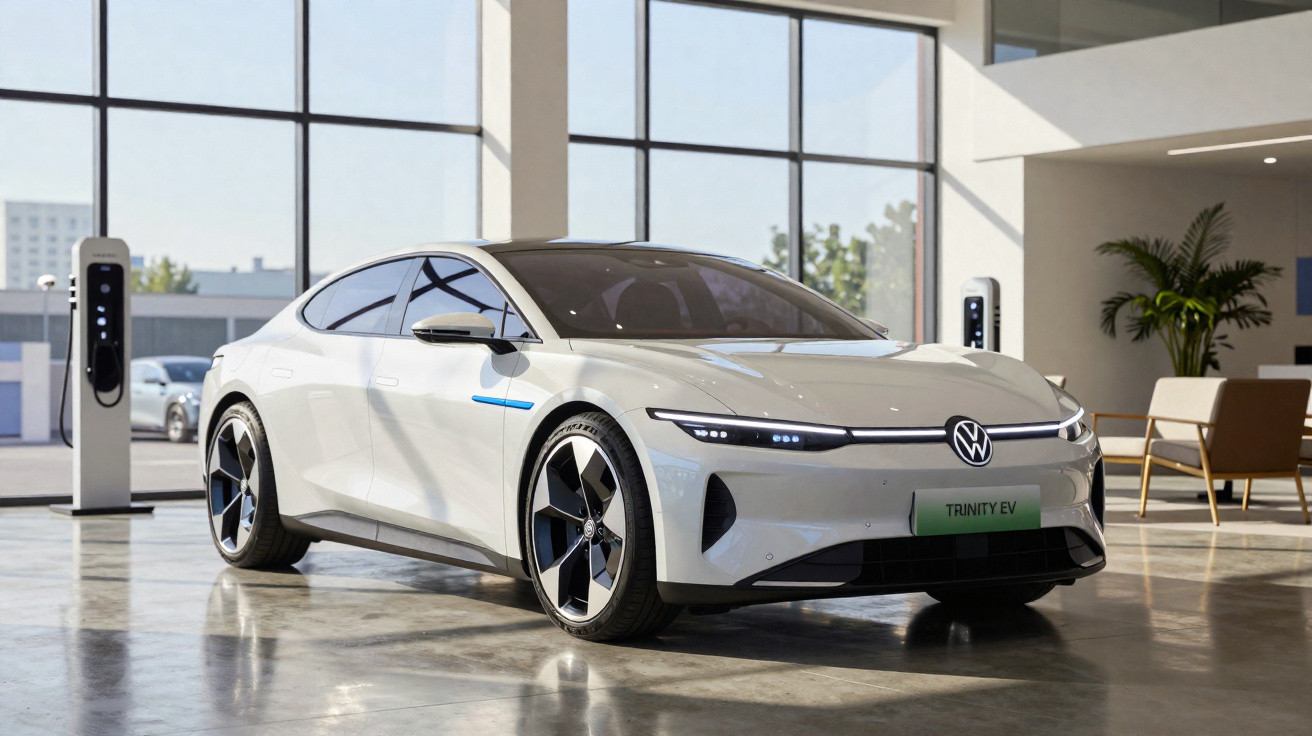
A cornerstone of Volkswagen’s “ACCELERATE” strategy, Project Trinity - the brand’s upcoming 100% electric flagship - has been shown for the first time in a teaser.
Scheduled to reach the market in 2026, it will take the form of a saloon, which is noteworthy given the ever-growing dominance of SUV/crossover models.
Naturally, with its launch still some way off, details about Project Trinity remain limited. Even so, Volkswagen has started to lift the curtain on what will become its future top-of-the-range EV.
What do we already know?
Project Trinity production and positioning
Volkswagen has confirmed that the production model derived from Project Trinity will be built at the German brand’s Wolfsburg plant.
Volkswagen Project Trinity: software, range and charging
Engineered with a strong emphasis on software, Project Trinity should, according to Ralf Brandstätter, Volkswagen CEO, set the benchmark in “range, charging speed (“charging as fast as conventional refuelling”) and digitalisation”.
That push towards digitalisation is expected to translate into the car offering Level 2+ autonomous driving at launch, while being technologically prepared for Level 4 autonomous driving.
Fewer versions and functions activated on demand
Alongside these promises, Volkswagen says Project Trinity - and its other electric models - will come with fewer variants and will share a significant number of components with one another.
Finally, Volkswagen adds: “The cars will have virtually everything on board and customers will be able to activate the desired functions (on demand) at any time via the car’s digital ecosystem”. The aim is to reduce manufacturing complexity.
The “ACCELERATE” strategy
As mentioned earlier, Project Trinity is the central piece of Volkswagen’s recently unveiled “ACCELERATE” strategy. So what does this plan involve?
According to the German manufacturer, it is designed to tackle some of today’s biggest automotive challenges: digitalisation, new business models and autonomous driving.
In doing so, Volkswagen wants to become a “more attractive brand for sustainable mobility”, evolving into a “software-focused mobility provider”.
Electric sales targets to 2030
Under “ACCELERATE”, Volkswagen also intends to increase the share of electric cars within its overall sales. The target is that by 2030, 70% of its European sales will be electric models, while in China and the USA they will account for 50%. To help achieve this, Volkswagen is preparing to introduce at least one new electric model per year.
Software as a core competence and new revenue streams
On the technology front, Volkswagen aims to make software integration in cars - and the customer’s digital experience - one of its core strengths.
Finally, still within the “ACCELERATE” strategy, Volkswagen plans to roll out a new business model, made possible by the car becoming a software-based product.
The brand’s goal is to generate additional revenue throughout the vehicle’s service life by offering service packages. These may be linked to vehicle charging, new software-based functions or autonomous driving services.
Comments
No comments yet. Be the first to comment!
Leave a Comment