
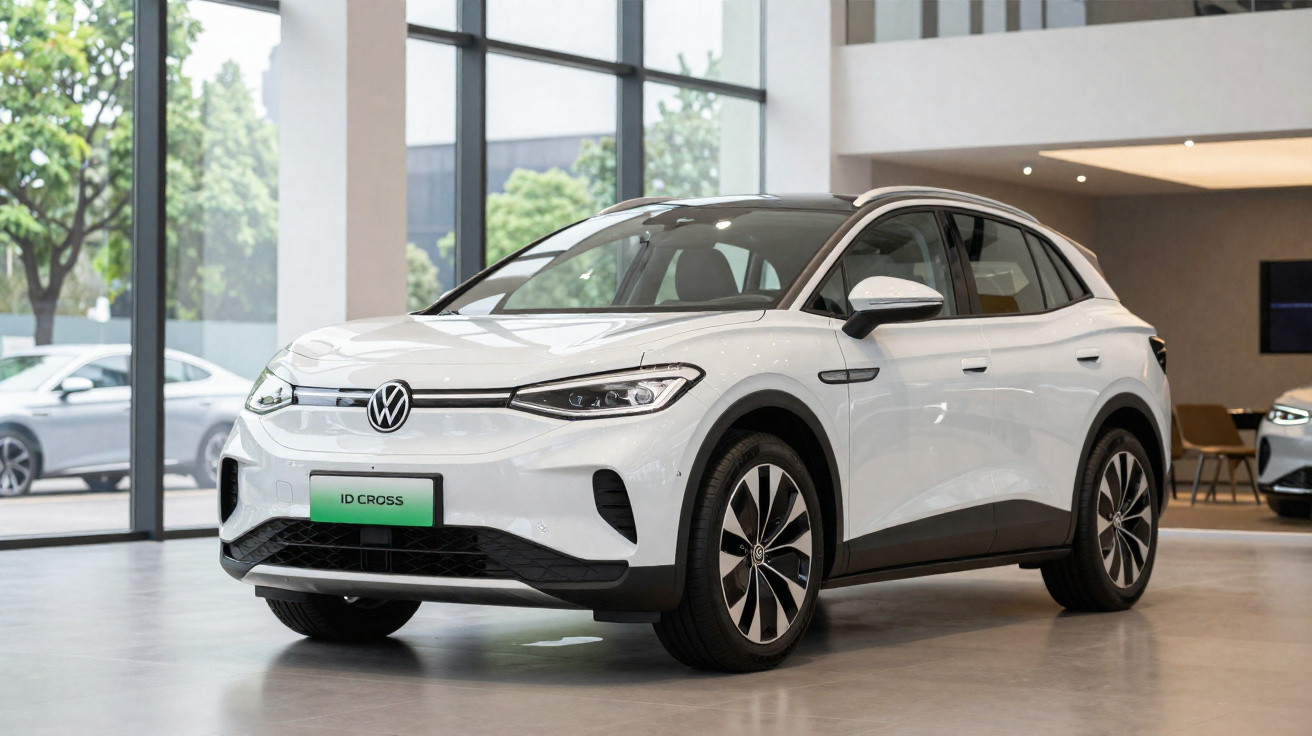
Volkswagen is about to usher in a new generation of more affordable electric cars. In some respects, the company is deliberately taking a step back from the first ID models - in exterior styling, cabin design and even naming - towards choices that the brand’s customers tend to prefer. At the same time, there’s a clear technological step forward, most notably in battery chemistry and in how sensibly the capacities have been selected.
Let’s take this in stages. After meeting the ID. Polo, we went to see its SUV counterpart: the ID. Cross, positioned as the natural successor to the petrol-powered T-Cross.
That relationship is immediately obvious in the exterior proportions and, even with the pre-production cars wearing camouflage, the styling lines appear very close to the concept shown at the Munich Motor Show in September last year - which we were also able to experience first-hand.
Retro? No thanks
On the outside, virtually no changes are expected versus the concept. Inside, however, Andreas Mindt and his team have aimed for a cabin that feels more “welcoming” than some of the ID models currently on our roads. There are more soft-touch surfaces, the colour palette is more cohesive, and there are more physical buttons. You’ll also find a few retro-leaning cues (Golf I-inspired) in the instruments, intended to create a clearer link to Volkswagen’s past.
The dashboard itself adopts a horizontal layout, with the instrument display (10.3 in) and the central infotainment screen (12.9 in) aligned along the same visual axis.
In the instrument cluster, the so-called “retro view” naturally stands out: a traditional speedometer on the left and a “rev counter” on the right - except it doesn’t count revs, instead showing power being delivered or recuperated by the electric motor. Personally, I preferred to drive with the more modern, cleaner instrument layout, because the retro view felt more tiring due to the extra visual clutter. Opinions will vary.
More buttons are the right call
The redesigned multifunction steering wheel - flat at the top and bottom - is completely new. The left-hand button area groups the driver-assistance functions, adaptive cruise control (depending on version), and audio volume. On the right, you manage the Digital Cockpit and trigger voice control. Behind the wheel there’s also the selector stalk for the transmission.
The climate controls sit centrally on the dashboard in a row of physical buttons. Beneath them is the optional wireless charging tray for your phone. Ambient lighting customisation has been expanded significantly, too.
The new T-Roc didn’t mind donating its interior door handles to the ID. Cross. And while we’re on the doors, there’s another small but meaningful change compared with other ID models: you now get four window switches for the four electric windows, thankfully ditching the previous two-switch setup that had to be toggled between front and rear.
From the driver’s seat, the build feels robust, although many of the trims are structurally hard, with only a thin soft layer or fabric covering in some areas.
Compact, but with plenty of room
The ID. Cross measures 4.153 m long, making it only slightly longer than the T-Cross (+2.6 cm). Its wheelbase grows by another 5 cm to 2.601 m, matching the forthcoming ID. Polo. As is typical for a purpose-built EV, that translates into more generous space for rear-seat passengers.
Volkswagen says it will carry five adults, and in the second row there’s around three fingers’ clearance above the head to the roof and four fingers between knees and the front seatbacks - using a 1.80 m-tall occupant as the reference. Rear passengers also get central air vents, but without the ability to adjust temperature or airflow intensity. The flat floor makes it easier to fit someone in the rear middle seat, even though that position remains narrower.
The boot offers 475 litres, which is 20 litres more than the T-Cross and almost 100 litres more than a Golf. Under the boot floor there’s a notably deep compartment that Volkswagen says can hold two drinks crates. There’s also a front boot (frunk) with 22 litres of space, particularly suited to storing the charging cables.
Three motors and two batteries
Like the ID. Polo, it uses the front-wheel-drive MEB+ platform, setting it apart from the rest of the ID family (rear-wheel drive or all-wheel drive). Volkswagen hasn’t paired electric propulsion with front-wheel drive since the e-Up and e-Golf.
The shared elements with the ID. Polo continue under the skin, with the same APP290 motor family and lithium-ion batteries. You get the same three power outputs - 85 kW (116 cv), 99 kW (135 cv) and 155 kW (211 cv) - and the same two battery capacities - 37 kWh (LFP, for the first time in the German brand) and 52 kWh (NMC). The (to be confirmed) combined WLTP ranges are 316 km to 436 km, respectively.
Even though the capacities differ, both packs take up a similar amount of space because NMC chemistry offers roughly 30% higher energy density. That, in turn, helps enable higher charging power and better efficiency for the motors.
AC charging is rated at 11 kW in either case, while DC charging peaks at 90 kW with the smaller battery and 105 kW with the larger one.
That’s noticeably lower than in other ID models (for example, 145 kW in the ID.3), but Matthias Baehr, who leads development of the powertrain system, told me that the “focus was on sustaining charging above 100 kW, which is then maintained between 40% and 72% state of charge”.
There are also significant chassis changes. Choosing front-wheel drive for MEB+ allowed Volkswagen to fit a particularly compact semi-rigid torsion-beam rear axle (with rubber supports on the springs and bushings using a technology designed to greatly reduce vibration and noise).
Up front, there’s a MacPherson layout with a system specifically designed to manage compression forces acting on the damper, plus stiffer stabiliser bar mounts.
When I asked Andreas Rickmann, the engineer responsible for chassis development, whether four-wheel-drive versions would be offered, he clarified that “no, because that would require developing an independent rear axle, completely different, and there aren’t enough markets - little more than Switzerland, Austria and the higher parts of Germany - to justify the additional investment”.
Instead, the car will feature a limited-slip differential on the front axle to make driving on slippery surfaces and more winding roads safer and more effective.
Behind the wheel in Amsterdam
That’s not exactly the case around Amsterdam, where straight, flat roads suit the many thousands of cyclists who ride here every day.
I drove the 211 cv version, the most powerful option and the one with the strongest performance: it reaches 100 km/h in 7.4s, and top speed is capped at just 160 km/h (150 km/h in the two less powerful versions).
The first thing I appreciated was the brake pedal feel and response, improved through a one box design that makes it more immediate and linear, while also blending regenerative and hydraulic braking more smoothly.
It’s also a welcome move that the rear wheels now use brake discs - something early ID models did without, because regenerative braking was so dominant and the electric motor sat over the rear axle.
Next, the handling is a pleasant surprise. It stands out thanks to a strong balance between stability and comfort and, above all, it delivers a sense of lightness that’s rare in an EV - typically you feel a lot of mass low down due to a battery weighing hundreds of kilograms. Great for a lower centre of gravity, but not always great for agility.
Rickmann explained that “this was one of the main goals of the dynamic development, for the ID. Cross to drive more like a combustion-engined Volkswagen”. The takeaway is that this target has been met.
Body integrity also deserves praise, whether travelling over rough surfaces or during more demanding weight transfers. The steering is quick enough and reasonably communicative (2.8 turns lock-to-lock), but I didn’t notice meaningful changes in steering weight or overall response between drive modes, even between Eco and Sport. The accelerator response felt similarly consistent.
The regeneration strategy is new as well. With the transmission selector in B, you can have maximum regeneration (one pedal drive, to the point of almost not needing the brake pedal) or choose a milder level via the central screen. In D, there’s no regeneration unless you select Sport mode.
Starting from how much?
The new Volkswagen ID. Cross is due to arrive on the Portuguese market in November, with prices starting marginally below €30,000 for the version with the 37 kWh battery. That’s almost €5,000 more than the entry-level ID. Polo.
Get to know the specifications:
Comments
No comments yet. Be the first to comment!
Leave a Comment