
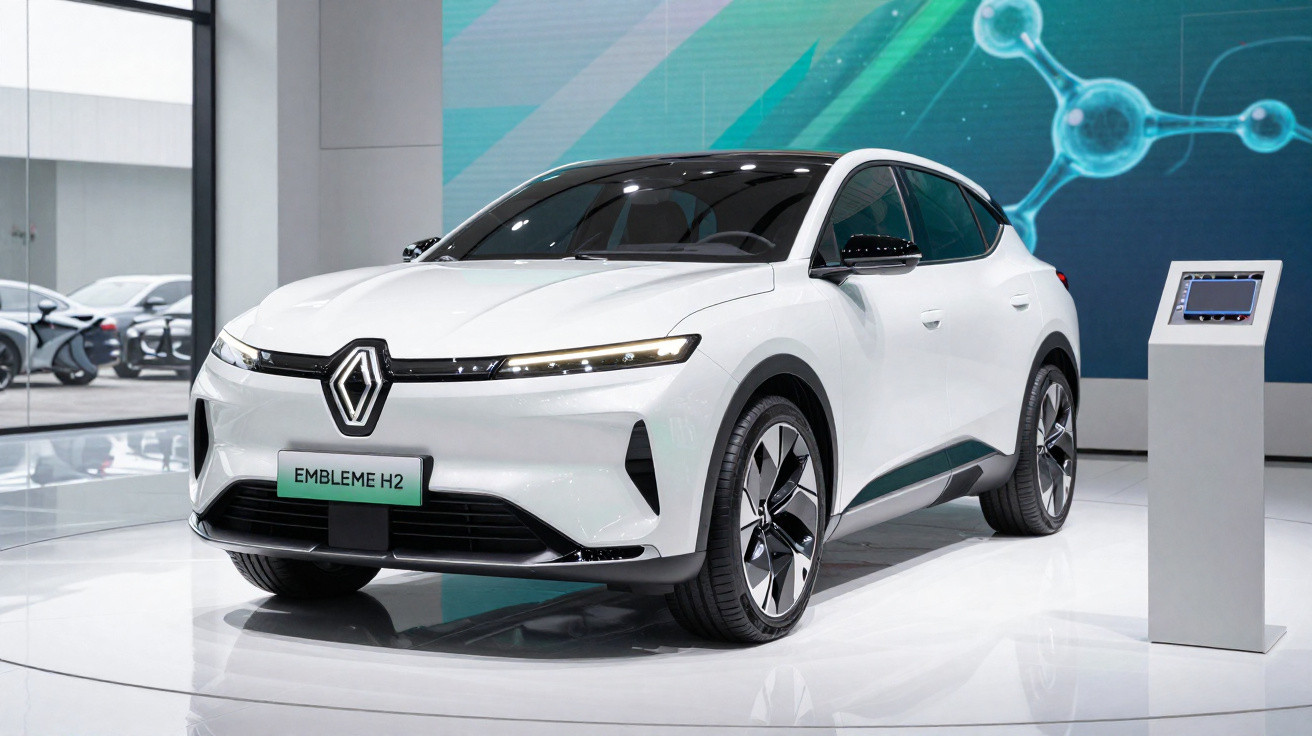
In the race to cut emissions and reach carbon neutrality, Renault is mapping out an electric future that relies not only on batteries but also on a hydrogen fuel cell. Those two technologies come together in the new Renault Emblème concept.
Lifecycle emissions: ‘cradle to grave’ target
However, to achieve the 90% reduction in greenhouse-gas emissions from cradle to grave that Renault is claiming for the Emblème-compared with an equivalent vehicle built today-this hybrid powertrain approach on its own is not enough.
To get there, the concept draws on recycled and natural materials, reused components, and manufacturing methods powered by renewable energy, among other measures. On Renault’s figures, the Emblème will emit just five tonnes of CO₂e (CO₂ equivalent) over its full life cycle.
Batteries + hydrogen fuel cell
The Renault Emblème is an electric vehicle-rear-mounted motor producing 160 kW (218 cv)-but it uses two energy sources to supply that system.
The first is a 40 kWh battery using NMC chemistry (nickel, manganese, cobalt). The second is a 30 kW hydrogen fuel cell with a maximum efficiency of 60%, supported by a hydrogen tank with 2.8 kg capacity.
This is not the first time Renault has worked on this kind of setup. In 2022 it presented the Scenic Vision, which used a similar powertrain layout.
Why combine the two?
Blending both solutions helps ease one of today’s biggest EV drawbacks: long ranges typically require very large, heavy battery packs that also take a long time to charge.
Renault has not published final figures, but says the Emblème’s reasonably small battery should still deliver a few hundred kilometres-enough for everyday use. The fuel cell adds 350 km and, unlike a battery, does not need lengthy stops: refuelling the hydrogen tank takes under five minutes.
With both energy sources working together, Renault says the Emblème can cover 1000 km as quickly as a combustion-engined car. The reason is simple: there is no need to stop to charge, and the two planned hydrogen refuels take about as long as filling up with petrol or diesel.
Weight compared with battery-only EVs
Using the two technologies also helps counter the high kerb weights that often define electric cars. While the stated 1750 kg does not make this 4.8 m-long prototype featherweight, it is still several hundred kilograms lighter than comparable battery-only EVs.
It is also around 100 kg lighter than the fully electric Scenic, despite the Scenic being more than 30 cm shorter.
New Renault design
Style matters too, and to showcase the strengths of this technology package Renault has wrapped it in a sporty-looking shooting brake that still keeps family duties in mind.
The Emblème also introduces a new design language. It mixes flowing curves with sharper, more technical lines, and adds new graphic elements (including the lighting) inspired by Renault’s diamond-shaped emblem.
Beyond the new look, Renault highlights efficiency as a core pillar of this design direction, reflected in aerodynamic optimisation. The quoted Cx is 0.25 (lower than the Megane’s 0.29, for example).
There are no interior images yet, but the Renault Emblème will be shown publicly at the Paris Motor Show, which opens on 14 October. For now, there is no indication that this concept directly previews a production model.
Comments
No comments yet. Be the first to comment!
Leave a Comment